| | US stocks recover after a multi-day tech selloff, Ukraine’s leader ramps up rhetoric against Washing͏ ͏ ͏ ͏ ͏ ͏ |
The World Today | 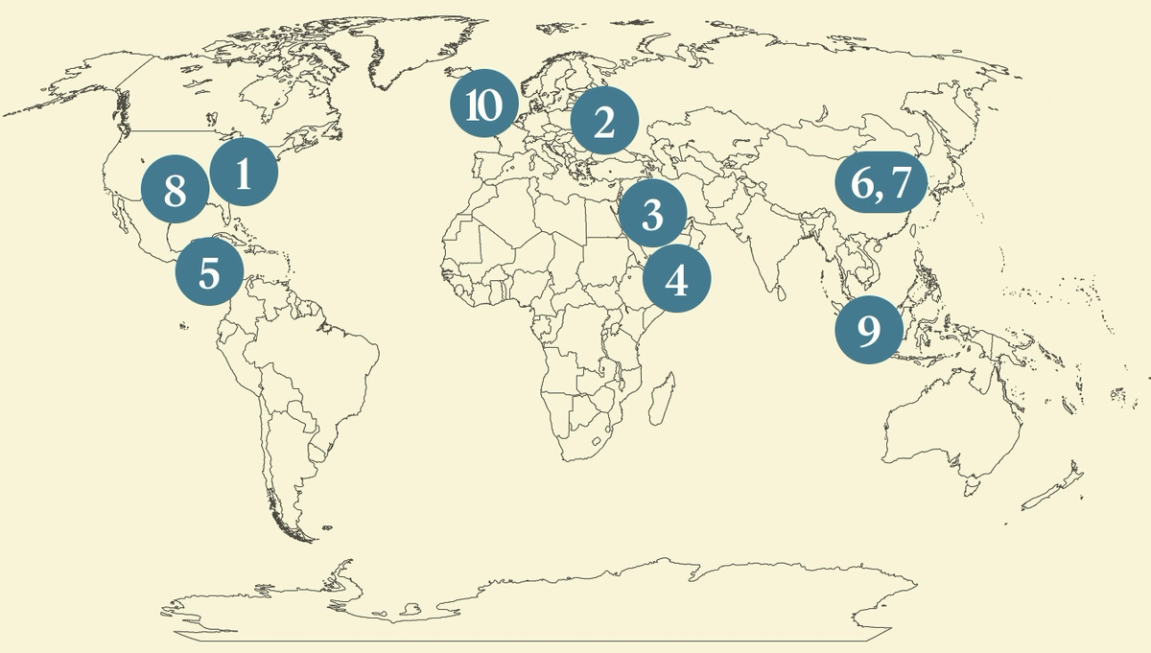 - Markets feel AI jitters
- EU-Zelenskyy meeting
- Airports become targets
- Houthis’ effective attacks
- US’ ineffective drug strikes
- EU ramps up China fight
- China’s chicken surplus
- Public execution canceled
- El Niño’s risks to ecosystems
- UK soccer’s financial ruin
 A ‘profound reading experience’ from a Pulitzer winner. |
|
Tech fluctuates on demand, inflation fears |
 Jeenah Moon/Reuters Jeenah Moon/ReutersUS stocks clawed back losses Thursday following a multi-day tech selloff, as investors flocked to safer assets on concerns the AI buildout could falter in the face of weak consumer demand and high inflation. US producer prices increased at the fastest pace in four years in September, new data showed, bolstering the case for the Federal Reserve to hike rates this month. Bumper earnings from AI-exposed firms this week have failed to quell fears that higher rates could halt or slow the debt-fueled data center buildout that’s currently powering the US economy. Still, some of the AI trade’s biggest spenders appear undeterred: TSMC said Thursday it was building plants at an “unprecedented pace” and could expand its US footprint further on “extremely robust” AI demand. |
|
Zelenskyy meets EU leaders amid US rift |
 Alina Smutko/Reuters Alina Smutko/ReutersEU leaders are expected to ask Ukraine’s Volodymyr Zelenskyy to moderate his rhetoric against US President Donald Trump amid Kyiv’s widening rift with Washington, the Financial Times reported. Zelenskyy and Trump have engaged in a war of words this week, with the former defying Washington’s directive to stop striking Russian refineries and accusing Trump of “loving” autocrats: “It might be true,” a European official said. “But it doesn’t always need to be said out loud.” The EU is concerned such diatribes could further destabilize the fragile transatlantic relationship. Still, past reconciliations with Washington have proven largely futile for Kyiv, a former US diplomat argued: Zelenskyy “flattered and thanked Trump, agreed to all his crazy ideas... and still got screwed.” |
|
Airports become targets in war |
 Stringer/Reuters Stringer/ReutersCivilian airports are increasingly becoming military targets, as nations at war seek new ways to inflict economic and psychological damage. Ukraine, under US pressure to stop striking Russian refineries, has expanded its targets — bombing data centers and clogging air space — while considering more aggressive tactics like directly hitting Russian airports, The Atlantic reported. Kyiv said Thursday it only responds in kind “to specific Russian strikes.” Such a shift would intensify threats to global aviation safety: The Houthis have reportedly struck Riyadh’s airport 20 times this month, clouding Saudi Arabia’s investment outlook; Germany accused Russia of attempting to bomb Leipzig’s airport in August; and an Iran-linked threat prompted the US to remove bombers from a UK airfield earlier this month. |
|
Saudi military falters in Houthi war |
 Hamad I Mohammed/Reuters Hamad I Mohammed/ReutersSaudi Arabia increasingly appears to be on the back foot in its escalating war with the Iran-backed Houthis despite possessing a formidable military arsenal — a symptom of the kingdom spending too much on the wrong things, experts argued. A top-10 global arms spender, Riyadh has too often sprung for what analysts call the “glitter factor,” such as next-generation jets and interceptors that are proving to be ineffective against the Houthis’ cheap drone swarms and homemade missiles. Diminishing interceptors have also hamstrung Saudi attempts to defend territory three times the size of Texas. The kingdom wrongly assumed the Houthis wouldn’t strike civilian targets like airports, experts told PBS, and with their recent military successes, the once-ragtag militia now feels “untouchable.” |
|
US expands anti-cartel campaign |
 Jose Cabezas/Reuters Jose Cabezas/ReutersThe US is sending hundreds of soldiers to Latin America as the Pentagon widens its campaign against drug traffickers, The New York Times reported. A 600-strong battalion is reportedly being deployed to Panama; the head of a research group that tracks such deployments said he could not recall one “that ever came close to 600 except for contingencies like invasions or natural disasters.” President Donald Trump has made fighting cartels a priority of his second term, but US strikes on alleged drug traffickers have done little to dent the global cocaine trade, with shipments rising to record levels. Washington’s policy “is more about visibility and narrative… than one that genuinely disrupts organized crime,” an expert told The Wall Street Journal. |
|
UK, EU eye China tariff coordination |
 Stephanie Lecocq/Reuters Stephanie Lecocq/ReutersThe UK said Thursday it was prepared to align its tariffs on Chinese EVs with those of the EU, delivering a boost to Brussels as it negotiates with Beijing to narrow the trade gap. European leaders have adopted a more aggressive stance to shield native businesses from a tidal wave of Chinese imports, which policymakers have blamed for deep job losses among European automakers and other sectors. So far, counter-efforts have involved both protectionist and industrial policies, including “Made in Europe” rules that have stoked discord among some of Europe’s largest economies. Having won Beijing’s agreement to halve hybrid vehicle imports, Brussels is now eyeing checks on Chinese chemicals and machinery, Politico reported. |
|
Chinese chicken disrupts export markets |
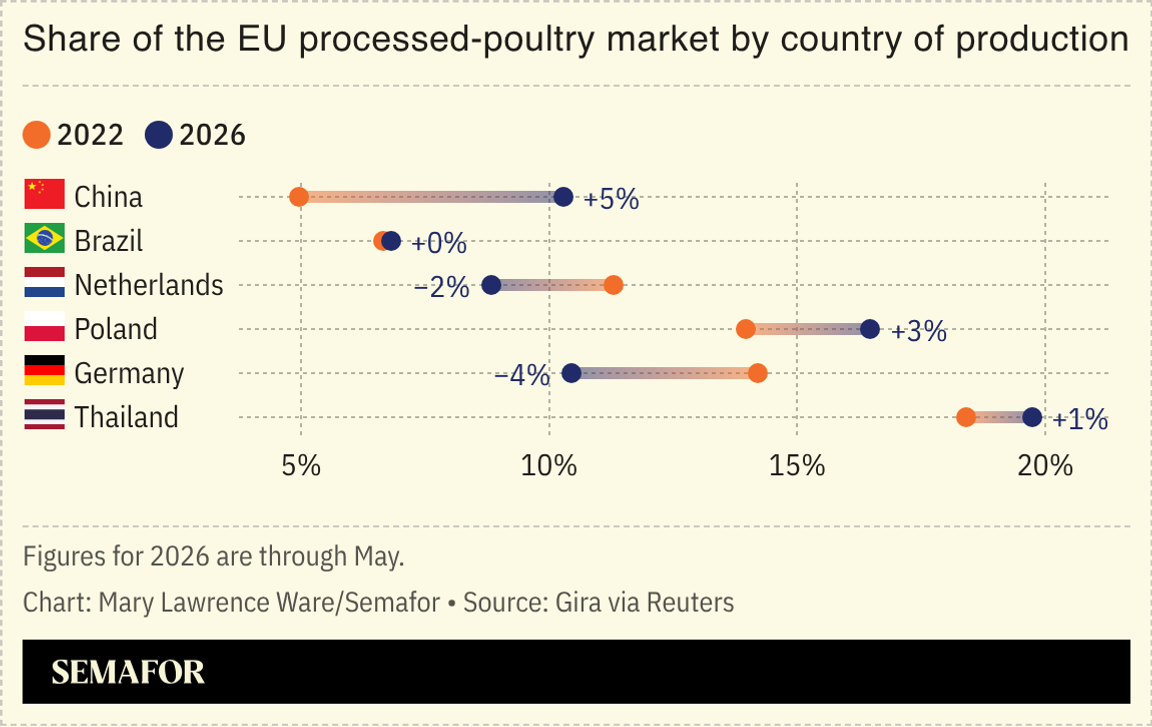 China produces far more chicken than it can possibly consume thanks to Beijing’s national food security push, causing producers to dump the protein on global markets at cut-rate prices. Agriculture is one of the few areas where China runs a trade deficit, but that’s changing: The country’s producers have doubled their share of the European market since 2022, mirroring Beijing’s strategy toward solar panels and EVs. “It’s very worrying,” a poultry industry insider in Thailand told Reuters, as importers increasingly treat Chinese prices as a negotiating benchmark. For international clients still wary of China’s food safety record, “when the meat is $1,000 cheaper per ton than Brazilian and Thai competitors, they have to either buy from China or lose out,” one producer said. |
|
 Behind closed doors, a new era of healthcare policy is taking shape. With US healthcare spending projected to hit $9 trillion annually by 2034, Medicaid cuts hanging in the balance ahead of the midterms, and increasing calls for regulation of clinical AI, the forces remaking healthcare policy are accelerating. Introducing Healthcare from Semafor Washington, DC, your weekly briefing on the politics, policy, and business driving the industry. Delivered every Thursday from David Lim, each edition will provide essential reporting and analysis on the forces reshaping healthcare, and what comes next. Read the first edition here. |
|
Trump cancels execution livestream |
|
El Niño’s threats to global ecosystems |
|
|


