And the AI trade

Make sense of global economic trends and what they mean for the world. Subscribe to Reuters.com for $1/week.


Econ World

Econ World

By Carmel Crimmins, host, Reuters Econ World podcast

Hello there,

The global selloff in the AI trade is sending investors piling into government bonds. They’re searching for safe havens as rising interest rates stoke concern about whether the billions poured into artificial intelligence will deliver sufficient returns.

US Treasuries rose across the curve and even French bonds got a boost, though not as much as other government paper. No surprises there: AI may have its financing problems but so does Paris. I homed in on France’s fiscal fault lines in this week’s Econ World podcast, specifically the generational battle over resources.

The protests by French students over dilapidated schools and overcrowded classrooms are a natural sequel to the demonstrations that roiled France back in 2023 when President Emmanuel Macron tried to raise the retirement age from 62 to 64.  In each case, the protesters see themselves in a fight with the government over resources, but in reality they are in a battle with each other over how those resources are divided up. Interestingly, my colleague Leigh Thomas, who covers the French economy, says the students don’t see it that way. You can catch the whole episode here.


The headlines

  • Ukraine resumes strikes on Russian refineries as Zelenskiy says 'we're done'
  • Russia builds major new drone attack base in six weeks, satellite images show
  • Banks, buildings burn as Albania's capital Tirana erupts into student violence
  • Two ships sink near Hormuz after being hit by projectiles amid surge in attacks
 

The bump to bonds from the AI rout could be a big relief for governments looking to finance their budgets, but as columnist Mike Dolan points out, they should be careful what they wish for. The International Monetary Fund is flagging significant growth and financial stability risks from a potential ending of the AI investment boom.

Geographically speaking, South Korea is the epicentre of the selloff because its market is so heavily concentrated on chip stocks, amplified by leveraged retail bets. Stocks there closed down nearly 8% on Thursday. But looking at individual names, CoreWeave is at the eye of the storm.

CoreWeave is a neocloud, a term used to describe companies that rent out computing power and other services to tech companies like Microsoft and Alphabet’s Google. These computing suppliers have borrowed big to finance their growth and investors are now separating off AI companies that have solid cash balances from those that need debt to build.

CoreWeave owes nearly $50 billion and saw one-fifth of its equity value vaporised on Wednesday. Its debt is trading at a 20% discount and the cost of insuring the company against default has blown out past 1,000 bps, according to LSEG data, meaning it now costs over $10 to insure $100 worth of bonds.

In a note to reassure staff, the company CEO pointed out that it has a revenue backlog of over $100 billion in the second quarter and said markets can sometimes "misunderstand and act irrationally".

As always, I'd love to hear from you by hitting reply on this email or finding me on LinkedIn.  


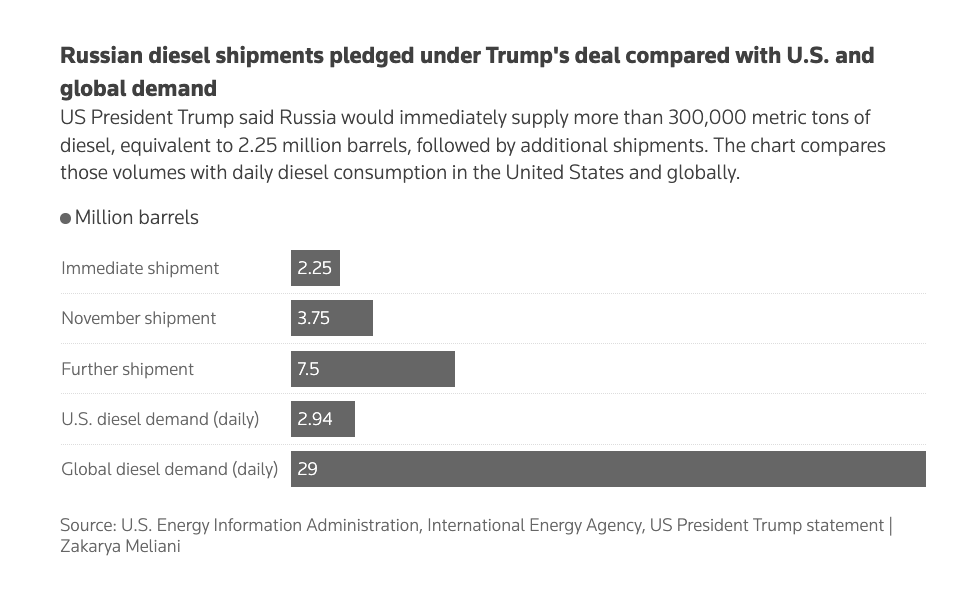
The chart

President Trump agreed a surprise deal with Russian President Vladimir Putin to release around 2.25 million barrels of Russian diesel onto US and global markets. But that amount is less than a day's supply for the US transport sector alone. 


The podcast

 "When you look at the opinion polls in France, there's a recognition that the public retirement system is not financially sound and sustainable, but there is not a majority of people that want to increase the retirement age. So, something's got to give at some point."

Reuters senior correspondent Leigh Thomas on France's fiscal challenge.

Students are protesting all over France about poor conditions in schools. But as Leigh Thomas tells me on this week's Econ World, their frustrations may go much deeper. Watch it here.