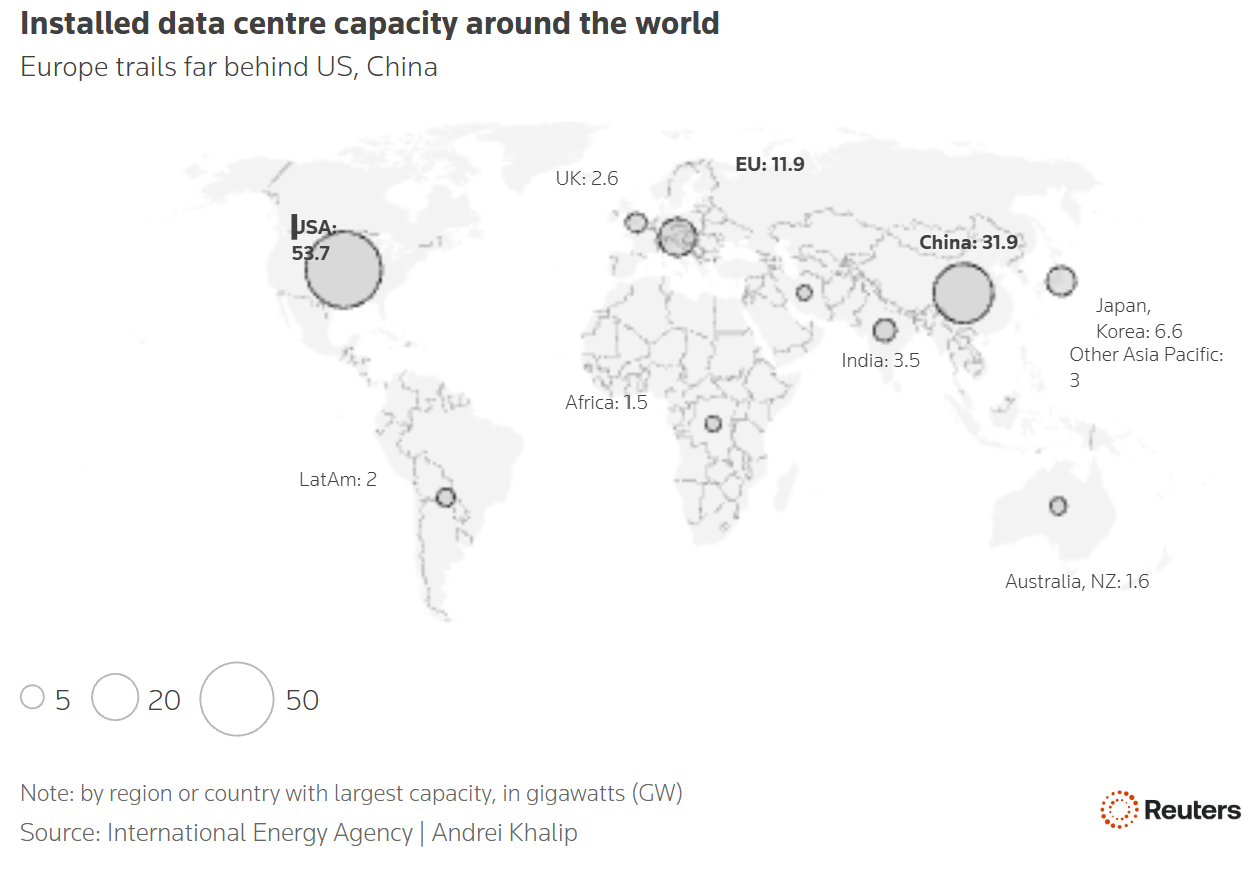
Hello! Today’s newsletter continues from last week’s focus on data centers and we’ll be looking at some of the innovative startups that aim to solve their high energy and water consumption.
As a brief refresher, last week’s newsletter explored the governmental policies and initiatives around the world aimed at data centers and their high resource consumption, with a few words from Amazon about their plans to decrease their water use.
I spoke to Big Tech leaders and some innovative start-up founders working on solutions from geothermal solutions to direct-to-chip cooling and waste heat recovery aimed at solving the data center problem. But before we get into all the latest climate tech start-ups, here are some more data center stories that are also on my radar today: |
|
|
A bus with a sign opposing AI data centers by Humans First, a conservative AI safety group, near OpenAI headquarters. San Francisco, California, US. REUTERS/Manuel Orbegozo |
Startups targeting AI data centers' soaring energy |
I began my journey into the world of climate tech aimed at reducing data centers’ energy and water use by speaking to Amy Duffuor, co-founder and general partner of Azolla Ventures, which specializes in scaling overlooked and underfunded climate solutions. I wanted to understand which companies are getting funded by investment firms like hers in order to scale up.
One of the innovations she spoke about was offshore floating wind platforms co-located with data center infrastructure. She said one company liked by investment firms is Aikido Technologies, which develops floating, offshore data centers powered directly by offshore wind energy. The company argues that stranded or delayed offshore wind sites can be repurposed to host large-scale artificial intelligence and cloud computing facilities. Its first demo is in Norway next year. She also mentioned Zanskar, a geothermal energy company that uses AI to find underground geothermal resources and then develop power plants that generate carbon-free electricity. Zanskar recently received US government funding to scale its geothermal projects.
I also spoke to Tom Grizzetti, co-founder and chief executive officer of HT Materials Science (HTMS), an Irish-US company that develops heat-transfer fluids designed to improve the efficiency of commercial and industrial cooling and heating systems. “Direct-to-chip cooling is the latest ‘cutting-edge’ way to cool a data center through a cold plate that sits on top of a chip as opposed to cooling a rack,” said Grizzetti. He highlighted that Ecolab, a US-based sustainability and industrial services company, has become increasingly involved in direct-to-chip liquid cooling for AI and high-performance computing data centres, not just traditional cooling towers and water treatment.
I also spoke to Simon Kerr, head of heat networks at EnergiRaven, a UK energy-infrastructure and consulting company focused on capturing and using waste heat. He says the technology “reduces demand on the grid as new homes, or homes retrofitting their heating, can just use existing waste heat rather than needing to add extra power for heat pumps.” |
|
|
|
But what about big tech leaders? Do they care? |
I spoke to Brian Marrs, general manager of energy and carbon at Microsoft, who spoke about the clean energy power purchasing agreements in place that are aimed at tackling the data center issue and meeting the company’s carbon negative announcement in 2020.
Since then, Marrs notes that Microsoft has sourced 40 gigawatts (GW) of new carbon-free energy supply across 26 countries, working with more than 95 utilities and developers across 400 contracts and counting.
“To put that amount in perspective, that’s enough energy to power about 10 million US homes. Of that contracted volume, 19 GW are now online, delivering new clean energy supply to the power grid, while the remainder are slated to come online over the next five years,” says Marrs. Microsoft has also launched a new data-center-focused climate tech incubator this year by University of Washington CoMotion Labs and investor network E8. Amazon was also working on funding new climate tech solutions through its Climate Pledge Fund. Although this sounded like a lot of progress being made in the climate tech space, I felt like there was something missing.
Data centers currently account for about 0.5% of global carbon dioxide emissions, but their power demand is expected to rise sharply as companies build out infrastructure for artificial intelligence. I spoke to Natascha Hospedales, lead lawyer on artificial intelligence and environmental impacts at ClientEarth, who is advocating for a delay on data center expansion.
“We aren’t saying no to data centers, but that it needs to be paused until such time it can be achieved and operate within our planetary and societal limits,” said Hospedales. |
The body of a dead wild elephant is cordoned off with "Do Not Enter" tape in Ambanpola, Sri Lanka. REUTERS/Thilina Kaluthotage |
-
Special report: Sri Lanka is facing one of the world’s most serious human-elephant conflicts. An average of 138 people have been killed in encounters with the animals each year in Sri Lanka since 2019, the second-highest death toll in the world. The death toll for elephants, forced into villages for food as their habitat shrinks, climbed to an average of 402 a year during the same period, the world’s highest.
-
Albania student protests: Tens of thousands of students stormed the streets of Tirana during a protest over rising education costs and corruption claims against Albania’s Prime Minister Edi Rama, who has faced growing discontent at perceived graft surrounding top officials. Protesters also dismiss opposition figures as unpalatable alternatives.
-
Reuters graphic on India protests: In the past few months, civilian protests across India have been increasingly met with police intervention - and allegations of excessive force have taken centre stage. Reuters examined the guidelines and recent protest data to explore where these possible excesses against demonstrators are happening and why. Click here for the full graphics explainer.
-
France student protests: Swedish activist Greta Thunberg joined French high-school students demanding better learning conditions. Four weeks into nationwide protests over teacher shortages, classroom overcrowding and dilapidated school buildings, more than 161,000 people took to the streets of major cities, according to interior ministry figures.
-
Hacking fridges: Could hackers get inside your fridge? A question I never thought about until this fascinating story about a group of cybercriminals who sabotaged refrigeration systems at hundreds of French supermarkets. In many cases, attackers are more interested in stealing data, disrupting services or using connected devices as a way into a larger network. Click here to find out more about how regular household devices could be hacked.
|
|
|
|
Aragon, a sparsely populated region of northeast Spain, has become one of Europe's fastest-growing digital infrastructure hubs due to what tech companies hail as its agile local permitting laws and swift decision making. A dozen company officials, experts and campaigners told Reuters that the most decisive factor drawing investment to the region is its data center–friendly governance. Click here for the full story.
|
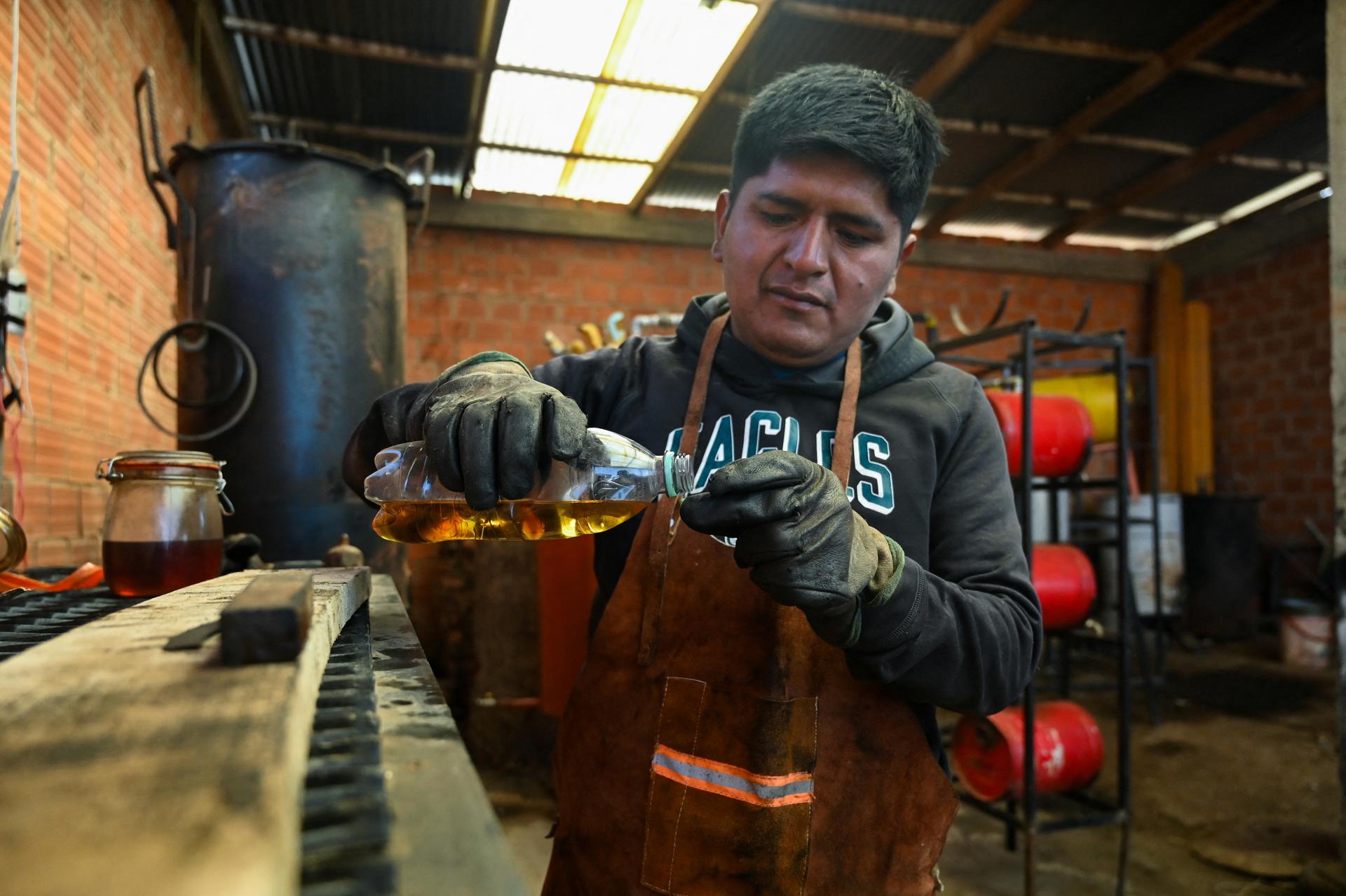
Etson Machaca tests fuel at a small-scale pyrolysis plant that converts waste into fuel used to power his agricultural equipment, in Ancocala, Bolivia. REUTERS/Claudia Morales |
The theme of innovation continues in today’s spotlight where a local |
|
|
|
|