| | New US inflation figures show Trump has run out of time to bring down energy prices before the midte͏ ͏ ͏ ͏ ͏ ͏ |
 - Diesel stays tight
- Price controls
- Big Law talent war
- Minimal benefit
- Fuel crisis
 China’s solar giants shrink, while Big Oil has more cash than it knows what to do with. |
|
 Fossil fuels are an economic liability, and not just because of the war in Iran. Rising energy costs were a major driver of the hotter-than-expected US inflation figures reported yesterday. This fact won’t surprise anyone reading this newsletter. Still, the numbers are pretty astonishing: Behind an overall gain of 3.7% across all goods and services in the past 12 months, gasoline prices are up 34.2%, and fuel oil prices (relevant mostly for home heating) are up 74.2%. The proximal cause is the war, of course, and the figures cement that US President Donald Trump has by now run out of time to change the picture ahead of the midterm election. But the broader takeaway here is that the inherent volatility of oil and gas prices is a persistent vulnerability in the US economy that can only be solved by limiting exposure to these energy sources. Many politicians before Trump have seen their domestic economic agenda undermined by global fossil fuel price dynamics largely outside their control — an effect European Central Bank official Isabel Schnabel dubbed “fossilflation.” The best evidence of the benefits of a less oil-reliant economy is that inflation isn’t even higher now; during the US oil crises of the 1970s, when cars were less efficient and oil was far more widely used in power and other sectors, Consumer Price Index inflation surged well above 10%. Domestic drilling has put more of the supply-demand balance under US control, but can’t shield American consumers from global price turmoil. The transition to non-fossil energy has its own inflationary impacts, from the costs to heavy industry of adopting new technologies to the production costs of critical minerals. If the Fed chooses to raise interest rates to tamp today’s inflation down, capital-intensive renewables will suffer. But from an economic standpoint, the best thing about replacing oil and gas with non-fossil electric alternatives is that the energy they produce, in addition to being cheap (although not always to consumers’ benefit, as we discuss below), can be predictably priced. A world with very boring energy prices would be one in which inflation is significantly more divorced from geopolitics. |
|
No diesel relief this year |
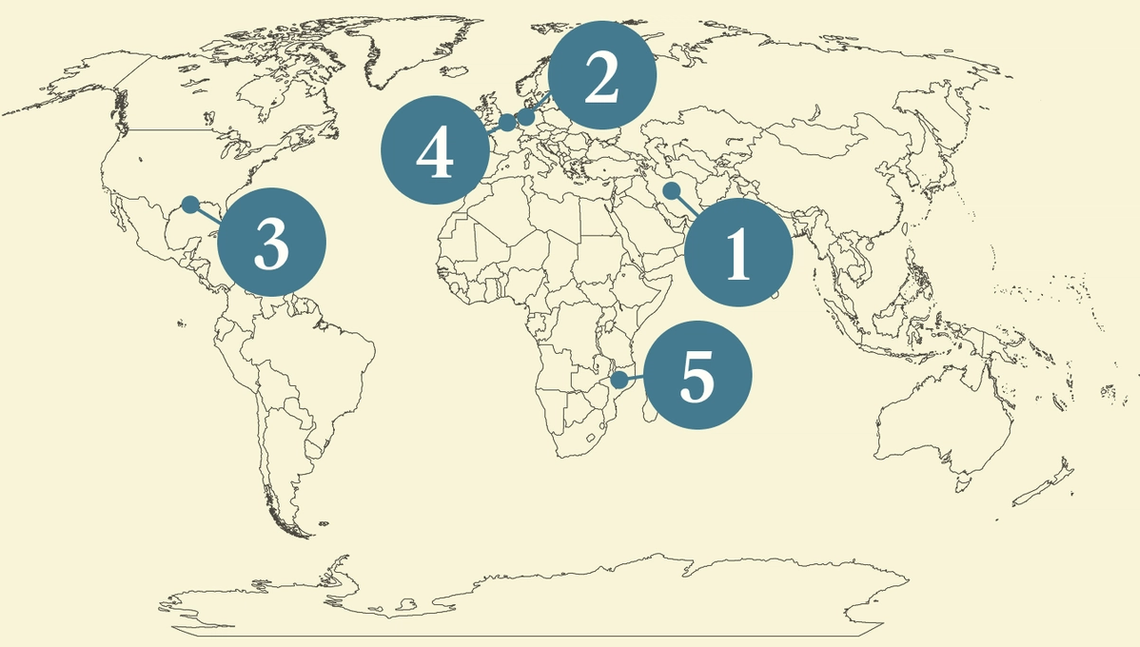
 IRIB/Handout via Reuters IRIB/Handout via ReutersThe International Energy Agency cut its forecast for oil demand next year and warned that diesel supplies will remain tight. Disrupted supplies and higher prices will bring global crude demand about 0.6% below 2025 levels next year, the IEA predicted. Supply is expected to recover, however, creating a recipe for lower prices that could benefit consumers but frustrate oil companies that have pocketed enormous profits this year. Diesel fuel is an exception; although the IEA predicts supply will recover, it will take well into 2027 to replace this year’s rundown of reserves. The speed at which more diesel can be released from those reserves will be the central focus of an IEA meeting today. In the meantime, Iran’s increasing attacks on ships in the Strait of Hormuz have made October one of the most violent months in the waterway since the war began, as Tehran looks to exploit US President Donald Trump’s political vulnerability ahead of midterm elections. Two Emirati cargo vessels sank in the past 24 hours after being struck; Iranian officials told Reuters that Tehran was deliberately ramping up strikes to keep oil prices elevated before Nov. 3. Washington’s lack of response is “remarkable,” a Eurasia Group analyst said: “Trump continues to promise action, but only after [midterms].” |
|
Renewables not helping prices yet |
 George Calin/ Inquam Photos/Reuters George Calin/ Inquam Photos/ReutersHigher rates of wind and solar deployment in the US and Europe haven’t yet translated to lower retail power prices, a BloombergNEF analysis found. Renewables do produce cheaper electrons than gas or coal. The problem is those prices aren’t usually the determining factor in the bills consumers actually pay. Retail power prices are set through a complex bidding process through which the cheapest power is dispatched to the grid first, but the price is set by the most expensive power plant needed to fully cover demand. The situation varies between countries, but on average in the US and Europe, the report found, renewables actually set the power price less than half of the time. Other factors, including gas price variability, rising demand, the costs of complying with environmental regulations, and grid bottlenecks, also pile on to raise final prices. The analysis suggests that the deflationary benefits of renewables will become more apparent over the coming decade once they are able to displace more fossil generation — but that policy-related costs will come to form a higher share of retail power prices, placing a burden on governments, not just utilities or project developers, to drive them down. |
|
Big Law talent battle moves south |
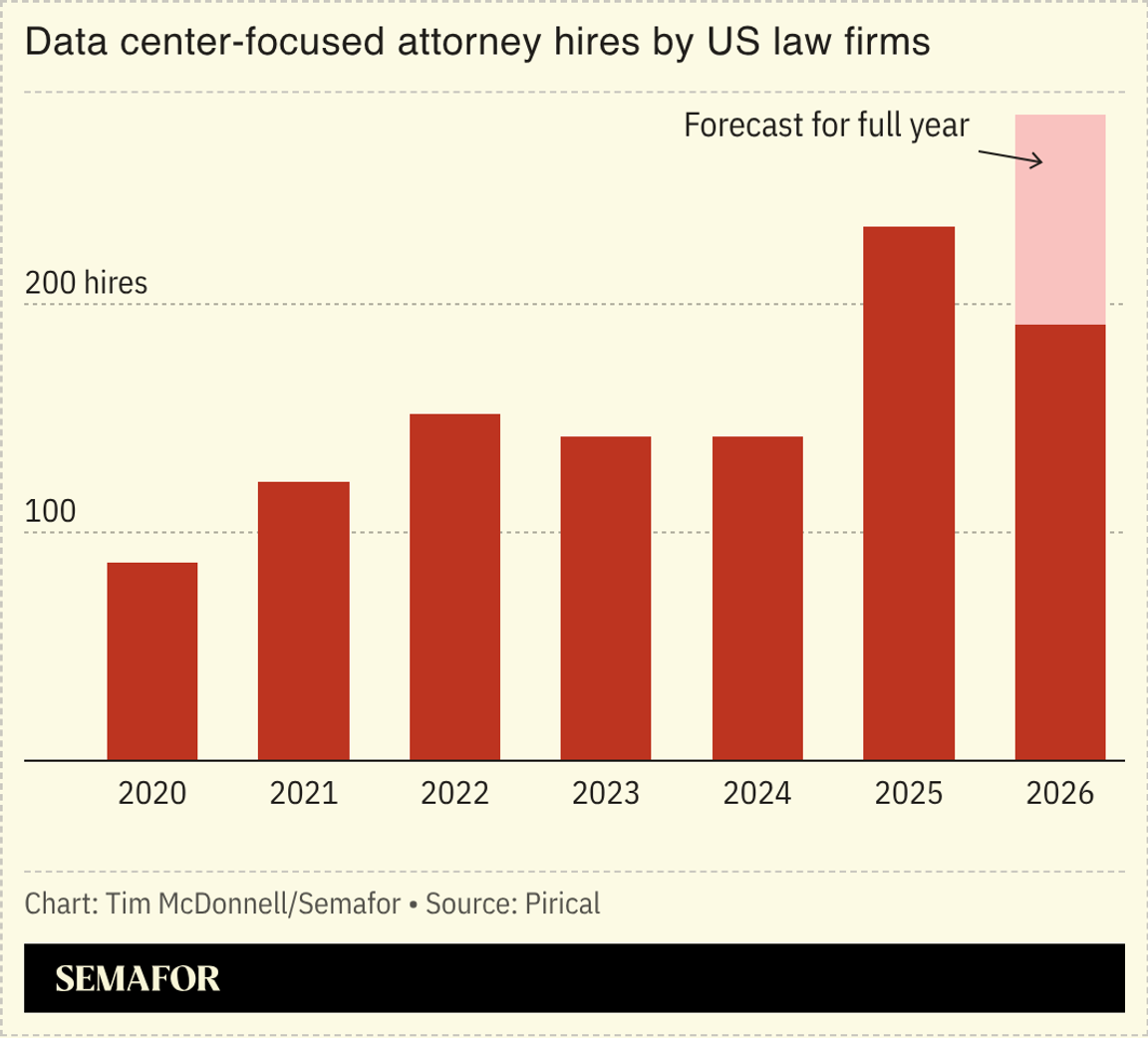 Competition among US law firms for attorneys with data center expertise is heating up. The top 200 US firms are on pace to hire nearly 300 data center lawyers this year, up 21% from the year before and triple the rate in 2020, according to an analysis of public data by the legal business intelligence firm Pirical, first shared with Semafor. Kirkland & Ellis and Dentons have the biggest teams, each with more than 200 lawyers in this area. As we reported recently, the AI explosion has transformed law firms’ energy-related dealmaking desks from a relative backwater to the busiest and most lucrative corner of the office. “The hiring has also moved south,” Pirical analyst Craig Savitzky said. “Houston has matched Washington DC so far this year, which makes sense now that power availability decides whether a project gets built at all.” |
|
Methane rule pause may not help |
 The EU’s decision to delay the implementation of its methane regulations won’t help consumers much, environmental groups argued. European officials decided this week to delay the regulation — which was meant to come into effect in January 2027 to introduce stronger reporting requirements for energy companies’ methane emissions — after facing pressure from industry stakeholders and French leadership, who argued it would further drive up energy prices. However, a Carbon Limits report found that compliance would cost between 0.03-0.6% of production value. “We’re not saying [the regulation] has no impact [on prices]. We’re saying that it is not driving any of these massive [cost] burdens you’re seeing, and therefore can’t solve [them] either,” Léa Pilsner, the Environmental Defense Fund’s energy policy director, told Semafor. The legislation also shifts the deadline for setting intensity standards for methane emissions from imported fuel, “which is really where you start seeing the benefits when it comes to the climate,” she added. – Eugenia Perozo |
|
 Eldson Chagara/Reuters Eldson Chagara/ReutersCountries across Africa are reeling from higher fuel costs, sparking unrest and grinding economies to a standstill. Malawi launched a nationwide crackdown on fuel hoarders and black market sellers as the nation struggles with shortages that have left truckers queuing for up to a week and bus fares doubling on some routes. Diesel and gas have been scarce for weeks because the country lacks the hard currency to buy fuel; motorists are sleeping at gas stations, sometimes for days, in the hopes of being there when supplies arrive. Under the new measures, unlicensed resellers face arrest, and stations caught hoarding can lose their license. Kenya, meanwhile, hiked fuel prices in order to contain surging government spending. The increases put state-mandated prices of petrol and diesel 20% and 31% above prewar levels, respectively, pushing inflation in September to the highest rate in almost three years. And record prices in South Africa have pushed households to turn to firewood, coal, illegal electrical connections, “and other dangerous alternatives,” The Sowetan reported. |
|
 New EnergyFossil Fuels Jim Urquhart/Reuters Jim Urquhart/ReutersFinancePolitics & PolicyMinerals & MiningEVs |
|
|


