| | In tonight’s edition: How Fox News covers data centers, an Israeli media figure’s ties to Benjamin N͏ ͏ ͏ ͏ ͏ ͏ |
| |  Tel Aviv Tel Aviv |  New York City New York City | Ottawa |
 | Media |  |
| |
|
 - Netanyahu and the media
- ABC’s vanishing act
- Mixed Signals
- Synthetic influencers
- Data center data
- NDA documentary
- Canada’s unreliable boyfriend
|
|
 Is the news media’s doom-and-gloom view of AI leading to needless panic? Or will it be a necessary check on an unregulated industry experimenting on the fly with an unpredictable and terrifying technology? Ben Smith and I have been debating this topic over the last few weeks as we’ve observed the emergence of a new type of media figure — the AI safety whistleblower — that is dominating the front pages of many major news orgs, and appearing prominently on the podcast and television news circuit. Their predictions and stories are frightening, fueling growing calls among American lawmakers to think more deeply about regulating the industry. But others think the media and the public are being played. A portion of the left believes AI companies are doom-trolling, using the media to inflate the supposed world-ending power of their AI models. AI accelerationists, on the other hand, argue that some of the whistleblowers tend to be younger, less-experienced, and, in their view, a bit overdramatic. Last week, the response we got to a fairly straightforward writeup of the nonprofit Tarbell Center’s investments in AI-focused journalism showed just how much this debate over the AI narrative is playing out in the media. It’s become increasingly clear that how the media covers AI — and how it adapts to the technology itself — will be two of the biggest themes on the beat we write about here at Semafor Media. So send us your best tips! Also today: How Fox News covers data centers, an Israeli media figure’s ties to Benjamin Netanyahu, and the mystery of a disappearing ABC News story. |
|
 Amir Cohen/Reuters Amir Cohen/ReutersHacked messages from an adviser to Prime Minister Benjamin Netanyahu are providing a glimpse of his aides’ close ties to supporters in mainstream Israeli media. The messages include conversations between Netanyahu aide Jonatan Urich and Amit Segal, a central media figure who is chief political analyst for Channel 12 News, the country’s leading broadcaster, and host of its news program Meet the Press. In the exchanges, Segal offers advice about the Netanyahu campaign’s videos and messaging, suggesting that Netanyahu’s management of the aftermath of the October 7 attack is his core political advantage. Segal addressed the controversy over the messages on News 12, describing them as part of a “very delicate tango between the journalist and the subject of their coverage.” |
|
What happened to ABC’s Anduril story? |
 Toby Melville/Reuters Toby Melville/ReutersWhen ABC News removed a story about ties between defense companies and Donald Trump’s sons from its website without explanation on Thursday, an unnamed company source told media reporters the article had been published “prematurely.” But emails between ABC News and its subjects, provided to Semafor, show the network seeking to downplay its errors by misrepresenting its own processes. After the piece was published, an Anduril spokesperson contacted Nathan Lee, the reporter who’d written it, with urgent requests for correction. The company wanted the network to clarify investments in Anduril by 1789 Capital, a firm tied to Donald Trump Jr.; the firm had invested $50 million in Anduril’s latest round, not billions, as the story had said. In multiple emails obtained by Semafor, Lee told Anduril Wednesday repeatedly that the network would tweak the language, but it was otherwise standing by its story. By Thursday, ABC News had changed its mind and removed the piece without explanation. Peter Charalambous, an ABC News producer in New York, reached out to Anduril and Powerus, a drone contractor mentioned in the story, and said it had been “published prematurely and removed from our website.” A corrections note that later appeared on the story said it “contained errors” and made no mention of a publication mix-up. ABC News’ suggestion that its initial story was published prematurely is familiar spin to anyone who has dealt with crisis PR. But at a time when distrust in the news media continues to rise, deflections like this can damage the credibility of mainstream, nonpartisan American journalism. Tellingly, the network seemed to know the difference in its official response, acknowledging that the original piece contained errors. |
|
Alex Gibney on ‘Mixed Signals’ |
 Reuters/Nathan Howard/Andrew Brucker Reuters/Nathan Howard/Andrew BruckerElon Musk refused to participate in Alex Gibney’s documentary. So Gibney decided to create an AI avatar of him instead. On this week’s episode of Mixed Signals, documentary filmmaker Alex Gibney joins Max and Ben to talk about his four-hour film on Elon Musk, including how he built an AI avatar of Musk using only his actual words, what Musk’s first wife revealed about his “gaslighting” as a management strategy, and why he thinks Musk’s political turn was less ideological than it was “transactional” and “childlike.” |
|
AI influencers are getting weirder |
 A Higgsfield AI influencer. Courtesy of Higgsfield. A Higgsfield AI influencer. Courtesy of Higgsfield.Forget deepfakes: Some users behind AI-generated “influencer” accounts are leaning into the uncanny. Higgsfield, an AI video startup that boasts 30 million users, has updated its AI influencer tool, making it easier for users to insert a character of their own creation into existing videos. They look photorealistic, but slightly off, sporting geometric haircuts or impossible body proportions. That’s part of the appeal, a Higgsfield spokesperson told Semafor’s Jake Angelo: “A flawless face is the fastest way for a character to read as generic AI.” The weird aesthetic of these AI influencers also makes it less likely for audiences to mistake them for real people. But the traffic and money is real enough: Some of these AI-generated influencers have racked up millions of views and thousands of followers across platforms, and some users are already using them to promote memecoins. |
|
How Fox News talks about data centers, in data |
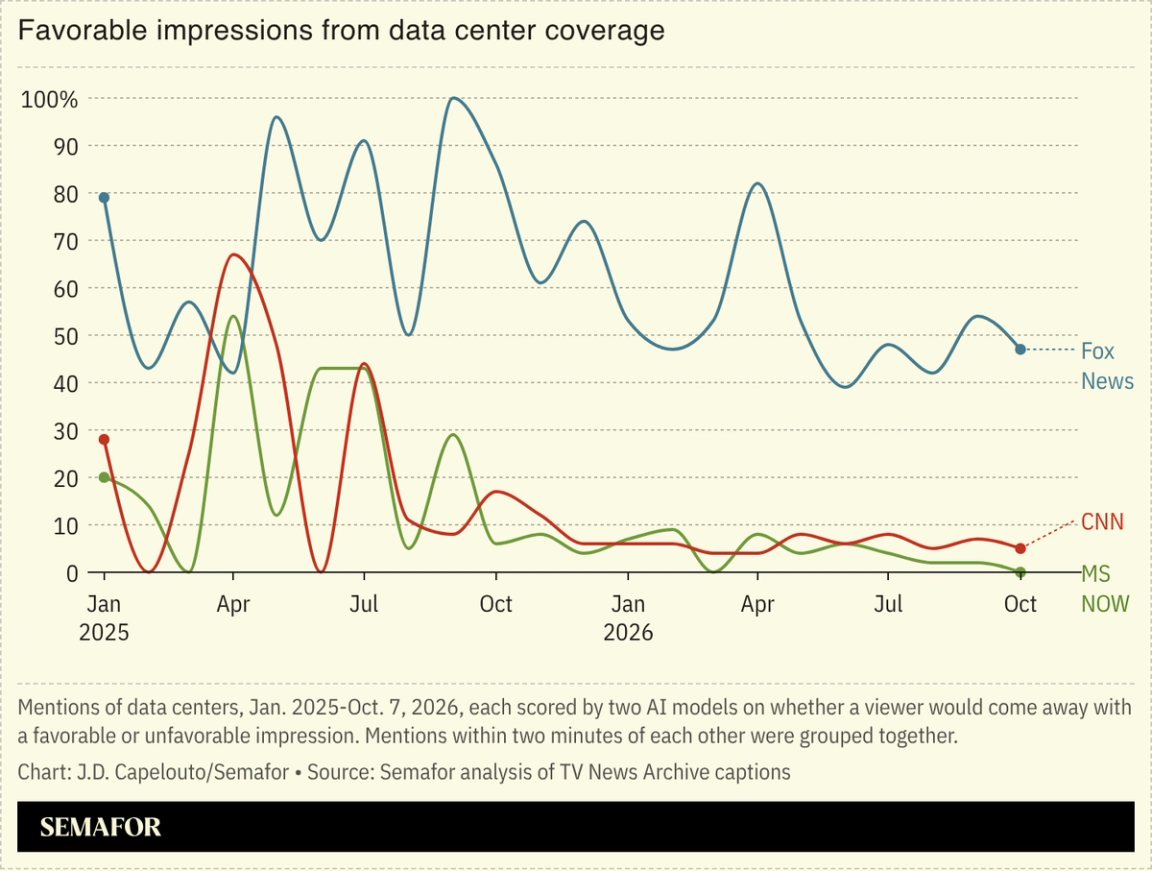 As Americans rage against data centers, Fox News’ comparatively warm coverage of them is an outlier. More than half of the references to data centers on Fox News over the last two years would have left viewers with a favorable impression, compared to less than 10% on CNN and 5% on MS NOW, according to a new Semafor analysis of mentions of data centers on each network. The mentions were pulled from closed captions preserved by the Internet Archive, which keeps a digital, searchable library of recorded TV news. A pair of AI models from Anthropic and OpenAI scored each reference on its content, with the network’s name removed. Mentions of data centers have, predictably, shot up across all three networks in recent months, as AI has become a prominent midterms wedge issue. But Fox’s opinion and morning shows, including My View with Lara Trump, Fox & Friends, and Life, Liberty & Levin, leaned on the promise of AI, economic investment and the race with China, skewing Fox’s coverage more favorably, the analysis showed. The network’s news shows were more measured. |
|
 Lachlan Cartwright. Lachlan Cartwright.A new documentary offers an unusual look at people who signed non-disclosure agreements — and then broke them, fueling some of the most important journalism of the last decade. Filmmakers Juliane Dressner and Miriam Shor spoke to corporate whistleblowers, sexual harassment survivors, and a journalist, to examine why people make the hard and risky choice to break a legal agreement, whether to protect potential future victims or simply tell their own story. One of the characters in My NDA is the Australian journalist Lachlan Cartwright (well-known to readers of this newsletter as the irrepressible Breaker editor) who describes how he signed an agreement with the National Enquirer not to disclose the paper’s “catch and kill” practice of suppressing stories on behalf of the likes of Trump and Harvey Weinstein. “This agreement was a cover-up for criminality. If it hadn’t been for the visa I wouldn’t have signed it,” he reflects. Another scene shows the New York Times reporter Jim Rutenberg talking Cartwright into taking his story to the Times because the paper will protect him legally — and because keeping the secret would be “soul-destroying.” The stakes are high, though: As the lawyer Vincent White tells another client who signed an NDA over her rape: “Being honest and sincere — it does not provide a shield in our system. With an NDA, you can be sued even for telling the truth.” The film is screening around the country and online next month at DOCNYC. |
|
Freeland says media misses Trump’s ‘charm’ |
 The USMCA signing in 2019. Henry Romero/Reuters The USMCA signing in 2019. Henry Romero/ReutersChrystia Freeland is in a unique position to evaluate the media’s coverage of Trump. The former deputy prime minister spent plenty of time with the US president and his team during negotiations over the US-Mexico-Canada Agreement during Trump’s first term. She was a journalist before that, writing for the Financial Times and Reuters. That’s why I asked Freeland, whose book about the US-Canada relationship hits shelves this week, what the media doesn’t quite get right about Trump. “The media misses his genuine charm, and he is actually charming and charismatic in some circumstances, particularly in person. And he can be so vile in other circumstances that it can be easy to miss that,” she said. Freeland also said mainstream outlets are often guilty of “sanewashing” Trump, meaning they don’t report “the real outrageousness of the things the president says and does.” She cited his annexation threats against Canada as an example. Freeland’s book offers an insider’s account of the tedious trade negotiations with the US — Canada’s newly unreliable boyfriend. — Morgan Chalfant |
|
|


