|
|
|
|
Good morning. Artificial intelligence moves fast, and it’s revolutionizing robotics. Some day, robots could free us from domestic drudgery and work alongside us. To get there, companies are paying gig workers to record themselves completing household chores. What can this footage teach AI-powered humanoids? And why is venture capital throwing millions at a Canadian startup to collect it? More on that below. |
|
|
|
|
Programming note
There will be no newsletter on Monday, Oct. 12, as the team observes Thanksgiving. However, our website will be staffed through the day, so please visit us online. We’ll be back in your inbox Tuesday. |
|
|
|
|
|
|
|
|
|
|
|
|
|
|
|
|
|
Real estate: RBC’s asset management arm will vote against the proposed takeover of H&R REIT by GO Residential REIT, adding a prominent voice to a growing campaign against the deal. |
|
|
|
|
Defence: Legislation to transform Ottawa’s Defence Investment Agency into a Crown corporation is a positive step, industry members say, but concerns about slow-moving procurement remain. |
|
|
|
|
|
|
|
|
|
|
|
|
|
|
|
|
|
|
|
|
|
Reporter Joe Castaldo records himself performing household tasks to help train general-purpose robots. Jon Laytner/The Globe and Mail
|
|
|
|
|
|
|
|
|
|
|
|
|
|
|
|
|
Earlier this year, I spoke with an executive at an AI company about the industry’s insatiable appetite for data to build better models. What’s in demand today, he said, are first-person videos of people performing manual labour. I didn’t understand at first. Why would anyone want that? |
|
|
|
|
The answer was both surprising and obvious: to train robots. |
|
|
|
|
|
|
|
|
Just as the large language models behind chatbots need enormous amounts of text to understand human language, the AI models that will direct general-purpose robots need enormous amounts of video to understand human movement. |
|
|
|
|
I was fascinated by this idea, and soon came across a then-obscure Canadian startup called Mecka AI that collects video data for robotics training. One of its customers is 1X Technologies, which is building a domestic humanoid robot. Mecka has now raised more than US$120-million and is projecting a US$300-million revenue run rate by the end of the year. |
|
|
|
|
The company did not grant interviews, but that did not prove to be an obstacle in reporting on the massive global effort to capture how we move through physical space to build AI-powered robots, which you can read about here. |
|
|
|
|
One of the ways companies do this is low-tech: You download an app, strap a smartphone to your forehead and record yourself performing household chores, like folding laundry or cooking a meal. For your troubles, you can earn US$3 on some platforms for every hour of footage – if the video is accepted, that is. If your hands are out of frame or if the video is too shaky, it could be rejected. I know because I tried it out myself. (Alas, I do not think I have a bright career ahead of me training our future robot overlords.) |
|
|
|
|
|
|
|
|
|
A humanoid robot stacks boxes in a mock warehouse environment at this year's World Robot Conference. Kevin Frayer/Getty Images
|
|
|
|
|
Many people who sign up to these platforms live in lower-income countries such as the Philippines. One executive of a data capturing company was blunt about why. The Philippines is wealthy enough for people to own quality smartphones, but not so wealthy that they might turn up their noses at the pay. That’s capitalism, I guess. |
|
|
|
|
What we don’t think about when it comes to AI is the amount of hidden labour involved. Chatbots only appear to be so fluent, for example, because an unseen class of gig workers has rated, edited and provided feedback on responses. And as the thousands of people now recording first-person video demonstrate, the same is becoming true in robotics. |
|
|
|
|
Some analysts predict humanoid robots will be adopted in warehouses and factories before they show up in our homes. To that end, companies are also partnering with workplaces to capture video data from baristas, carpenters and more. Daniel Wigdor, co-founder of AI venture studio Axl in Toronto, told me this represents an opportunity for labour unions. His pitch is for Axl to partner with unions to form a startup, capture data from workers, build an AI model and ensure union members have equity. |
|
|
|
|
It’s a wild idea. After all, doesn’t that make workers complicit in training their own robotic replacements? Wigdor countered that humans and robots will work together some day. The other thing is companies are already collecting this data for general-purpose robots to work on job sites, only without the involvement of Canadian unions. His argument was that labour can let the robotics revolution sweep it away, or capitalize on it. |
|
|
|
|
Indeed, the robots are coming – with a lot of human help. |
|
|
|
|
|
|
|
|
|
|
|
|
|
|
|
|
|
|
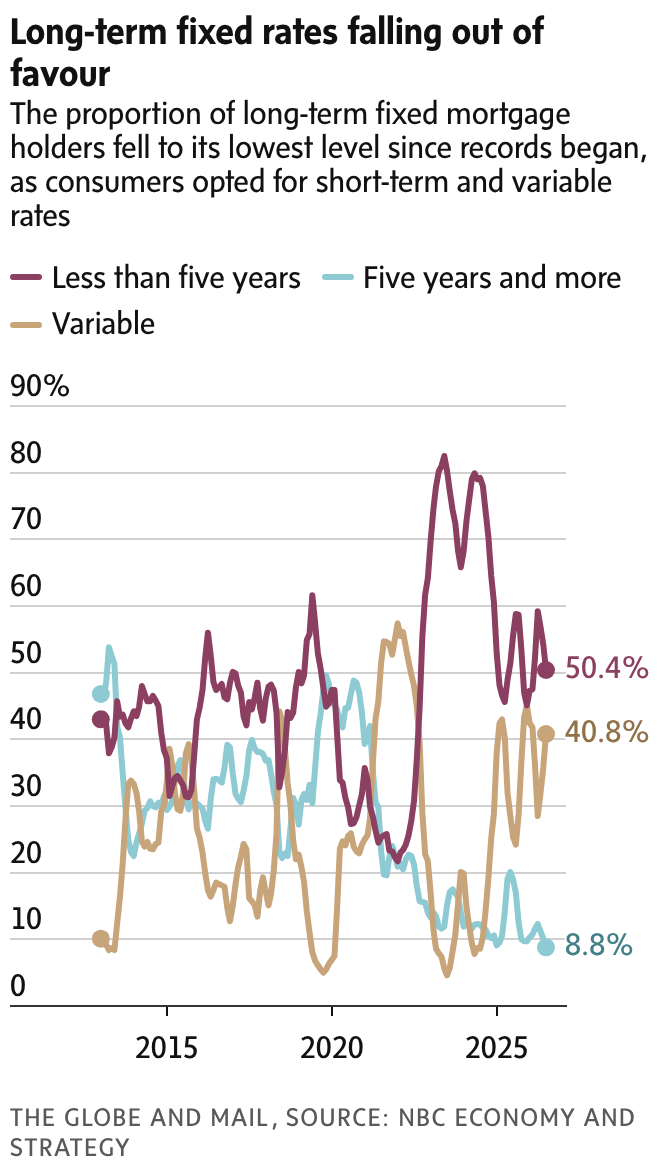
Record few homeowners are opting for long-term fixed mortgages, and economists say a reliance on cheaper, less stable products could leave the market susceptible to monetary policy changes and outside forces. |
|
|
|
|
|
|
|
|
|
|
|
|
|
|
|
|
|
|