
|
 |
What’s It Really Like to Be An Author?
A Q&A with author Becca Freeman on her new romance novel, building a writing career, and the books she can't stop recommending.
|
| |||||||||||||||


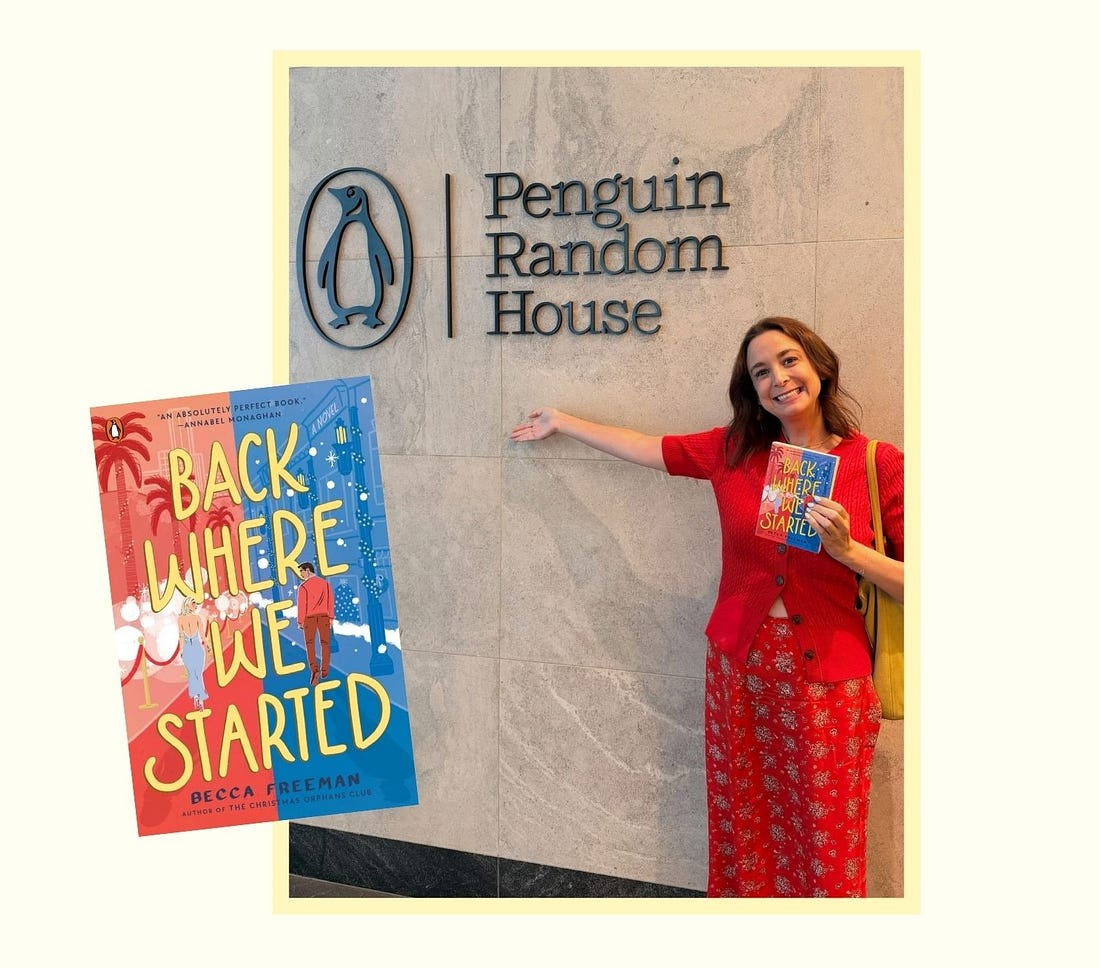
If you’ve ever wondered what really happens behind the scenes of writing a book, Becca Freeman is the person you want to talk to. She’s the Brooklyn-based co-host of the Bad on Paper podcast, the writer behind the Book Enthusiast newsletter, and now the author of two novels. Her latest, Back Where We Started, hits shelves October 13th. I’ve known Becca since the OG Girls’ Night In days (raise your hand if you were at the live Bad on Paper event in D.C. pre-pandemic?!) so of course I had to reach out to catch up.
I sat down with Becca to talk about what it takes to make a writing career work, her second novel, and, of course, her best downtime recs. Also: Did Tree Paine make her change her book's Taylor Swift-inspired title?! :) Enjoy.
 |
Q&A with Author Becca Freeman
Alisha: Becca, congrats on the new book! Before we get into it, let’s talk about the world you’re in now. You generously share info about the author life on your podcast and newsletter. What’s one thing about the author life that readers might be surprised to learn?
Becca: I didn’t fully realize how much work goes into a book. Of course, I understood that writing a 100,000-word manuscript takes time, but I didn’t realize how many rounds of edits there’d be or how substantive they’d be. My first draft of this book was maybe 105,000 words, and I ripped it down to the studs so many times — full plot lines changed, people’s jobs, personalities, everything. I didn’t understand how normal it is to fully rip apart a book. I talked to Grant Ginder, who said he doesn’t think a single word from his first draft made it into his final draft.
On a lighter note, I think people would be surprised by how little involvement the author usually has in the book cover process. The author is the approver, offering feedback, but not designing it. There are exceptions, though. Ann Patchett commissioned a painting and handed it to her publisher with the draft and said, “Here’s the cover.”
Alisha: Yeah, but she’s Ann Patchett.
Becca: She’s Ann Patchett. For the rest of us, there’s a whole production side of the house that deals with copy editing, designing the interior, the art department that designs the cover. Then there’s marketing and publicity, and a whole sales force getting the book into bookstores. It’s a much bigger machine than I realized.
On The Realities of the Author Life
Alisha: How have you been navigating the financial side of an author career, especially given how long it takes to write a book? I’m always curious about this, and you’ve been very open.
Becca: With my first book, I was working in marketing consulting. It was a pandemic project; I suddenly had less of a social life and more time. I was lucky because I was mostly working West Coast hours while living in New York, so my mornings were free, which is when my brain is freshest. After I sold the book on a two-book deal, I was really excited because I’d lost passion for consulting. I thought I could write a book in a year—you look at Carly Fortune, Annabel Monaghan, they’re churning out books. I thought having written one, the second would be easier. But that was not the case whatsoever.
It became clear about six months after my first book came out that I was not close to finishing the second. Having financial pressure on that second book really changed the process. It was tied up in the mental muck of finances in a way the first one wasn’t. So in February 2024, I launched the paid tier of my Substack, going from monthly to twice weekly. I wanted to build an income stream outside of books. The podcast has always existed as an income stream, but it’s much smaller than people would guess. Building that Substack side was the best thing I could have done to take the financial pressure off.
Alisha: I’m so glad it’s working for you. Through your podcast, I also learned that most authors typically have an additional job or two to make it work. I was surprised by that, but it makes sense!
Becca: As I meet more authors, I’m struck by how many have 9-to-5 day jobs and are writing in the early mornings or on weekends. People who are writers in their day jobs—churning out articles for digital publishers and then coming home to write novels. I can’t fathom how they have enough brain cells to do that!