Hello there,
One of the questions that France-watchers inevitably ask as we try to understand the implications of the current nationwide demonstrations over school conditions is: How are they different from the many other street protests that country has seen over the years?
As far back as the late 1980s, French schoolchildren were joining often fierce protests over university reform; then in 1995, there were the big public sector strikes over welfare reforms; in the early 2000s, anger once more spilled over onto the streets over then-prime minister Alain Juppé’s attempted pension reform and welfare cuts; nearly two decades later came the “gilets jaunes” and their protests over fuel prices and the rising cost of living. Now, hundreds of thousands of students, parents and teachers are taking to the streets to air longstanding grievances over educational under-funding. Is this, as the French say, just a case of “the more things change, the more they stay the same”? Well, not quite.
“In the past, pretty much every time there has been strife, money magically appeared to calm things down,” Paris bureau senior correspondent Leigh Thomas told me of how French governments of the day have so often secured social peace at a price to the state purse. “But there’s not a lot of room to do that now.”
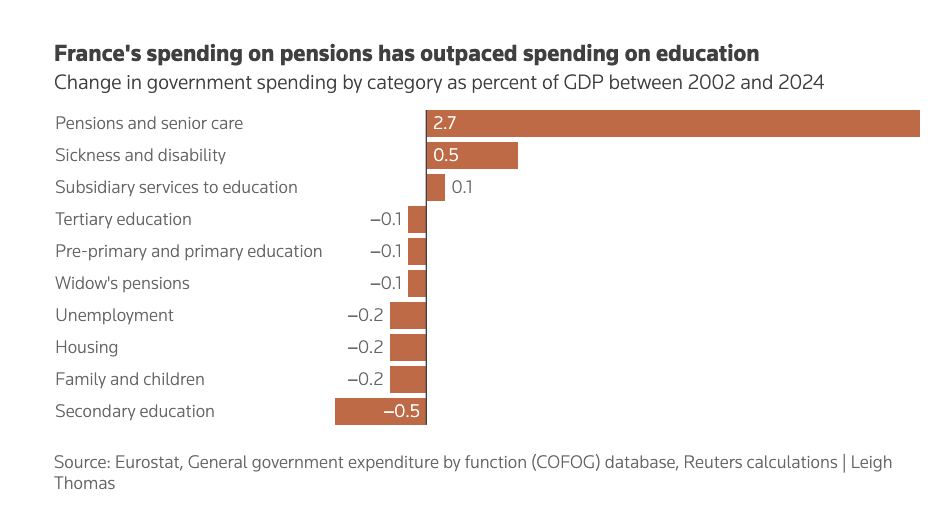
This is the problem. Within the politically fraught confines of the French budget debate now taking place, this advanced G7 economy apparently has no money to fix schools where classrooms are infested with cockroaches and rats, or where temperatures can swing from freezing to sweltering depending on the weather.
This time, things have come to a head with the government hemmed in by investors worried about rising debt in a country which has not balanced its budget since 1974. The yield on French 10-year bonds briefly hit a 24-year high of over 5%, making the cost of its borrowing even higher. The 2027 budget presented last week by Emmanuel Macron’s government has done little to assuage concerns and anyway is likely to get ripped to shreds in the parliamentary process of the weeks to come.
For now, fears that this could balloon into a wider euro zone crisis are probably overdone. For one thing, the hit to French bonds is still nowhere near as big as it was to, say, Italian and Greek debt during the European debt dramas of the 2010s. And while policymakers have made it clear there is no justification at present for the European Central Bank to step in and support French assets, investors broadly sense that the ECB would act if the contagion spread to others.
Unless the government can find the extra resources to treat the root causes of the current anger while not further spooking markets, the unhappy stalemate is likely to continue. And this is where the other difference with previous bouts of social strife comes in: the risk it will play well for the political extremes. Whereas in the past, mainstream politicians have been able to just about muddle through, this episode could contribute to their demise. Far-right leader Marine Le Pen was already leading opinion polls ahead of April’s presidential election; the question is whether she will be joined by her far-left rival Jean-Luc Mélenchon, a strong supporter of the protests, in the head-to-head second-round runoff. If she is, surveys suggest she will be heading towards the Élysée Palace.