
|


 |
We are seeing a new wave of general purpose consumer-friendly agents, and it’s causing many thousands of AI startups to re-evaluate their place in the market. Some questions:
Will these new horizontal players take over completely?
Will it be winner take all?
Can products that focus vertical use cases survive?
The new wave of products - Muse, Town, Instinct, Grokbot, etc - come from taking the power and magic of Openclaw/Hermes but wrapping it in polished, secure, consumer-friendly experience. This is only the beginning, and soon every major tech company will throw their hat in the ring and thousands of startups that have been working on vertical agents in X (travel, shopping, family, work, SMB, etc etc) have big existential questions to answer.
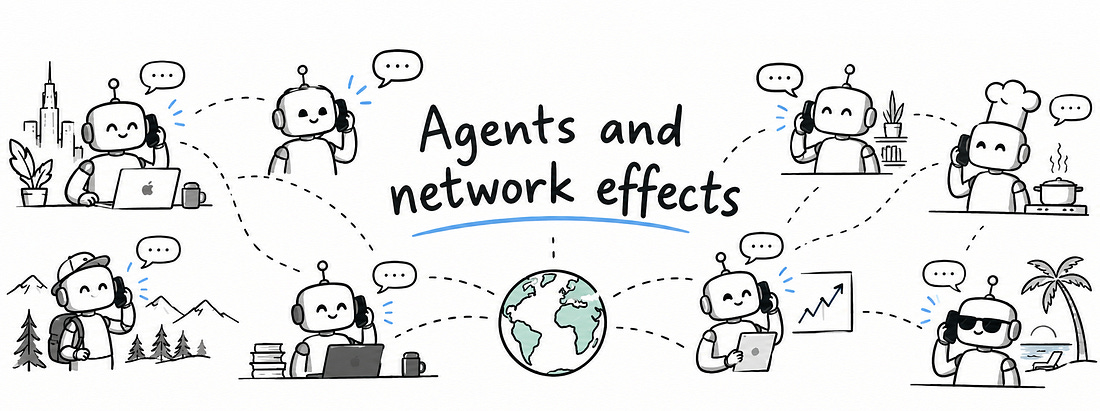
The simple case against winner-take-all dynamics: These agents are tools, not networks. They inherently provide a solo experience, and although packaged as chat experiences, they don’t have network effects the way that Whatsapp or phone networks do. They’re more like email clients - I can use Superhuman and someone else uses Outlook and someone else is on Gmail, but in the end we just send email to each other. In that metaphoi, if a Muse agent encounters a Instinct agent, they will just figure out how to talk to each other by building APIs, or using email/messaging/etc., so that there’s no advantage to everyone running the same thing. Further, you can swap out the underlying LLM - as we saw in the Claude vs Clawdbot saga - things will still work. The memory and underlying context are just text files, and AI are great at porting things from one system to another. So where’s the moat?
Just because they are tools today doesn’t mean they can’t evolve into networks. As I’ve written about in the past, instead of discussing “network effects” as a vague/amorphous concept, let’s instead overlay it against core KPIs each product has to build against:
Acquisition network effects: More users** = lower CAC, higher virality, more signups
Engagement effects: More users = higher retention, deeper usage, more frequency
Monetization effects: More users = higher ARPU, higher conversion, more share of wallet
(**PS. and by “more users” of course I actually mean, of course, higher network density with more interconnection within/across networks. Not scale effects)
So looking at these sub-categories of network effects, you might ask: What are the features that you’d build to actually create network effects in agents? How does this category become winner-take-all?
Acquisition network effects
In the pre-AI world, network effects in customer acquisition were driven by users taking actions that then bring in even more users - whether that’s sending an invite, sharing a piece of content, or getting mentioned in a comment. Those users would then join the network, repeat the same actions, creating more viral loops that would throw off more users. In the post-AI world, both users and agents can initiate these loops. Agentic viral loops are about to be a thing. An agent might suggest, “hey, do you want me to help organize a New Years celebration with family” and then might pull together a group chat with your siblings, in-laws, and parents. It might build a microsite for the event and ask people to sign up and RSVP, creating an opportunity to generate a signup. Or for work, you might finish a slide deck and your agent asks if you want to pull together a meeting to present it to your team. When it does that, it might create a prep doc, take notes, and host it all on a microsite that engaged others.
These types of agentic viral loops need a few things to work: They need to be able to plug into your contacts, and to have enough context to know when to loop which people into which projects/events/activities. They need access to communication channels like email/messaging/otherwise, specifically where they can reach potential users, as this serves as the viral substrate for propagation. The magic will be how to get all of these things without being creepy, and to create enough trust to reach out to friends/colleagues/etc on your behalf, without being too push. No one wants an agent that says, “hey Andrew would like to get lunch next week” followed by “and sign up for this agent to agree!” - it has to be better and more subtle than that.
Many viral loops in the pre-AI era, particularly in the workplace, were built on a content creation loop - you use Google Slides to make a thing, you share a link, and then people would view it. Eventually they might make their own. Many products like Figma, spreadsheets, Notion, Canvas, are all built on this loop, and so are YouTube, Instagram, etc. In the agentic world, you might start by talking to your agent about interior decoration ideas, and it might ultimately build you a Pinterest-like board and make it easily shareable with others. It might build you a spreadsheet mini-app with a budget, a schedule, etc., and again, make it easily shareable. It might volunteer to do this inside a group chat with your friends, and if they want to view it, they should sign up and get their own agent too.
If the content creation loop works for agentic virality, I think it means there’s a big incentive for every agent to volunteer to make visually-appealing, shareable content, do this often. AI is so good at codegen that creating a one-off disposable artifact will probably be more useful than not. And there’s a big incentive to drive virality by building/owning the content yourself as the agent. In the interior decoration example, it would be more viral to create a standalone version hosted by the agent, rather than building an actual Pinterest board, or to build a self-contained mini-spreadsheet rather than creating a GSheet. A properly tuned agentic viral loop will do the former because it helps spread the agent, rather than helping spread Pinterest/GSheets. There’s an incentive towards building walled garden assets rather than building/sharing other products.
Agentic viral loops are limited by different constraints - and thus, lead to a different type of viral factor - than pre-AI viral loops. As I wrote in my viral loop braindump a while back, traditionally getting your viral factor >1 has to do with: 1) reducing the friction (length/focus) for each step of the loop, 2) sharing/inviting enough people, and 3) building on a high-conversion marketing channel. For agentic viral loops, theoretically there’s no friction because your agent can just share things for you. It can pick who to share/invite, so if appropriate it should publish content to millions of people so there’s no limitation there. However, agentic viral loops are naturally limited by the fact that people don’t want their agents running around shilling themselves - the 4th time your sister gets the message “hey I’m X, andrew’s agent, and he wants you to try using an agent too!” you’ll get an annoyed text and you’ll stop using that agent. And of course, the marketing channel itself will become limited if everyone starts to filter/block agents, or even better, agents will filter/block other agents as a form of protection. Yet it’s clear that some types of agents will push the boundaries here, and some - perhaps free offerings targeted at less sophisticated segments of the market - will thrive in the same way that banner/popup-laden websites survive.
This might all sound like horrific spamminess to you, but I think it might be done tastefully. If an agent is high-retention and high-usage, you’ll have many shots on goal to gradually invite your friends onto the same platform as you. The first shot might come from an invite loop that says your colleague/friend wants to set up a place to share photos/coordinate calendars/etc., and even if you say no, over time, your friend might share very useful microsites for projects or events or research that’s relevant, and you might decide that you want to sign up to leave a comment, but then eventually you might try the other functionality as well.
Engagement network effects
It’s easy to imagine that in a world where everyone by default has super intelligent agents that product engagement in agents would go up. The simple argument is that the ubiquity of agents would lead to more successful task completion, making agents more useful and applicable to more problems. Routine tasks like scheduling something or summarizing/sharing notes from a meeting, would happen instantly if it ran through agents and you removed humans completely. As agents become more successful over time, not only with your own tasks but in coordinating larger and more complex multi-user decisions, you’d end up using them more.
However, this does not answer the question of network effects. The question there is, does your agent get better when other people are all using the SAME agent? As I said earlier, the argument for NO is if each type of agent runs on a frontier AI model, can talk to other agents (all different types) in real-time via email/messaging/APIs/connectors/etc. Then there’s not much leverage. If you’re just organizing a meeting or a dinner party or meeting the agents just ask each other in real-time - and even if they are heterogeneous - they can use email and calendars and figure it out.
But some tasks do benefit from everyone running the same agent, because you get the benefits of centralization: