| | In today’s edition: Saudi-backed forces make headway in Yemen, BlackRock leans into the Gulf, and CZ͏ ͏ ͏ ͏ ͏ ͏ |
| |  | Gulf |  |
| |
|
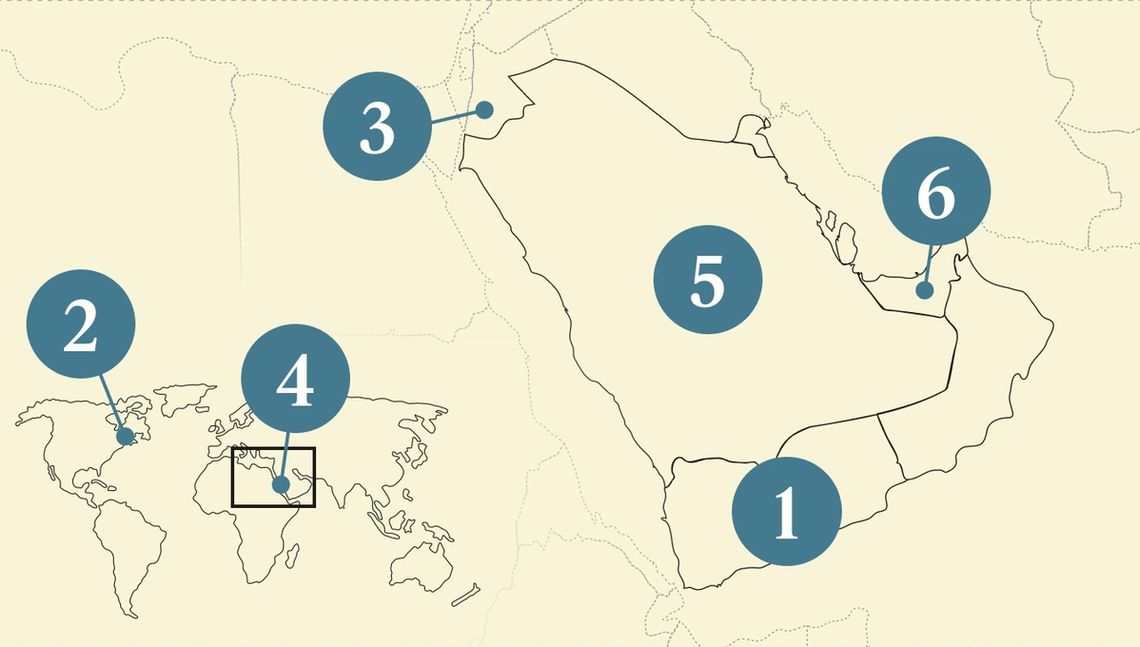 - Yemeni forces take Mokha
- BlackRock sees stable Gulf
- UAE-Jordan rail link
- Uneven non-oil economies
- Saudi expat labor shrinks
- CZ’s Abu Dhabi life
 An app for buying that low-number plate. |
|
 Amr Alfiky/Reuters Amr Alfiky/ReutersEvery October, Fujairah, the UAE’s often overlooked east-coast emirate, fills with oil traders for the Gulf Intelligence Energy Markets Forum. It is usually a technical affair, focusing on crude grades, bunkering, and shadow fleets. This year, the Iran war has turned it into a showcase of how the UAE is rerouting trade around the Strait of Hormuz. Much of Abu Dhabi’s crude now flows through Fujairah via a pipeline built long before the war and work is underway to expand the port for goods. Nearby, Sharjah’s sliver of a terminal at Khor Fakkan is taking on more cargo, with Emirates Global Aluminium planning to ship up to 250,000 tons of the metal per year from there. I didn’t see signs of a boomtown on the drive from Dubai. I’m told the action is at the ports, where trucks queue to move cargo across the country. I will visit them today. Fujairah cannot replace the trillions of dollars of infrastructure built inside the Gulf, and capacity is already a constraint. But the war has made it an essential alternative. This lack of capacity has created some stress in the economy. Food and building-material costs are rising, and there are shortages of other goods. This has affected my family, arguably in a good way. After months of waiting for a new Kia or Hyundai, we gave up and bought what was available: a growling, 400-horsepower Ford Explorer that we now use for my kindergarten-age daughters’ school run. The girls love the acceleration. But the lack of choice in one of the world’s top consumer economies is a sign of how the war is changing life in the region. |
|
Yemen offensive targets Bab el-Mandeb |
 Southern Giants Brigades/Reuters Southern Giants Brigades/ReutersSaudi-backed government forces in Yemen said they had taken control of Mokha from Houthi militias in a major counteroffensive launched on Monday, as the internationally recognized government looked to retake the Bab el-Mandeb Strait. Around 9% of global maritime trade flowed through the chokepoint before the war, including 3.1 million barrels of oil a day — a figure that has grown as Saudi Arabia has rerouted 70% of its energy exports through western Red Sea ports to circumvent the Strait of Hormuz in the east. But some are concerned the counteroffensive could widen the Iran war, further upending energy markets. Overnight attacks against Saudi airports in Najran and Jazan resulted in three injuries and limited damage, with explosions heard over Riyadh. Türkiye and Pakistan agreed to the rapid deployment of forces to Saudi Arabia to counter Houthi attacks on the kingdom. The decision followed an emergency meeting of defense and foreign ministers of the three countries under the Mecca Joint Defense Agreement, a pact signed in August. Saudi Arabia also announced it would regularize the status of Yemenis in the kingdom illegally as part of measures to support the country, following a request from Rashad al-Alimi, head of Yemen’s Presidential Leadership Council. It has already announced a $60 million package to pay public-sector salaries and support Yemen’s budget. |
|
BlackRock bullish on Gulf |
 Carlo Allegri/Reuters Carlo Allegri/ReutersBlackRock is ramping up its commitments to the Gulf as the world’s largest asset manager seeks to boost exposure to a region that it expects to use more of its vast state wealth to invest domestically in the wake of the Iran war. The firm is “undiminished in our focus” on the region, said Ben Powell, chief investment strategist for the Middle East and Asia-Pacific at the BlackRock Investment Institute. Counterintuitively, the bullishness stems from the Gulf’s relative stability: “In terms of the rules of the game, the positive attitude towards business, not to mention human capital, financial capital, energy … I feel very confident that this is a story that is true and real and going to play out over the next five, 10 years,” Powell said. Stability “in a world of great moderation, that’s not that interesting,” he added. “But in a world of excitement, that becomes much rarer.” |
|
Abu Dhabi backs Jordan’s $2.3B railroad |
 Emirates News Agency Emirates News AgencyAbu Dhabi is backing a rail link to enhance the logistics behind Jordan’s main exports. The 403-kilometer network will carry 16 million tons a year of phosphate and potash, used in fertilizers, from mines to the Port of Aqaba. The line, which will replace truck convoys and an aging freight track, is expected to cut transport costs by $40 million annually. Abu Dhabi Crown Prince Sheikh Khaled bin Mohamed and Jordan’s King Abdullah II broke ground on a $2.3 billion project, part of a $5.5 billion investment framework the two countries agreed to in 2023. The UAE is investing in rail infrastructure across the region, including Etihad Rail at home, Hafeet Rail to Oman, and other links that are part of a planned India-Middle East-Europe corridor, which would run through Jordan. |
|
Most Gulf industries are in expansion mode |
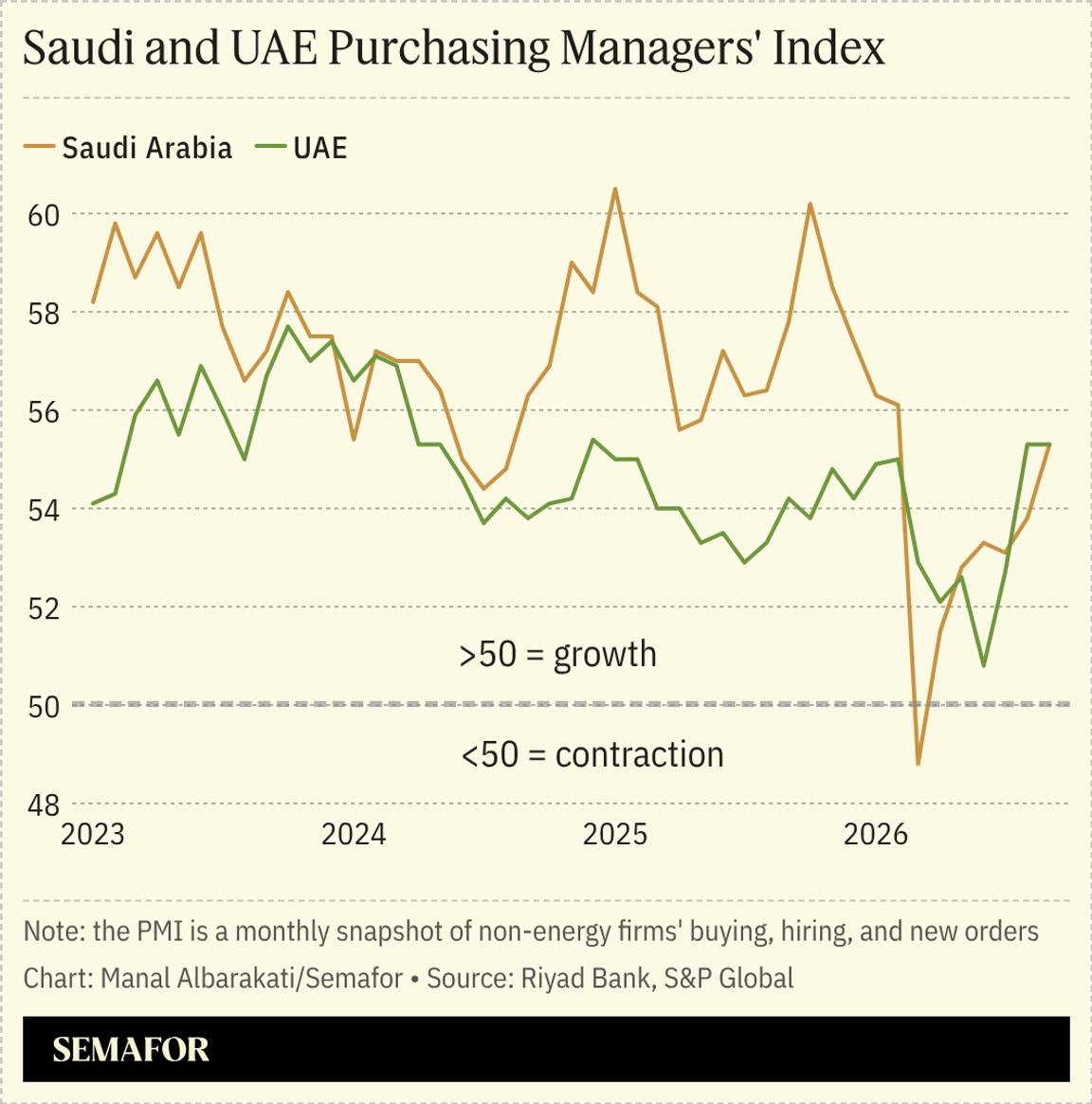 Non-oil business activity in Saudi Arabia and the UAE is expanding at its fastest pace since the war began, according to S&P Global’s latest surveys. Saudi Arabia’s reading rose to a seven-month high on stronger domestic demand, even as export orders fell for a seventh straight month. The UAE held at its August level, with export orders growing at the fastest rate in nearly two years. Kuwait expanded for a third month, though more slowly. Only Qatar continued to contract, and at a faster pace. Shipping disruption is pushing up prices: UAE firms raised them at the fastest pace in more than 15 years, and Saudi firms at the second-fastest in more than six. |
|
Saudi’s expat workforce shrinks |
 Mohammed Salem/Reuters Mohammed Salem/ReutersSaudi Arabia’s expatriate workforce shrank for the first time in more than two years, amid layoffs, the Iran war, and a backlash against hiring foreigners at state-controlled companies. Foreigners employed in the country, excluding domestic workers, fell by 16,000 in the three months to June, driven by a drop in construction jobs, according to the government’s quarterly report. Medical insurance policies for expats didn’t grow at all in the first six months of 2026, another indicator that fewer foreigners are coming to the kingdom. State-controlled firms have been trimming workforces or not renewing contracts as budgets were cut for some projects, while others, like NEOM, have scaled back significantly. The Iran war has also dented the region’s reputation for safety. The unemployment rate for Saudi citizens hasn’t budged and the economy is creating new jobs, albeit at a slower pace. Forward-looking data from the Purchasing Managers’ Index suggests hiring will bounce back. — Matthew Martin |
|
Binance’s CZ at home in Abu Dhabi |
 Tyrone Siu/Reuters Tyrone Siu/ReutersThe normie life of crypto’s most powerful founder, the subject of a profile in The New York Times, is a kind of meditation on the appeal (and embrace) of the UAE for a new generation of tech oligarchs. Binance’s Changpeng Zhao, better known as “CZ,” was jailed in the US for a financial crime and pardoned by President Donald Trump a year ago; he’s now living in Abu Dhabi in a nine-bedroom villa, with four bodyguards, two dogs (one named “Broccoli”), and a yacht. Like the average Gulf expat, he has the requisite IKEA furniture and tools around town in a white Nissan Patrol. But unlike the rest of us, on his arrival in the emirates he was met by the UAE minister of AI and approved for a 10-year golden visa within hours (he was later granted a UAE passport). Shortly after, he was advising governments on crypto regulation. |
|
 The politics, policy, and business driving healthcare. Delivered weekly from David Lim, Semafor Healthcare will connect the dots between decisions in government, business, and technology to reveal how they impact the future of healthcare. Each edition will provide the analysis you need to understand and stay ahead of a rapidly changing landscape. Don’t miss the first edition — subscribe for free. |
|
 Commodities- ADNOC will supply up to 2 million tons of LNG to Thailand’s Gulf Development under a multi-year deal starting in 2027. The Abu Dhabi energy producer aims to expand its LNG marketing and trading unit to handle 47 million tons per year of the fuel.
Deals |
|
|


