| | In today’s edition: Trump moves to broaden access to tax-exempt diesel, and how AI is changing the w͏ ͏ ͏ ͏ ͏ ͏ |
| |  | Washington, DC |  |
| |
|
 - Collins’ Trump approach
- Trump’s diesel play
- New fraud push
- Dems press on AI framework
- AI workplace impact
- Crypto spending questions
- Fed reviews banks
- Debate season
PDB: Trump says his PAC, not government, will pay for TV ads  Trump attends event for defense tech firm Anduril in Maryland … US publishes trade data … France rocked by student protests |
|
Collins’ Trump approach faces key test |
 Susan Collins and Troy Jackson. Kylie Cooper/Brian Snyder/Reuters. Susan Collins and Troy Jackson. Kylie Cooper/Brian Snyder/Reuters.Maine’s Senate race goes into overdrive tonight as Sen. Susan Collins squares off against her Democratic opponent Troy Jackson in their first debate. And the main dynamic to watch is whether Collins and her behind-the-scenes maneuvering pushing back against some of the Trump administration’s decisions buys her enough goodwill with an electorate that is clearly experiencing Trump fatigue. She’s worked quietly to get the Trump administration to scale back an ICE surge, restore some funding for Maine, and exempt certain goods from Canada tariffs. She argues if Jackson replaced her, her state would lose that backchannel — and suffer as a result. “I got results,” Collins told Semafor’s Burgess Everett, referring to her quiet talks with then-Homeland Security Secretary Kristi Noem. “The Troy Jackson approach would be to rant and rave about it.” Democrats argue it’s not enough — and that the real solution is a Democratic Senate. |
|
Trump expands access to tax-exempt diesel |
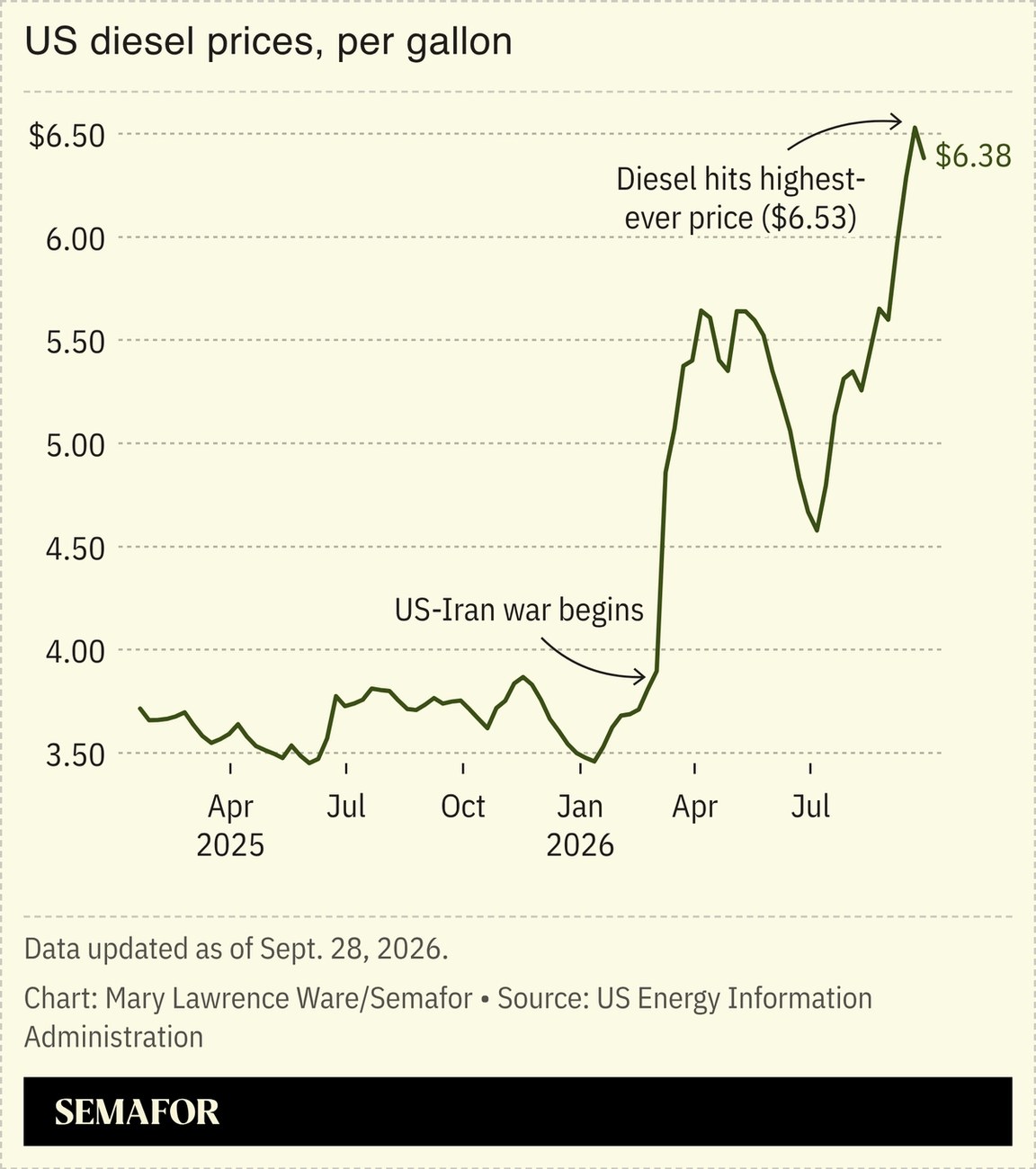 President Donald Trump is expanding access to tax-exempt diesel while simultaneously pledging a swift end to the Iran war, an implicit acknowledgment that his administration is running out of ways to significantly stem the conflict’s economic fallout. “It’ll end very quickly, and prices are going to come down very sharply,” Trump said at the Nebraska rally last night, where he signed the executive order on so-called red-dyed diesel. “You might say, ‘Please, please, sir, it’s going down too fast.’” Later, he again promised to pay every American $5,000 if Republicans come out ahead in the midterms, warning of a “1929 South economic depression” if Democrats win. Republicans are cool to the checks idea, and despite Trump’s promises to wrap up the war, his administration has no clear way out of the conflict. — Eleanor Mueller |
|
WH sends Congress anti-fraud language |
 Mark Schiefelbein/Pool via Reuters Mark Schiefelbein/Pool via ReutersThe White House sent Congress proposed legislation that would impose mandatory minimum prison sentences on people convicted of defrauding federal benefit programs, according to a copy of the proposal seen by Semafor’s Shelby Talcott. Under the measure, sentences would be tied to the amount of losses caused by the fraud, ranging from one year for losses less than $40,000 to 20 years for losses of $100 million or more, with a lifetime maximum sentence. The measure would also hold government employees accountable if they knowingly ignore suspected fraud and make them financially liable for losses resulting from fraud. The proposal follows Trump’s call over the weekend for lawmakers to punish fraud, as Republicans nationwide pledge to crack down on “waste, fraud, and abuse.” It likely faces a steep climb in both this Congress and the next one, particularly if Democrats retake power. |
|
Dems press WH on secret AI framework |
 Evelyn Hockstein/Reuters Evelyn Hockstein/ReutersTwo Democratic senators want answers from Trump administration officials on industry influence on the still-unreleased AI regulatory framework, part of the AI executive order Trump signed earlier this year, according to a letter shared first with Semafor. “We are concerned that the Trump administration is accommodating the interests of Big Tech CEOs rather than addressing the safety and security risks posed by increasingly sophisticated AI systems,” Sens. Elizabeth Warren, D-Mass., and Richard Blumenthal, D-Conn., wrote in the letter addressed to Treasury Secretary Scott Bessent, White House cyber adviser Sean Cairncross, and White House chief of staff Susie Wiles, among others. The letter cites reported industry influence over what eventually became the executive order. It also highlights Meta CEO Mark Zuckerberg’s central role in shaping the more recent White House AI accord, pointing to the administration’s “cozy relationship” with and “deference to industry executives.” — Ashley Gold |
|
How AI is changing the workplace |
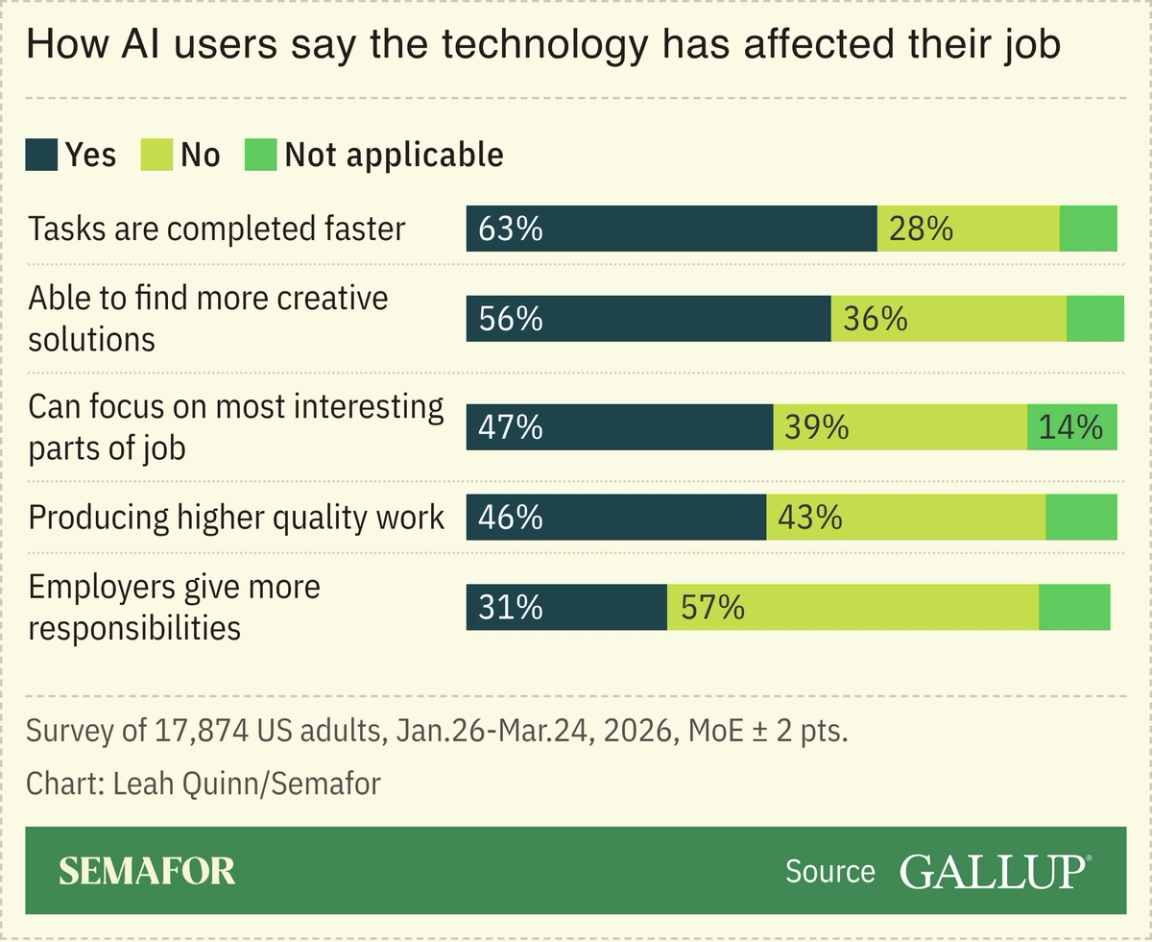 As AI adoption spreads across the US workforce, new polling suggests that its benefits have so far been concentrated among those likely to hold upper-level positions. Twenty-eight percent of US employees say they use AI at least weekly, according to a two-year study from Jobs for the Future, The Families & Workers Fund, and Gallup, while 54% say they haven’t used it at work. Use of the technology on the job is much more common among those with college degrees and those in managerial roles. Speed is the most common benefit that AI users point to, with 63% saying the technology helps them do their jobs faster. Among those in the highest-paid positions — people earning $10,000 or more a month — seven in 10 say it’s accelerating their work, while fewer Americans who earn less say the same. |
|
Crypto PACs’ House targets raise eyebrows |
 Dado Ruvic/Illustration via Reuters Dado Ruvic/Illustration via ReutersThe cryptocurrency industry’s leading network of super PACs is under scrutiny after revealing it will back 19 House Republicans but only 13 House Democrats. Fairshake, which emerged as a kingmaker last election cycle, said just three members from each party would receive $1 million ahead of November. But it did not provide a breakdown for the rest of its spending, even as skeptics pointed out that its list contained more Republicans than Democrats in tough races. “The absence of [North Carolina Democratic Rep.] Don Davis is the most dangerous thing, because that’s a Dem who’s in a swing seat who’s not getting love,” despite backing the industry’s top legislative priority, one cryptocurrency executive told Semafor. Last cycle, “there was at least the argument that Dems had driven them to this; this time, it’s been two years of going hard in on Trump.” — Eleanor Mueller and Nicholas Wu |
|
Private-credit worries spur Fed review |
 Eduardo Munoz/Reuters Eduardo Munoz/ReutersThe Federal Reserve Bank of New York has been visiting big banks to review their loans to private credit firms and understand their exposure to a financial industry that has unnerved investors and global policymakers, Semafor’s Ellen DiMauro scoops. Fed officials have gone into JPMorgan, Wells Fargo, Barclays, and Morgan Stanley since the spring with questions about overall exposure, risk management, and collateral quality, people familiar with the matter said. The review was prompted in part by JPMorgan’s move in March to mark down large swaths of loans in private credit portfolios, particularly those to software companies threatened by AI, the people said. The Fed has concluded its review of some of the banks, including JPM. It’s not uncommon for the Fed to go into banks to review their holdings, particularly when there are frequent headlines about potential risks. |
|
Senate contenders prepare for debates |
 Iowa state Rep. Josh Turek and Iowa Rep. Ashley Hinson. Nathan Layne/Nathan Howard/Reuters. Iowa state Rep. Josh Turek and Iowa Rep. Ashley Hinson. Nathan Layne/Nathan Howard/Reuters.The Collins-Jackson showdown tonight, the first of four bouts in Maine, kicks off a week of debates in closely fought Senate contests around the country. Tomorrow night, Iowa Rep. Ashley Hinson and state Sen. Josh Turek will head to a PBS studio for their first debate in the Iowa Senate race — a forum where Hinson, who was a TV reporter before entering politics, is typically strong. And on Thursday, Michigan Democrat Senate nominee Abdul El-Sayed and Republican Mike Rogers will debate in Grand Rapids, after El-Sayed mocked Rogers as a “beta” and challenged him to even more in-person face-offs. — David Weigel |
|
Blindspot: Hulk and Hilton |
 Stories that are being largely ignored by either left-leaning or right-leaning outlets. What the Left isn’t reading: Actor Mark Ruffalo threatened to “Hulk out” if President Trump attempts to meddle with the vote in the midterm elections. What the Right isn’t reading: California gubernatorial candidate Steve Hilton is facing criticism over a sexually suggestive political ad. |
|
 The politics, policy, and business driving healthcare. Delivered weekly by David Lim, Semafor Healthcare will connect the dots between decisions in government, business, and technology to reveal how they impact the future of healthcare. Each edition will provide the analysis you need to understand and stay ahead of a rapidly changing landscape. Don’t miss the first edition — subscribe for free. |
|
|


