
|


 |
Paul Krugman is the greatest econ writer in the world, and also a legendary economist. But I sometimes feel that he has a blind spot when it comes to the value of new technologies. In 1998 he famously wrote:
The growth of the Internet will slow drastically, as the flaw in ‘Metcalfe’s law’—which states that the number of potential connections in a network is proportional to the square of the number of participants—becomes apparent: most people have nothing to say to each other! By 2005 or so, it will become clear that the Internet’s impact on the economy has been no greater than the fax machine’s.
By the time he wrote that, America was already well into an IT-driven productivity boom that would temporarily interrupt the stagnation that had begun in the 1970s. The internet was surely part of that story; it allowed companies to reshuffle and optimize their supply chains for greater efficiency, find customers, suppliers, and workers more easily, conduct business communications cheaply and in greater depth, and so on. Dolfen et al. (2023) estimate large consumer gains from the rise of e-commerce, Barrero, Bloom, and Davis (2021) find large economic gains to households from high-quality internet access, and so on. The internet is a lot more than just people yelling at each other on forums and social media. (Krugman later argued that the internet’s economic impact had been disappointing, but I suppose that depends on your expectations.)
In 2011, Krugman wrote that American kitchens hadn’t changed much since 1957. I can forgive him for not being an early adopter of the air fryer or the Instant Pot, which came out in 2010, but he really should have given more consideration to countertop microwaves, food processors, Keurig-type coffee machines, crock pots, and induction stoves, all of which became available between 1957 and when he wrote the post.
So although it’s always dangerous to disagree with Paul, I am going to go ahead and push back on his argument that AI technology “does nothing” for most Americans:

He writes:
There is also, however, a more prosaic reasons for the public’s dislike of AI: This is a technology of, by and for oligarchs, with hardly any of the benefits trickling down to regular Americans…Or to put it a different way, never before in history have corporations spent so much money — playing a major role in soaring interest rates — to create so few jobs.
I think that this is basically wrong. Although we don’t know the long-term effects of AI on the distribution of income and wealth, right now we can see a substantial amount of economic benefit flowing — I wouldn’t say “trickling down”¹ — to regular Americans.
This is not to say that regular Americans couldn’t stand to benefit more from the AI boom. I think they could. I like some (though not all) of Jared Bernstein’s ideas for spreading the benefits of the data center boom more broadly. But I think Krugman has underestimated the benefits of the data center buildout in terms of direct employment, and has basically ignored the fiscal, macroeconomic, and consumer benefits of the current AI boom.
The AI buildout is creating lots of construction jobs
Building data centers takes a lot of labor. But Krugman argues that data centers aren’t doing much in the way of providing construction jobs:
Given this spending surge, one should expect a sharp rise in nonresidential construction spending — basically construction for businesses rather than housing...But that’s not what we actually see. Nonresidential construction…has basically flatlined under Trump, despite the immense AI investment boom…[E]ven the physical construction of a data center involves relatively little construction.
He quotes Van Nieuwerburgh (2026), who shows that only about a third of the cost of a data center involves construction work.
But I don’t think Krugman proves his case here. First of all, if we’re talking about construction jobs, we should look at employment levels, not spending. And here we see an increase in construction jobs since the AI boom began in late 2022:
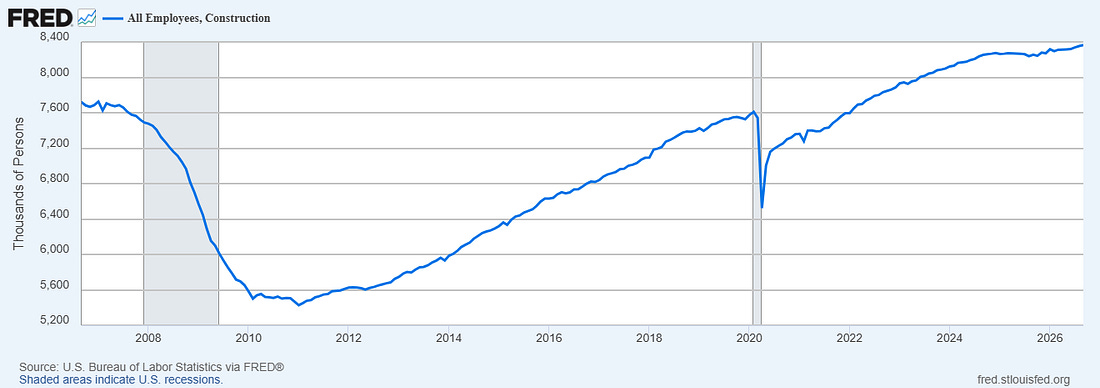 |
Construction has also increased as a percentage of the workforce: