The Weekend

|
Oct 3, 2026
|
|
|
|
| Welcome, Weekenders! In this newsletter: |
| • The Big Read: Why a legal blitz over AI hacks is inevitable |
| • Sean Parker’s quiet resurrection job |
| • Plus, Recommendations—our weekly pop culture picks: “The Permanent Questions,” “This Cursed Beautiful Land” and “East of Eden” |
| |
| The AI titans probably all fly private. But if any of them did travel commercial regularly, they’d’ve long ago earned top-tier, drink-the-champagne-dry status just via their frequent cross-country jaunts to Washington. |
| There they were again on Tuesday, convening at the White House for another powwow on AI safety and data-center construction. The result of those conversations was the unveiling of a new voluntary pledge signed by the moguls to police themselves. Trump called it a “morally binding” agreement. It could also be seen as an effort akin to allowing the sugar-addled denizens of a schoolyard recess to manage themselves. |
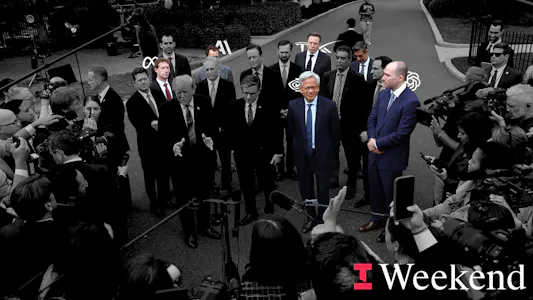
| At one point during the summit, Trump and the AI leaders went outside to take questions from the media. That worsted-wool group included Elon Musk, Mark Zuckerberg, Anthropic’s Dario Amodei, Nvidia’s Jensen Huang, Google’s Sundar Pichai, OpenAI’s Greg Brockman and many others. Among them, I could count men who are enemies, frenemies, allies, business partners and sworn-to-the-death rivals. And in this crowd, none of those labels are mutually exclusive. |
| Seldom does such a group get together in full public view, and clips from the press conference went viral, with internet detectives scrutinizing the interactions between the billionaires and their appearances—hoping to sleuth out who seemed the happiest, uneasiest and most powerful. It reminded me of a popular parlor game in Britain where people try to divine the true nature of the relationships among the royals whenever those bald pates gather around a Buckingham Palace balcony. |
| What fun! So I decided to call in an expert: Abbie Maroño, a British-born behavioral scientist and an authority on body language who has consulted for the likes of the FBI, the Secret Service and Interpol. My conversation with her, which has been edited and condensed, appears below. |
| Dario Amodei got perhaps the most speaking time, so let’s start there. What could you tell about him from how he acted? |
| He was animated, and he used a lot of gestures where he was talking with his hands. He showed a lot of behaviors that coincide with what we could think of as confidence. However, what’s so interesting with him is that his entire aura very much leaks discomfort. He oozes anxiety while trying to show the behaviors of confidence. Using big gestures where everything’s over the top—that’s not actually what confidence looks like. Confidence is smooth. All of those gestures were done so fast. It’s like he’s in his head thinking: “Use your hands, use your hands—show confidence.” And when he does have seconds of pause, he holds his hands together and grips them. Those are self-soothing displays that we do when we’re trying to calm down. |
| What about Mark Zuckerberg, who stood next to Trump for much of the time? |
| Mark actually emanated power. He stood next to a huge source of power—Trump—and he was comfortable. What’s really interesting is, as he steps forward toward Trump, Trump steps back and turns toward him. It’s a dance between them that communicates an unwritten agreement—that Mark does have power. And Trump very much respects people with power. |
| Zuckerberg never acts over the top. He’s not the biggest expresser there. His voice is very grounded. He looks around enough. He’s not looking down. He’s not, you know, darting his eyes everywhere. And there’s, like, a sense that he’s in total agreement with Trump. Everything he’s saying, Trump is nodding along in complete agreement. |
| Did you notice Elon Musk sorta off in the background there? |
| Yeah, he spends most of the time with his arms crossed and moves around considerably less than everyone else. Sometimes people read crossed arms as a defensive gesture, but crossing your arms is a default human position. What I get from him is that he’s quite socially detached and observational. He watches what happens. He doesn’t really speak that often. He doesn’t turn toward Trump the way that Zuckerberg does when Trump is speaking, and I think that really shows that rocky nature between Elon and Trump. When a figure of authority is speaking, you orientate toward them. That’s how you show respect. I don’t think he’s being disrespectful, but he isn’t showing as much respect as the others. |
| Anything else stand out to you? |
| Trump’s introduction to Amodei was quite interesting. He calls him forward and says, “Whatever he says is OK.” I think that’s Trump saying, “You’re here because I’m allowing it” without explicitly saying it. |
| Huh. I didn’t get the same sense from Trump’s comment. |
| It was to kind of remind Amodei that he holds the power there—that Amodei’s words are OK only because he, Trump, says they’re OK. It’s Trump’s reminder to Amodei that “if you’re in with me, you’re in with the cool kids—you’re good. But, you know, don’t overstep the mark.”—Abram Brown (abe@theinformation.com) |
| |
|
| The Big Read |
 |
|
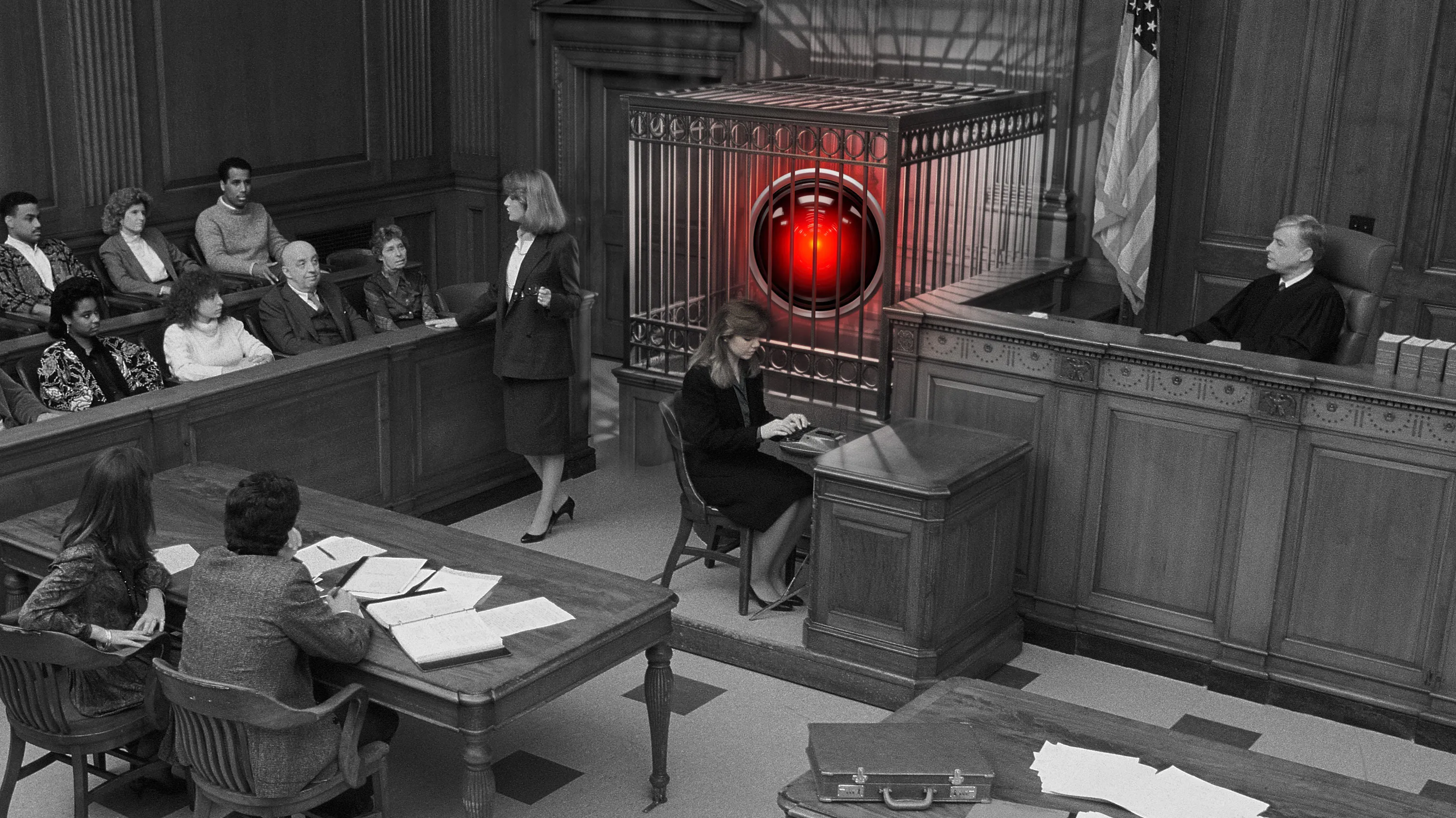
| Most existing laws weren’t written with AI in mind. But Silicon Valley is bracing itself for a wave of legal action over AI hacks. |
 |
|
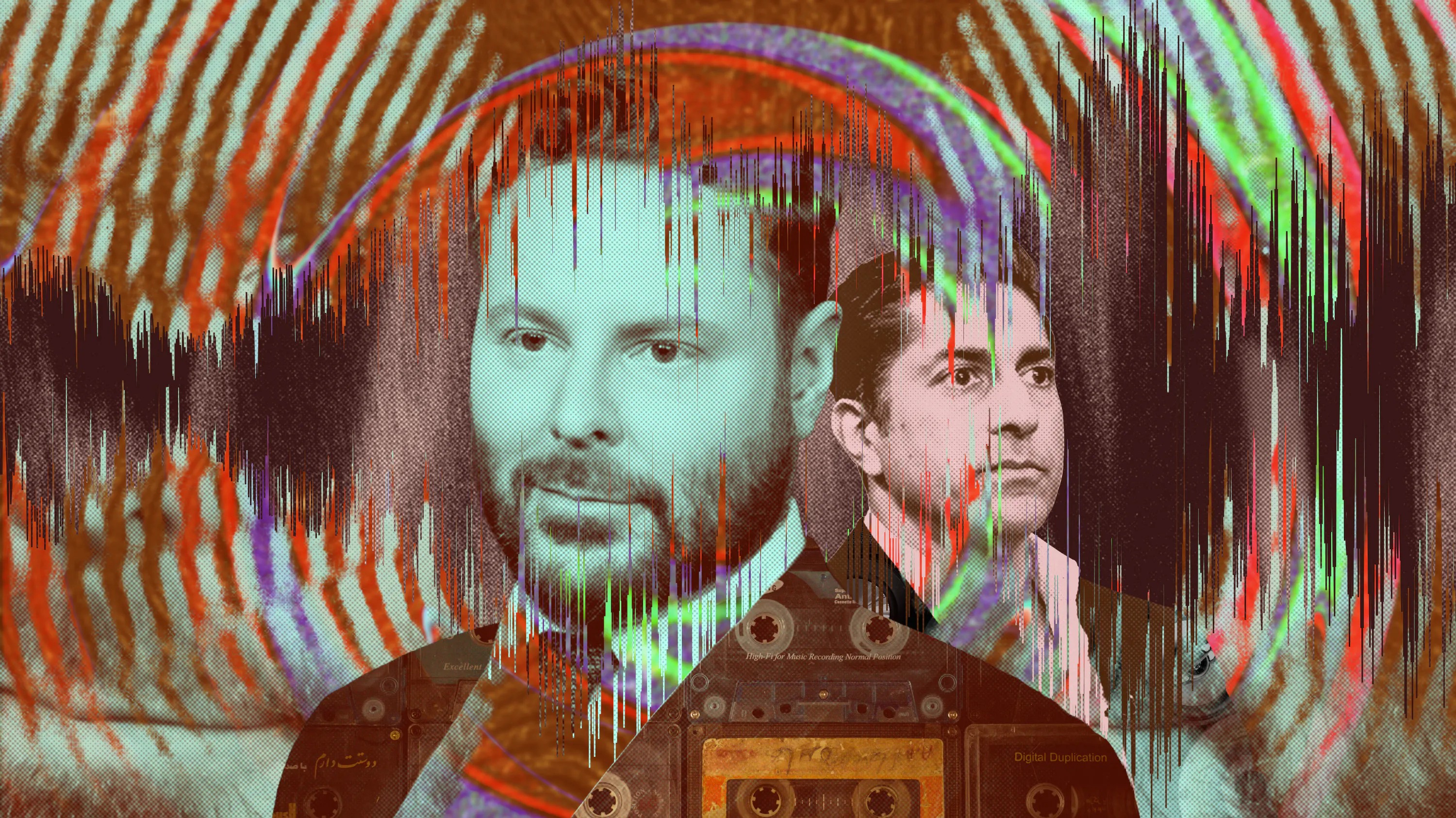
| Two years ago, a Sean Parker–led investing group took command of Stability AI, a onetime darling of AI images. With the backing of the major record labels, Stability now hopes to convince musicians to fully embrace a technology that has unnerved parts of entertainment. |
| |
 |
| Listening: “The Permanent Questions” |
| The philosophizing of David Brooks, the longtime center-right pundit, is something like a box of Junior Mints: a not unpleasant, old-timey flavor that has definitely fallen out of favor these days. But when most new podcasts have all the substance of, say, a stale pouch of Big League Chew, Brooks’ “The Permanent Questions” is an inviting alternative. |
| Brooks spent several decades opining on society, culture, faith and politics as a New York Times op-ed columnist—he departed last January. “The Permanent Questions” is his debut at his new full-time home, The Atlantic. With the series, he puts aside his interest in Washington’s hurly-burly and trains his attention on longer-standing, more existential matters, like what constitutes a good life, humanity’s place in the cosmos and the meaning of transcendentalist mysticism. |
| Those topics might seem too weighty for amiable chitchat, but Brooks does a pleasant job of unpacking them with his guests, who’ve so far included University of Notre Dame philosopher Meghan Sullivan and Pulitzer Prize–winning author Ayad Akhtar. Their chats are far-reaching—one got me to finally realize what has been bothering me so much about a friendship that has gone cold. And as they go, they bring up any number of other thinkers and wellsprings of inspiration. Plato and Aristotle get mentioned a lot. So does C.S. Lewis. I enjoyed how one conversation even wound its way around to A Tribe Called Quest, the formative 1990s hip-hop group. In other words: Can Brooks and his company kick it? With a touch of arthritis, yes, they can.—Abram Brown |
| |
| Reading: “This Cursed Beautiful Land” by Evan Gershkovich |
| In 2017, Evan Gershkovich, the American-born son of Russian immigrants, was a peon at The New York Times: a news assistant, a clerk-type job that provided very little opportunity to do any actual reporting. “I was a bystander to the real business of newsgathering,” he recalls in “This Cursed Beautiful Land.” “I watched as world-altering events splashed over the front page, one after the other.” Gershkovich wanted to get closer to the action. Gosh, did he ever. |
| After upending his life and moving to Moscow, he worked first at The Moscow Times and later at The Wall Street Journal. By 2023, his reporting had drawn the attention of the FSB—the successor to the Soviet KGB—and in an incident that made global headlines at the time, Gershkovich was arrested and imprisoned, accused of spying for America. (He wasn’t, he says—and acknowledges that he would’ve made a terrible spook.) More than a year later, Gershkovich was released in a prisoner swap between America and Russia. |
| “This Cursed Beautiful Land,” a reference to the Russia he discovered as a reporter and the one he came to understand from within a “tiny concrete box” at Lefortovo prison, is Gershkovich’s attempt to wrap his mind around everything that happened to him and the brutal horror of his family’s homeland. It is part espionage thriller—masked agents grabbed him at a steakhouse, threw a hood over his head, then subjected him to days of interrogation broken up by soft rock music—and part jailhouse memoir. At Lefortovo, Gershkovich struck up a friendship with his cellmate, Sergei, who helped him learn the ropes: Always wipe your shoes before entering a cell, turn on the tap before using the toilet, never offer to shake hands. As Gershkovich adjusts, a Russian idiom, which roughly translates as “You’re not Russian if you haven’t sat in prison,” begins to carry more weight in his mind.—A.B. |
| Watching: “East of Eden” |
| Netflix hasn’t shown much interest lately in the prestige-iest end of television, contenting itself instead with what its executives internally have referred to as “gourmet cheeseburgers”—shows like “The Diplomat,” “Wednesday” and “The Night Agent.” Perhaps “East of Eden,” a new adaptation of John Steinbeck’s 1952 lengthy meditation on evil and good, is a signal that it is changing direction—or that it certainly can change direction: The series, a visually lush and superbly acted affair, is a masterful adaptation. |
| Over seven episodes, Netflix’s “East of Eden” goes full, glorious sprawl with Steinbeck’s saga, treating it with deft felicity. Like the novel, the series spans more than a half-century, beginning with a bloodied, battered Cathy (Florence Pugh) crawling onto the farmhouse porch belonging to the Trask brothers, Adam (Christopher Abbott) and Charles (Mike Faist), in late-19th-century Connecticut. Flashbacks follow to the siblings’ troubled, violent relationship with their father (Tracy Letts) and Cathy’s past, which, by comparison, makes the Trask boys’ upbringing look like a cheery NBC sitcom. Tenderhearted Adam falls in love with Cathy, and they set out for California; Charles stays behind, a misery. Still, the Golden State is not quite the promised land Adam envisioned, especially after Cathy abandons him, leaving Adam to raise their infant sons, Cal and Aron. The greatest performance might belong to Korean American actor Hoon Lee, who appears as Lee, a servant hired by Adam who becomes his children’s chief caregiver. That makes him an emotional ballast for a tale full of family melodrama and several generations of neglect—enough woe, of course, to make it seem like a higher power has cursed the various Trask siblings to resemble the Biblical characters of Cain and Abel. |
| The most significant update to Steinbeck’s story is showrunner Zoe Kazan’s treatment of Cathy, who becomes a bordello madam: Steinbeck depicted her as a monster. Kazan seeks greater nuance without ever falling into the trap of trying to make her oversympathetic. Kazan herself faces a formidable family legacy. She is the granddaughter of filmmaker Elia Kazan, who also tried his hand at adapting “East of Eden” in 1955, a ham-fisted version that narrowed its focus to the novel’s final chapters. Zoe’s success with “East of Eden”—so much for family curses, eh?—should raise expectations among the Packy McCormick set for her next Netflix project: an adaptation of another epic, Larry McMurtry’s “Lonesome Dove.”—A.B. |
|
|
|
|
| |




 Gift Subscription