
|


 |
Friends,
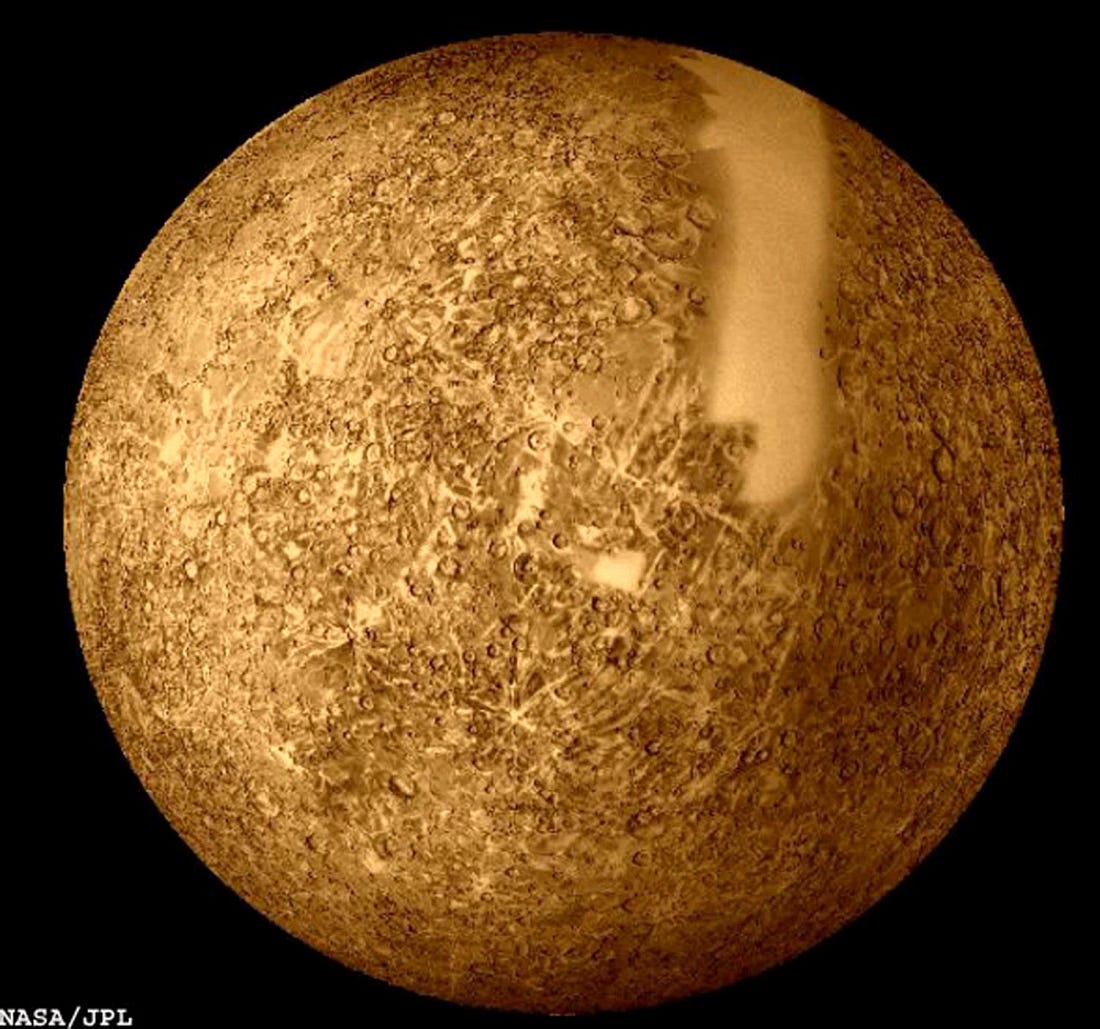
I’ve always felt a certain affinity for Mercury. Maybe that’s because Mercury is by far the smallest planet in our solar system — about 1/29th the width of Jupiter and just one-third the width of Earth — and I’m not a giant myself.
Mercury is becoming even smaller — it’s actually shrinking.
Apparently, when Mercury formed about 4.5 billion years ago in the primordial collisions of the early solar system, it was much hotter than it is now. Over many millennia since then, its metallic core has cooled and contracted, causing the planet’s surface to warp and wrinkle.
You know who else is warping and wrinkling, and shrinking?
Previous estimates suggested that Mercury had shrunk by just a few miles since its formation. Now, scientists say it’s shrinking up to 30 percent faster than expected. It might have even shrunk by as much as 14.5 miles, which is nearly 1 percent of its current radius of 1,516 miles.
This new estimate, published recently in the journal Geophysical Research Letters, gives astronomers a new understanding of how the planet — and others like it — formed and evolved.
And what’s in store for them. It’s not great news.
“Many bodies are shrinking nowadays,” said Gaku Nishiyama, a planetary scientist at the German Aerospace Center Institute of Space Research, who led the study.
Tell me about it. Humans start a slow, gradual loss of height during their 30s. Then they lose a half inch every 10 years. Between 30 and 70, they lose an inch or two.
That may not sound like much, but if you’re 4 feet 11 inches at your zenith, the loss of an inch or two is not welcome. Then, after age 80, the typical human who survives loses another inch. At this rate I may disappear entirely.
Dr. Nishiyama says Mercury’s estimated shrinkage is difficult to measure because researchers have to rely on topographies visible on the surface of the planet. “Inside, things may be getting much worse, much faster,” she said.
I know about that, too.
All heavenly bodies are shrinking, as are human bodies. With humans, it’s partly due to compressed spinal discs — as the soft cushions between back bones dry out and flatten over time. And because of osteoporosis, that can cause tiny cracks in spinal bones.
“Every planet is an odd little duck that has a story to tell,” says Dr. Sam Birch, a planetary geoscientist at Brown University.
Well, Dr. Birch, every human is an odd little duck with its own story, too. Planets and people — we’re all part of the same cosmos, with slightly different combinations of hydrogen and helium, oxygen, nitrogen, carbon, and neon.
We’re all parts of the same mystery.
| ||||||||||

