




 |
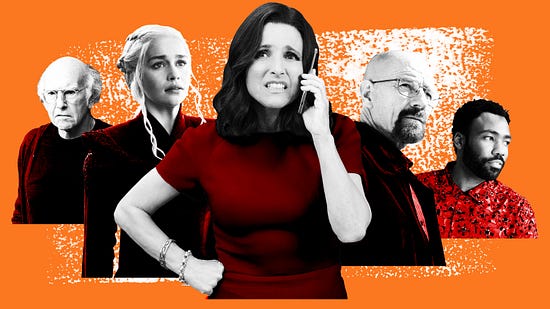
IF AN ALIEN CAME TO EARTH and took a gander at what we considered to be the highest of artistic achievement, as measured by the New York Times’s recent list of the 100 greatest television shows of the twentieth century, he’d likely throw his ship in reverse and hightail it out of here at Warp 10.
Just look at the top of the charts, as judged by the luminaries who voted in the Times poll. Atlanta, at number 10, is maybe the most upbeat of them, and it’s about a gangbanging drug-dealing rapper and his ne’er-do-well best friend. After that you have some hilarious misanthropy (Curb Your Enthusiasm and 30 Rock), incompetence personified (Veep), literally every vice under the sun with a bonus helping of fantasy vices (Game of Thrones), hilarious misanthropy with a side of priest-seduction (Fleabag), the worst people ever depicted on television (Succession), Don Draper (Mad Men), a show in which the most moral character is a gay hitman who winds up bleeding out on a convenience-store floor following his shooting death at the hands of a child (The Wire), and a feel-good comedy about a science teacher who takes a wayward student under his wing to start a small business to pay for his cancer treatments (Breaking Bad).
And the only reason the granddaddy of all these shows didn’t top this list—The Sopranos, indisputably the best TV show of all time; the show that made America stand up and cheer for murderous, woman-beating, thieving, whoring gangsters—is a quirk of timing: It debuted before the January 1, 2000 cutoff.¹
I’m not one to stand here in judgment: Each and every one of those shows, save maybe Fleabag, would potentially have found space on my ballot, had I been asked to draw one up. The alternates I’d have picked are, arguably, even darker. Deadwood is the greatest TV show ever made and it features a guy prone to delivering Shakespearean monologues while talking to the rotting head of an Indian chief.
We live in an age of antiheroes. And it’s worth considering how that has affected us.
As longtime readers and listeners of The Bulwark likely know, my boss and longtime friend, Sarah Longwell, believes that one of the downstream effects of this constant deluge of moral murkiness is . . . well, everything you read about and listen to on The Bulwark. She explains it thus in her bestselling book, How to Eat an Elephant: One Voter at a Time:
The moral clarity that comes with traditional good-versus-evil tropes, no matter how pat, has some social-psychological benefits. But twenty-five years of culture that said, “Let’s humanize this terrible person,” no matter how entertaining (and slightly truer to life), wore down the American antibodies to bad guys and instead taught us to say, “Sure, he’s a bad guy, but he gets results.”
I’ve never entirely agreed with Sarah on this (and I’d argue that two other genres, reality TV and professional wrestling, have had a much stronger deleterious effect, by propping up the image of Donald Trump as a business genius and birthing the idea of kayfabe into the world), but it’s hard to deny a fundamental truth: The abyss has been staring back for quite some time now, and it likes what it sees in us. That the creators of these shows, men like David Chase and David Simon and Vince Gilligan, so often have to sit down and reiterate that Tony Soprano and Omar Little and Walter White are, at heart, not heroes to be emulated, is the tell here. You can only watch the same debates over depiction and endorsement play out so many times before you wonder if intent even matters.
It does, of course; intent always matters. But audiences simply aren’t to be trusted, particularly with any screen-based medium that privileges the images projected, demands that attention be paid. As David Thomson put it while considering movies like The Silence of the Lambs, Hannibal, and Seven in his recent broadside against the film industry, A Sudden Flicker of Light, “this medium [film] has begun to diminish our nature . . . anything with pretensions to being an art or an entertainment has as much duty to serve our nature as photography was once treated as the imprint of reality.”
If art serves our nature, I fear what that Times list says about us. We have come a long way from Leo Tolstoy: “Art, together with speech, is a means of communication, and therefore also of progress—that is, of mankind’s movement towards perfection.”² Whatever progress we’ve spent the last quarter century slouching toward is undoubtedly represented in the degradation presented by these programs. Our nature is, undoubtedly, being served.
And we are shown to be lacking.
Digger Review
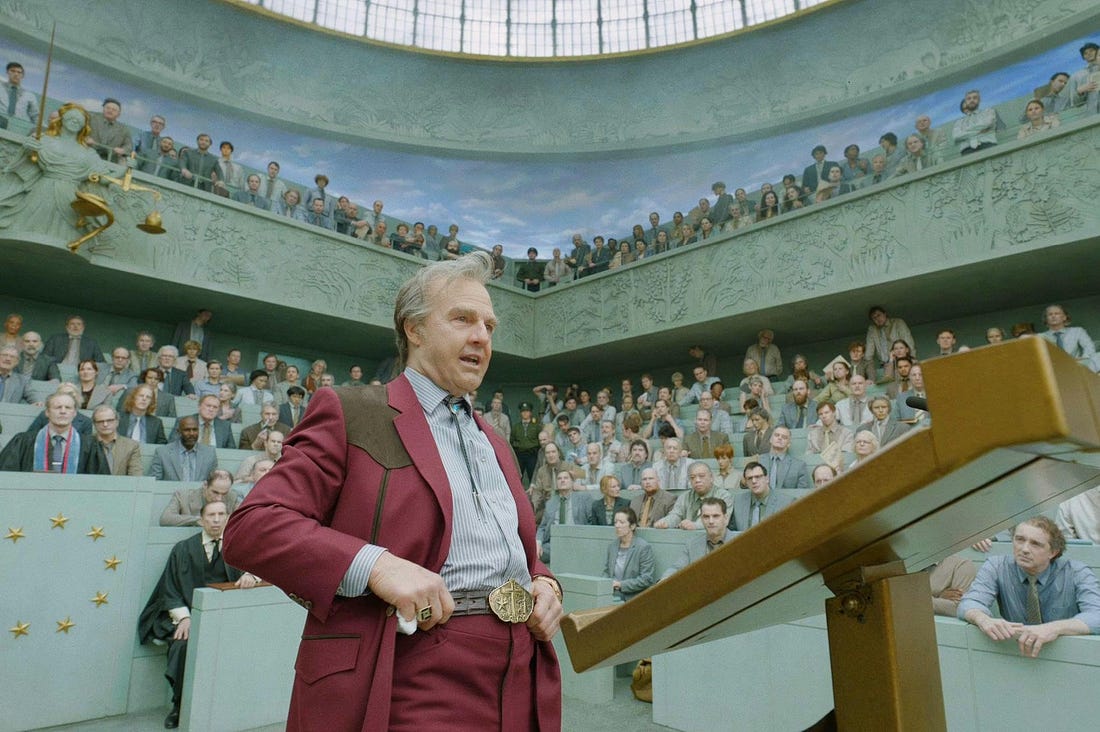 |
I DON’T THINK DIGGER IS GOOD, precisely, but I do think it’s pretty interesting. Frustratingly, the thing that makes it interesting is a thing I could not discuss for reasons related to spoilers. From my review:
Alejandro G. Iñárritu, who directed and co-wrote alongside (deep breath) Alexander Dinelaris, Nicolás Giacobone, and Sabina Berman, from a story by Iñárritu, Berman, and Jez Butterworth, is very perturbed by your lack of perturbation about climate change, you see, and so he has constructed this film and its wild structure to drive home just how serious the problem is and how future generations will laugh at our inability—nay, our refusal—to solve it. Imagine Don’t Look Up if Adam McKay and David Sirota decided that they needed to be even more literal in their messaging and slapped on a patina of pretentiousness, and you have some idea of Digger’s modus operandi.
And yet . . . the movie almost works based solely on the power and charisma and boundless energy of Cruise. For a movie about the need to embrace renewable energy, there’s some grim pleasure to be taken from the fact that Cruise himself is a self-charging dynamo. Don’t get me wrong: The whole cast is game. John Goodman plays President Compson with a sort of leering, messianic menace. And it’s always nice to see Michael Stuhlbarg show up; he has a genuine laugh-out-loud moment in a sequence in the Situation Room when we see his character, Compson’s vice president, react to the horrifying floods washing through Europe’s streets.
In keeping with the theme of the week, I may write a follow-up, after folks have a chance to see it, about what this film has to say about the utility—and uselessness—of art in the face of disaster. But that will have to wait until a few of you have had a chance to see the movie, I think.
Paramount’s Purchase, Federal Subsidies, and More!
Gotta love talking to Sean McNulty of The Ankler about the week’s news in Hollywood. We had a fun chat, as always, and got into what the future holds for Paramount and Warner Bros., what the odds of a federal film credit actually passing this year look like, and why sports rights are an underrated problem for the streaming services. Give it a listen!