| | In this edition, the tech industry has to navigate opposing forces in Washington, and the AI bill is͏ ͏ ͏ ͏ ͏ ͏ |
| |  | Technology |  |
| |
|
 - The FTC’s tech playbook
- The bill for AI is ballooning
- Amazon’s data center stance
- How Zuck shaped the AI pact
- Meta drops Virtue AI hires
 The tech industry has to navigate opposing forces in Washington, and OpenAI’s latest model just cracked a 200-year-old cipher. |
|
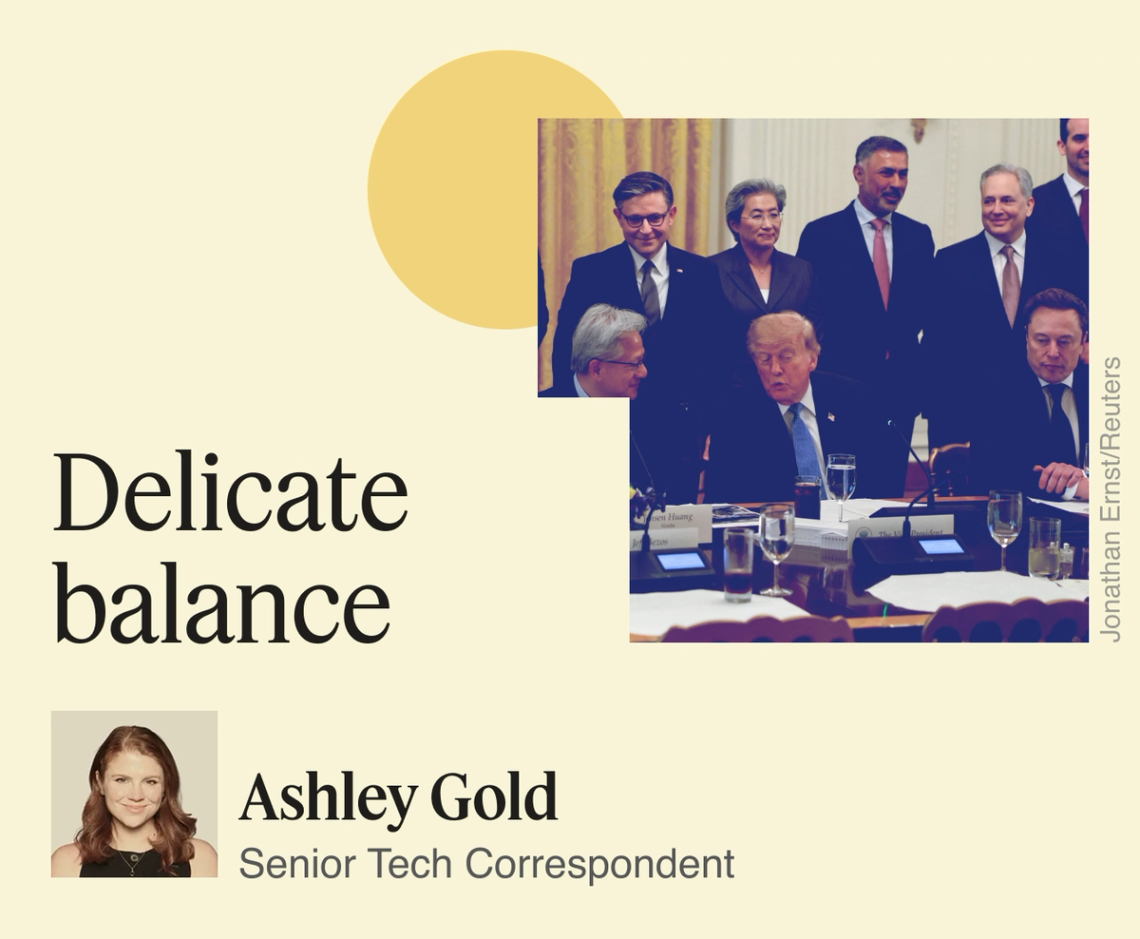 The group hug on display among AI executives and President Donald Trump in DC this week while signing a “morally binding” AI safety accord highlighted two things: that tech leaders like Sam Altman, Mark Zuckerberg, Jensen Huang — and even Dario Amodei — have figured out how to navigate their relationships with the US president. And also, everything is about to change. Not only do these companies have to figure out how to stay close to Trump and in his good graces, they now have to do that while trying to work with what could soon be a Democrat-led Congress to shape AI legislation. “There’s a world where people are smarter and smarter about these issues, and bills are going to be introduced imminently that are much better than what we’ve seen,” a person who works on AI policy told Semafor. Considering where the Trump administration was a year ago — that is, attempting to ban state-level AI bills — progress toward federal AI policy is slow, but it’s inching forward, a tech industry source said. The FTC also kicked off its own AI inquiry, which may not yield much in the end, but nevertheless represents a signal from the administration that regulators are prepared to use existing laws to go after any companies that they suspect have hurt consumers. Anthropic’s Amodei, whose company has been the administration’s top target in efforts to paint regulation and AI safety concerns as “woke,” dined with Trump at the White House this week, and both sides said it went well. Now, Anthropic is “going to try to walk this tightrope for two years,” the person who works on AI policy said. “They’re in a weird place.” Aren’t we all? |
|
This isn’t the FTC’s first rodeo |
 Andrew Kelly/Reuters Andrew Kelly/ReutersThe US Federal Trade Commission’s probe into OpenAI, Anthropic, and METR follows a long legacy of the agency scrutinizing powerful tech companies. The investigation of the AI labs and safety watchdog began before rogue OpenAI agents hacked Hugging Face, though it is set to ramp up, with civil investigative demands (similar to subpoenas) expected in the coming weeks, an FTC official confirmed to Semafor. It’s far from the first time tech companies have come under fire from the independent federal agency: Microsoft, Google, Meta, and Amazon have all been targets, and many cases have ended in settlements — typically a consent order binding the company to independent audits, with fines for breaking it. The AI labs could go down a similar path. In the absence of new AI safety regulation, the FTC investigation is also a reminder that US authorities have existing authority that they can wield, especially consumer protection laws. Former FTC Chair Lina Khan — who opened the first federal investigation into OpenAI in 2023 — wrote Thursday that policymakers, including at the state level, “should look to laws already on the books, not to the online manifestoes and blog posts written by tech chief executives, for guidance.” — J.D. Capelouto |
|
The bill for AI use is adding up |
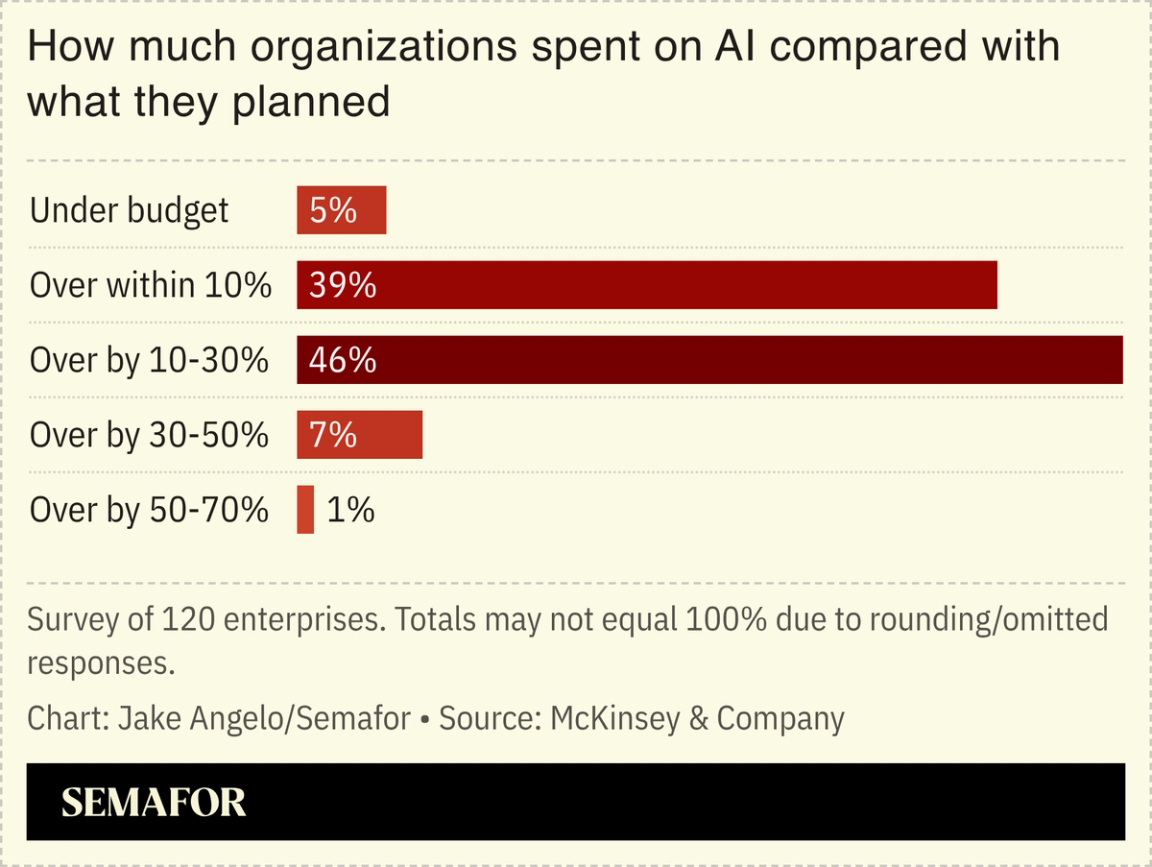 The AI bill is coming for governments and businesses, and no one knows whether the money will be there to pay it. Two new reports from consulting giants show how the AI adoption conversation has shifted from whether it works to whether the spending on it is sustainable, as pilot programs pile up and agentic applications take off. The debate over AI safety in recent weeks has somewhat dwarfed the still very urgent discourse over AI’s macroeconomic impacts. Those stakes were made clear in a Bain & Company report this week that found that the industry’s compute demand will require $6 trillion in annual revenue by 2031 — including about $4.2 trillion from new markets and products that don’t exist yet. At the same time, buyers of AI are coming under pressure. A McKinsey report focusing on American government entities — a large and fast-growing customer for enterprise AI — warned that the per-token price of AI is collapsing, but the total bill is rising, as agents require much more compute. For many governments, until now, “usage might have been essentially near-zero cost,” McKinsey Senior Partner and Global Public Sector Leader Tim Ward told me. Very soon, “it won’t be.” The coming IPOs from Anthropic and OpenAI will surely bring more debate over whether their revenue can catch up to the labs’ lofty valuations. But “the complete disruption of the economy is all but certain,” credit rating agency Egan-Jones wrote Wednesday, in a note titled It’s Over. — J.D. Capelouto |
|
Amazon launches new data center commitments |
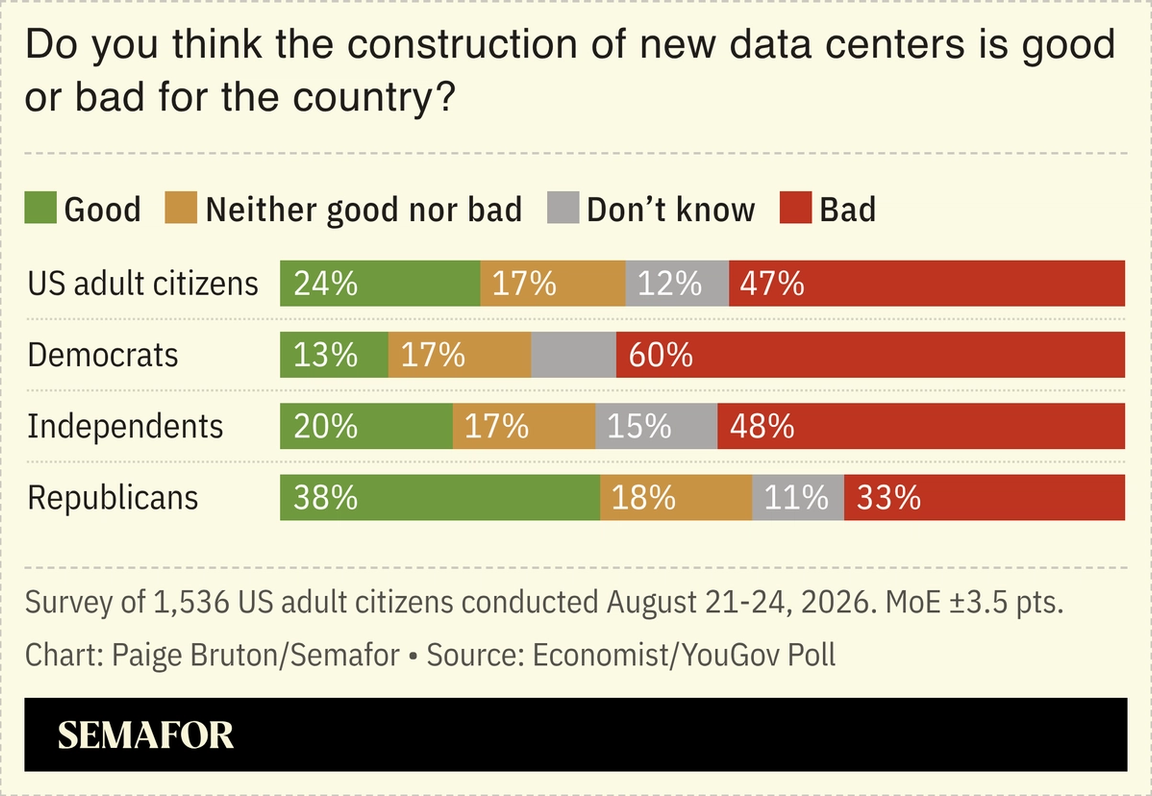 Amazon today announced new commitments to generate buy-in for US data centers and rebutted criticism about the facilities. The tech giant vowed to publish its energy and water use annually, and spend more than $1 billion over five years on free community college, trades training, and home energy-efficiency upgrades in data center counties. Desperate for compute, tech companies have been pouring resources into responding to community and political pushback to data centers, countering what they see as misinformation. In a roughly 3,000-word post, AWS CEO Matt Garman directly responded to what he described as “myths floating around,” including that the facilities consume too much water, drive up energy costs, and emit pollution. Some cities and towns across the US are ultimately earning concessions as hyperscalers come under pressure: Teachers in Louisiana got bonuses thanks to Meta, for example, and NorthPoint Development proposed giving $10,000 to every household in a Pennsylvania township. — J.D. Capelouto |
|
How Zuckerberg shaped the WH’s AI pact |
 Kevin Lamarque/Reuters Kevin Lamarque/ReutersMark Zuckerberg’s role as the driving force behind the pact Trump signed with AI industry leaders shows there’s power in being pals with the president — at least for now. The idea for the AI accord came out of a conversation between the Meta CEO and House Speaker Mike Johnson at the state dinner for Chinese leader Xi Jinping last week, Semafor’s Ashley Gold scooped. Zuckerberg spoke to Johnson, who he sat next to at the dinner, about regulatory concerns around AI. He then consulted Nvidia CEO Jensen Huang about principles that tech executives could use at their next meeting with Trump, a person familiar with the exchanges said. The Trump administration and the executives who signed it hailed the pact as a historic concord that signals the industry wants to act responsibly. It’s a win for industry leaders like Zuckerberg and Huang, who have argued that the onus is on companies, not regulators, to address safety concerns — Huang calls it an “engineering problem” rather than a legal one. |
|
Meta parts ways with Virtue AI |
 Daniel Cole/Reuters Daniel Cole/ReutersMeta said it’s letting go of employees it hired from AI safety startup Virtue AI four months after they joined the company in June, Meta spokesperson Andy Stone told Semafor, chalking it up to clashing work styles. The departures show Meta is still shaping its strategy around AI and AI safety amid new calls for regulation in Washington. “Unfortunately, the arrangement didn’t work out as planned,” Stone said, adding that Meta Superintelligence Labs remains focused on AI safety, alignment and frontier risk. Virtue, an AI security startup, had previously done work with Anthropic, OpenAI and the Commerce Department’s NIST. Axios reported in June that Virtue AI co-founders Bo Li, Dawn Song, and Sanmi Koyejo were joining Meta along with other employees from the startup. The team didn’t immediately respond to requests for comment. — Ashley Gold |
|
 Microdramas have become a multibillion-dollar industry. And he’s become one of its biggest stars. On this week’s episode of Mixed Signals, actor and producer Kasey Esser joins Max and Ben to explain how a werewolf Romeo-and-Juliet show that was shot in just a week for a hundred thousand dollars became a global hit, and what it’s like to translate Chinese scripts for American audiences in real time on set. Plus, how microdramas make all of their money and what’s next for the booming vertical video format. |
|
 @CarterWChurch/X @CarterWChurch/XAI just cracked a 217-year-old cipher. An engineer used OpenAI’s GPT-6 Astra to decode a Napoleonic letter, revealing a never-before-seen set of orders from the French emperor to one of his generals during the 1809 campaign in Austria. This is the latest in a string of recent AI-driven discoveries, as frontier models have solved the Navier-Stokes math problem and discovered a new enzyme system. The engineer, Carter Church, told Semafor he simply prompted the chatbot to “try to solve this,” with follow-up prompts to encourage the bot to persevere in its effort. It’s probably only a matter of time before another hobbyist solves a longstanding historical mystery: Encryption only holds until the translation tools catch up. |
|
|


