
|
 |
Republican Disarray And The Second Failure Of McCarthyism
The missing ingredient, for now, is consequences.
|

| |||||||||||||||


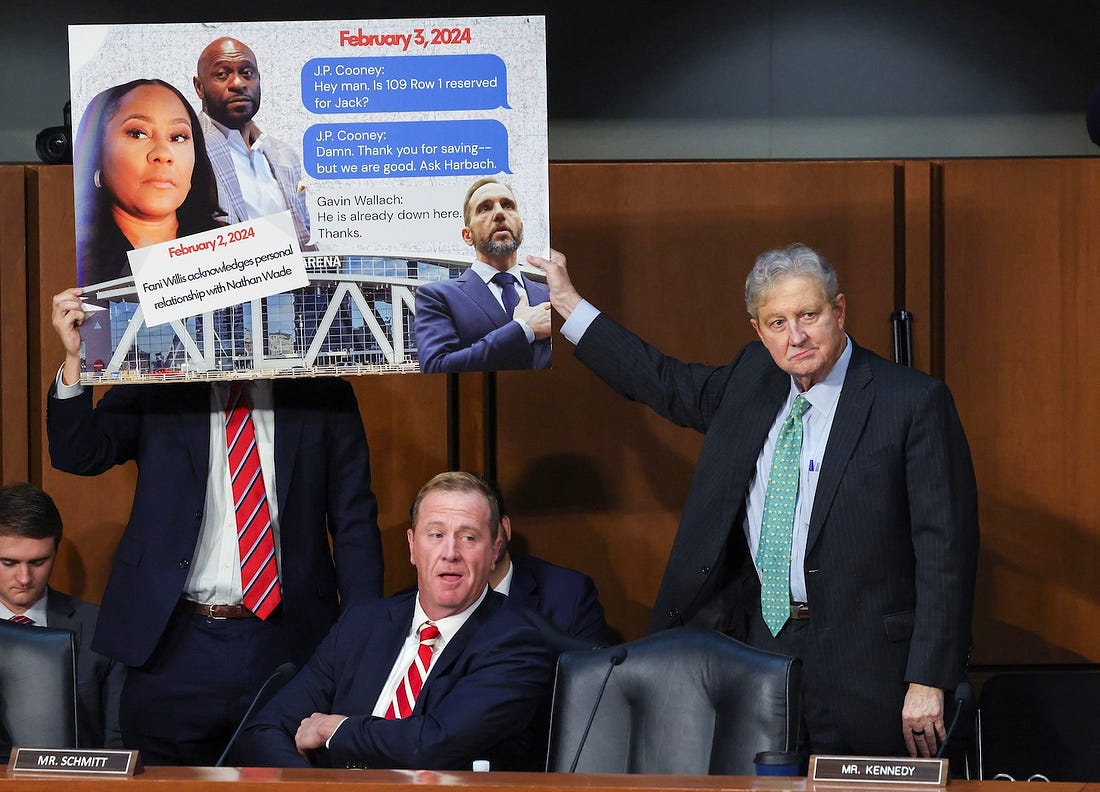 |
Being off the daily news cycle has its perks. But occasionally something happens like Senator D̶e̶r̶p̶ ̶M̶c̶C̶a̶r̶t̶h̶y̶ Eric Schmitt speed-running the arc of the second Red Scare over the course of about seven minutes, and it feels like you missed out on a fun party¹.
The only thing that could’ve made that fiasco more satisfying is if Jack Smith, the former special counsel sitting as witness, had driven home the similarities by asking Schmitt “have you no decency?”
Or, I don’t know, “dignity” might have been a more apt word.
All modern parallels to the McCarthy era are strained by the fact that, in our timeline, the leading right-wing demagogue didn’t gain control of one measly Senate committee. He controls the entire federal government. Eric Schmitt is not today’s McCarthy, Donald Trump is. Trump is president, not senator. And his following within the GOP is total, not fringe.
The modern right is in many ways a product of the belief that Joseph McCarthy and Richard Nixon and their acolytes got raw deals; that they should have persisted, and surely could have, were they not failed by a lack of sufficient will on the part of people who should have closed ranks. People like Ralph Flanders in 1954, and Barry Goldwater in 1974.
That’s why so many of them are Trumpites—they think they’re succeeding where their forerunners failed. They might be on the cusp of a hard lesson: As long as there are real elections in this country, voters have a say.
The humiliation of Eric Schmitt got me thinking about the end of the second Red Scare in a different way. About how this modern army of McCarthys is behaving a bit like how Joseph McCarthy and his collaborators behaved in the brief period between when his crusade collapsed and, censured by the Senate, he lost his formal power.
In brief, McCarthy was a shameless demagogue who ran a multiyear campaign of terror against the federal bureaucracy, particularly the Army and State Department, in order to purge it of people he deemed disloyal. It consisted of routine character assassination and what we today would call doxxing. He engaged in extortion and blackmail. He used doctored evidence and misdirection (though as far as I know, he never falsely accused anyone of attending an Atlanta Hawks game).
We’d also say he got high on his own supply. His impunity made him feel invincible. He became drunk with power (and booze). And, eventually, everyone just got tired of it. His efforts reached a crescendo in 1954 with the Army-McCarthy hearings, which put a huge national spotlight on his conduct. People were not impressed. Joseph Welch famously burst the bubble—“at long last….” Public opinion turned against McCarthy, and within six months, he was a pariah, censured by a vote of 67-22.
In the speed-run version, like air coming out of a balloon, Schmitt began the day as a contender to run for vice president with JD Vance, and ended it a laughing stock.
But the way the analogy really operates in my head isn’t in the raw and fairly obvious comparison between McCarthyism and GOP conduct in the Trump era. It’s in how the people who enabled or “normalized” McCarthy (out of loyalty and fear) behaved when they sensed his grip had slipped.
A right-wing senator named Arthur Watkins helmed an inquiry into whether McCarthy should face punishment. Vulnerable incumbent Republicans stopped accepting McCarthy’s support. McCarthy’s big dollar funders abandoned him. Republicans lost control of the Senate. Naturally, they waited until the lame duck period before taking any meaningful action. But when they did, half of McCarthy’s Republican colleagues voted to censure him.
You can see in this history how today’s Republicans believe the key is to never break ranks, and always push forward. Mercenary Republicans test every square inch of the body politic for weakness and then pummel vulnerable points with a battering ram. This is not a subtle or careful approach. It leads to things like the Schmitt meltdown. But it’s allowed them to seize immense power.
Trump is almost as unpopular right now as he was after the 2021 insurrection. But big-dollar right-wing money isn’t drying up. Hilariously, the Republicans running the Trump Justice Department are weighing the pros and cons of absolving Richard Nixon, and condemning their DOJ predecessors for mounting a Watergate witch hunt.
But the ones who have to answer to voters are getting very uncomfortable. And so we are seeing a similar breakdown of enforced party discipline.
There’s no select committee to investigate the Trump family, but a Republican senator did insist Senate Republicans should investigate Donald Trump, Jr. for profiteering and accepting bribes. Republicans are stripping Trump’s name off their campaign websites. They’re trying their best not to be caught dead with him on the campaign trail. Some are acknowledging belatedly that Trump lost the 2020 election. They’re abruptly abandoning their support—in rhetoric, but not with their votes—for Trump’s war in Iran and his deportation regime. Including deep in their own territory.