
|
 |



Today, as Trump was busy trying (and failing) to convince his own people that “affordability” is a word made up by Democrats, the courts were having a field day with him.
First up was the dismissal of the charges against Davey Hearn, the Olympian Trump tried to scapegoat for the problems he himself created at the Reflecting Pool. D.C. Superior Court Judge Todd Edelman dismissed the indictment with prejudice, in a 26-page written order, as the defendant’s lawyers, Norm Eisen among them, requested. The Judge had the discretion to dismiss the charges without prejudice, which would have given the government an opportunity to refile its charges at a later date. But in clear censure of how loose and fast prosecutors played with the evidence in this case—they knew, for instance, that a contractor said the coating on the pool was peeling a week before Hearn’s visit—the Judge dismissed the case with prejudice. The government is done.
Judge Edelman wrote, “Given the process that led to the Indictment in this case, Mr. Hearn and the public cannot view the promise that a future grand jury would protect him against a meritless, politically driven prosecution at some point in the future as anything short of facetious.” He concluded, “in the exceptional circumstances posed by this case, the government has no right to retain the ability to compound the errors it has already made, or even to threaten to do so, at Mr. Hearn’s expense.” The White House had no comment. And truly, there was nothing for them to say in the face of the damning and forthright criticism the Judge had of their case:
“Within a month, the government recognized that its prosecution lacked merit. It reached this conclusion not because it had misidentified Mr. Hearn as the perpetrator of the alleged act, but because no crime had occurred: the observed damage to the Reflecting Pool was due to a contractor’s ‘rushed and botched’ installation of the lining while conducting renovations, and Mr. Hearn’s actions had no effect on the value of the Pool.”
Meanwhile, on the other side of the country in Seattle, a federal judge ruled in favor of Roger Rogoff, the U.S. Attorney appointed by the court pursuant to the Vacancy Reform Act when Trump failed to confirm a candidate within the time period he was permitted to keep an interim appointee in place. Instead of abiding by the law, the Trump administration’s response was to fire Rogoff as soon as the judges appointed him. Rogoff sued and got his hearing in court today. It did not go well for the administration.
The Judge booted the Trump appoint and denied the Justice Department’s request that he stay his order. If Trump wants the U.S. Attorney of his choice, then he needs to put forward a nominee and have him or her Senate confirmed. Until then, unless a higher court rules to the contrary, the local court has the ability to appoint an acting U.S. Attorney to serve.
Obama U.S. Attorney in the Western District of Washington, Jenny Durkan told me, “The ruling was an important win for the Constitution, and the power of Congress and the Courts. The Rule of Law is most important when the powerful try to disregard it.” Her Republican predecessor, John McKay, put it like this, “This decision is a thorough rebuke of President Trump and his blatant disregard of the Senate’s Constitutional role to advise and consent to appointments of US Attorneys.” Bipartisan agreement!
On appeal, the administration is likely to argue that Congress violated the separation of powers when it gave courts the ability to appoint. But there is a strong argument in the law’s favor: Without it, presidents could freely bypass the constitutional requirement that their appointees be confirmed by the Senate.
In Minneapolis, Renee Good’s family sued the government. Their lawyers issued the following statement: “Renee’s death was not an accident. It was the predictable result of a coordinated campaign by senior officials in this administration to target Minnesotans of Somali or Hispanic origin and silence anyone who dared to raise their voice in protest.”
There are two separate civil cases:
The first is a case against the United States under the Federal Tort Claims Act, and it alleges that federal agents were responsible for Good’s wrongful death, as well as committing battery, assault, false imprisonment, emotional distress, and acting with negligence.
The second, brought in part under a civil rights statute, specifically names Jonathon Ross, the ICE officer who shot and killed Good, as well as other federal officials who were serving at the time of her death, including White House deputy chief of staff Stephen Miller and former Homeland Security Secretary Kristi Noem, alleging her death was part of a conspiracy to deny undocumented people’s rights.
The Federal Tort Claims Act is a difficult statute to recover under, and the courts have narrowed its application over the years. The second lawsuit is what is commonly referred to as a “1983 action.” The statute in question, 42 U.S. Code § 1983 allows individuals to sue the government for deprivation of rights. If these cases make it to the discovery phase—the government will file immediate motions to dismiss for failure to state a legally recognizable claim—the information it would be forced to give up and the types of officials who would be exposed to depositions could make this a revelatory legal exercise and not a welcome one for Trump administration officials.
The federal judge hearing the Broadview 6 case in Chicago, April Perry, has opened a “fact finding” process to determine whether the U.S. attorney’s office intentionally misled her in that case. It’s an exceedingly unusual step, and it could result in contempt proceedings or other sanctions depending on what she determines, including the possibility of criminal contempt.
The case involves indictments brought by the U.S. Attorney in Chicago against six anti-ICE protestors in September 2025. But the case fell apart. First there were allegations it was a selective, politically motivated prosecution. Then the Trump-appointed U.S. Attorney, Andrew Boutros, was forced to dismiss the case when evidence of serious grand jury misconduct emerged. He appeared in court to ask for the dismissal with prejudice before telling the judge that what the defendants did, protesting, was “unacceptable in a civilized society.”
The Judge, a former federal prosecutor herself, cautioned Boutros at the time that he wasn’t helping himself out by making a statement like that about the defendants after conceding the case against them should be dismissed. She warned that there could be sanctions down the road. Today, she set that process in motion.
All in all, it was a tough day, and deservedly so, in court for the Trump administration. Yes, ultimately, some of these cases go to the Supreme Court, which has been Trump-friendly to say the least. But not every case reaches the Supreme Court and not every bit of accountability the lower courts create can be undone there. The Hearn case exposed Trump’s rants that domestic terrorists were responsible for the damage to the Reflecting Pool as lies. Nothing can undo the truth.
That’s a lot of cases to keep track of in just one day. But the unprecedented deluge is proof of just how off the rails the Trump presidency is. He has no regard for the Constitution, the rule of law, or for people who are not satisfying his goals and aims. Increasingly, Trump supporters, like Republicans in Congress who are out of their jobs because of him or businessmen who are being strangled by his tariffs, are being forced to acknowledge the truth. That’s why we’re seeing Trump’s support in the polls unravel.
Joe Biden said it best, speaking at a Maryland Democratic Party event tonight: “The reflecting pool reflects something even worse than the narcissism and incompetence at the core of this administration. It’s the corruption. The corruption. The brazen, blatant corruption.” The former president continued, “He has no shame. Frankly, it’s embarrassing for the country. Trump couldn’t care less. Making money off the presidency is one of the reasons he wants to be president.”
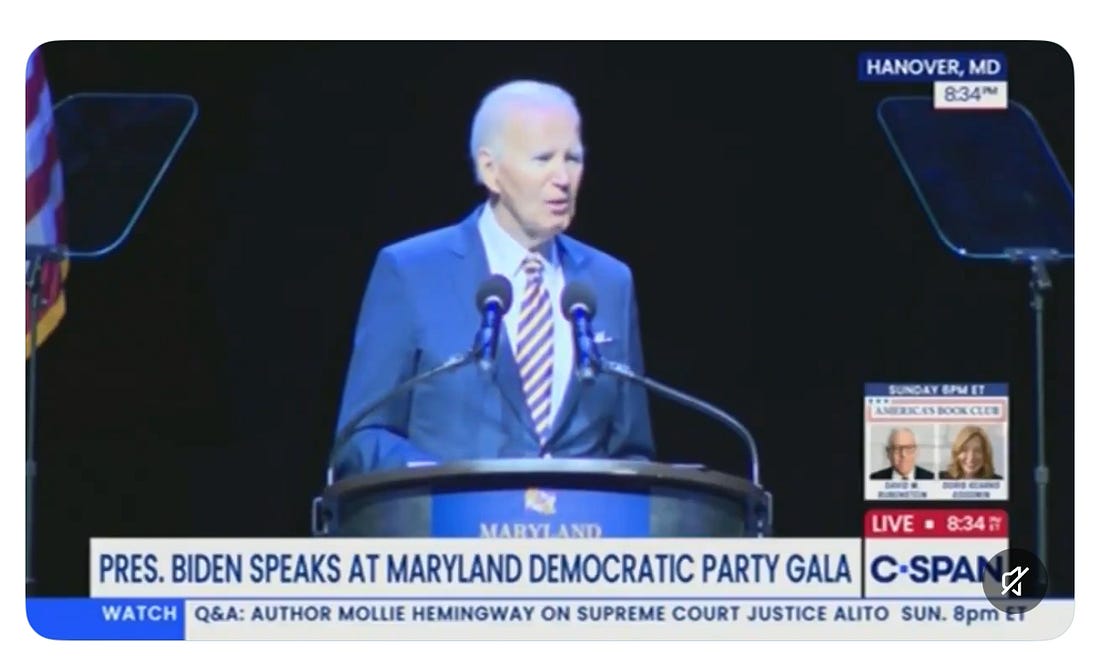 |
Even as he fights cancer, even after Trump’s personal attacks on him, Joe is not giving up. Neither can we, no matter how fast the news comes at us some days.
It is slow and painstaking, this work of following all of these developments carefully and sharing the truth about them. But the hard work is paying off, polls across the country say so. I hope that Civil Discourse makes you feel more capable of doing the hard work democracy is demanding of us right now. Thanks for being here with me.
We’re in this together,
Joyce