| | In today’s edition: Emirati prosecutors take on the flydubai cockpit stabbing, Israelis’ unplanned s͏ ͏ ͏ ͏ ͏ ͏ |
| |  | Gulf |  |
| |
|
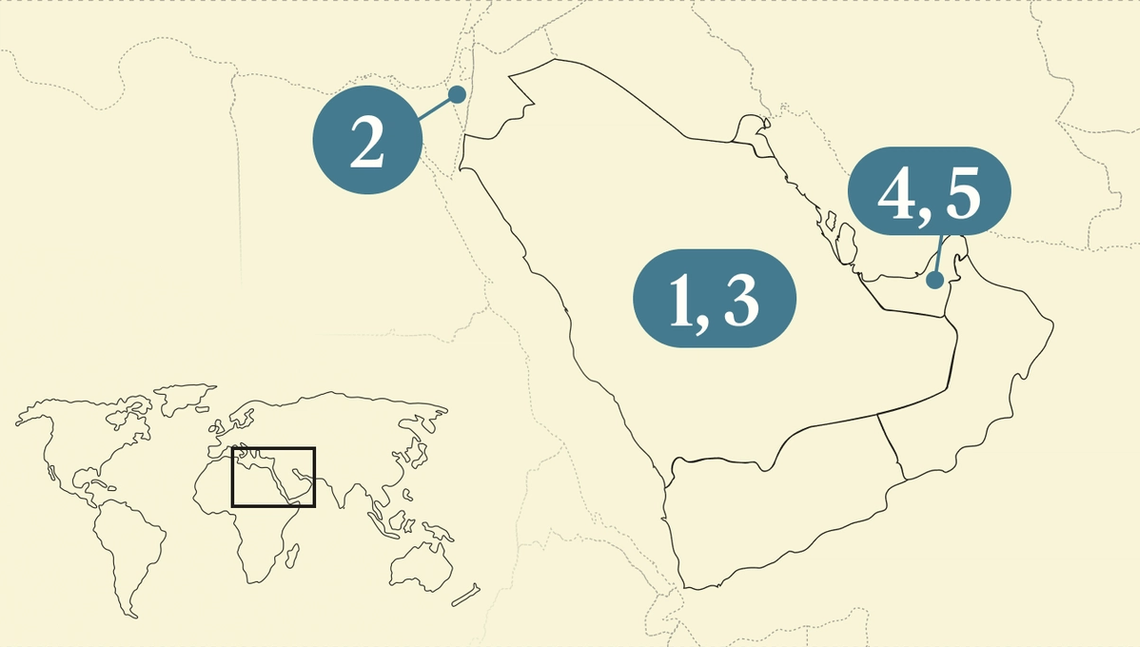 - Saudi extends deficits
- flydubai halts TLV flights…
- … after Israelis’ stopover
- AI a boon for oil
- AD Ports’ quantum ambition
 AlUla’s rocks inspire award-winning art in Paris. |
|
Saudi sees deeper deficits ahead |
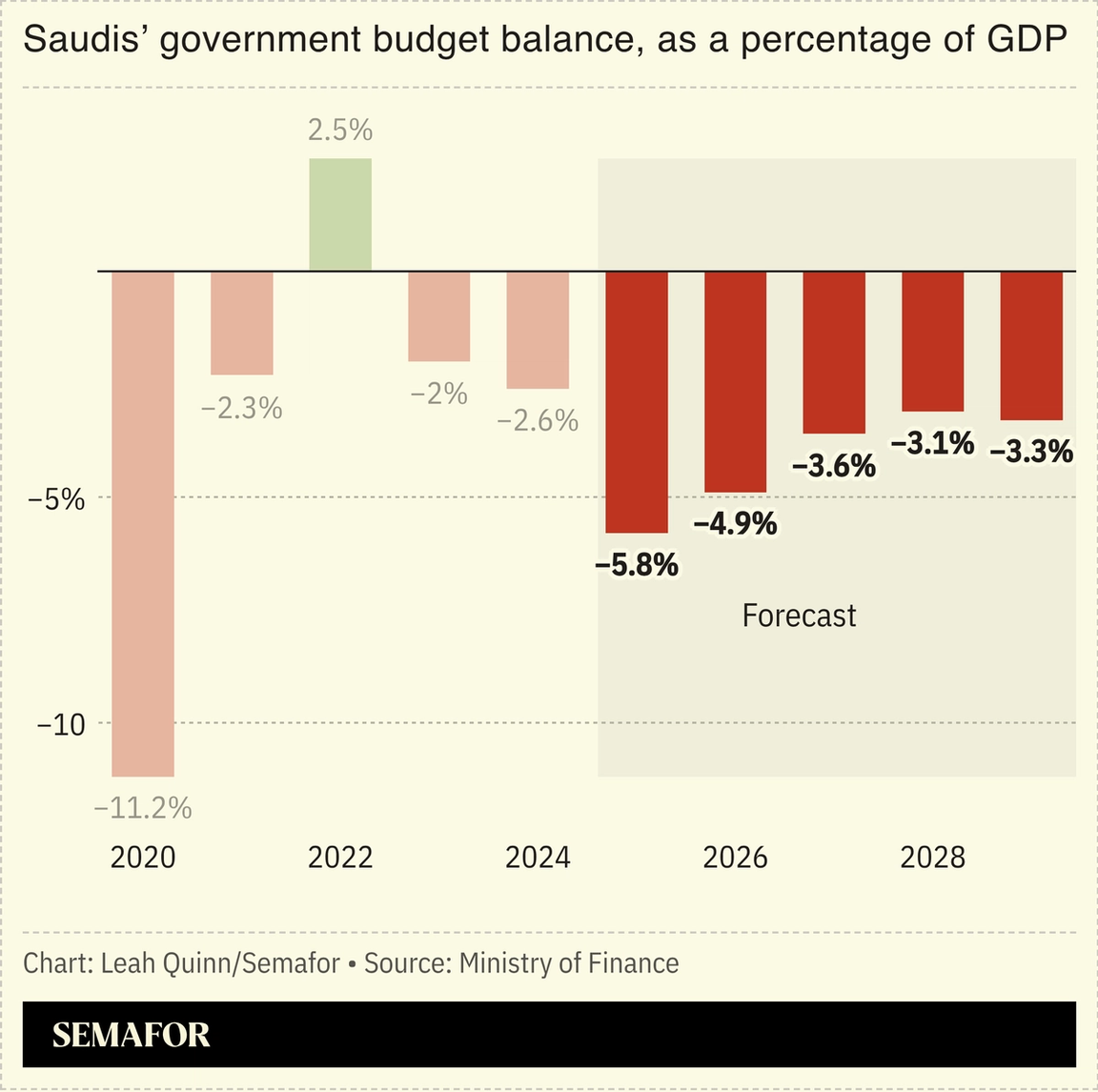 Saudi Arabia expects wider budget deficits for several years as it ramps up spending to support growth in the face of regional conflict. Higher oil prices have largely offset lower export volumes, lifting revenue above prewar estimates, but spending is set to rise faster. Next year’s preliminary budget shows the kingdom is willing to keep borrowing to bolster its defenses and build trade routes that bypass the Strait of Hormuz. That raises the prospect of government debt breaching its 40%-of-GDP ceiling before the decade is out if growth doesn’t pick up. The Finance Ministry now sees the government’s budget deficit at 4.9% of GDP this year, up from the 3.3% it predicted late last year. The economy is expected to shrink 3.6% this year as oil output falls sharply, but could rebound almost 13% in 2027 if oil flows are restored. The government says the non-oil economy and job creation drove growth in the first half of this year. Riyadh has brought oil exports close to prewar levels by piping crude to the Red Sea and sending tankers through Hormuz, despite Iranian threats. Still, the government has taken steps to cut back on non-essential spending. — Matthew Martin |
|
flydubai halts Israel flights |
 Israel Foreign Ministry/Ammar Awad/Reuters Israel Foreign Ministry/Ammar Awad/Reutersflydubai has suspended flights between Dubai and Tel Aviv after an attempted hijacking of an Israel-bound plane yesterday, leaving hundreds of Israelis stranded in the UAE. Emirati prosecutors opened an investigation after a co-pilot stabbed his captain mid-flight, asserting jurisdiction over a crime that also concerns Saudi Arabia and Israel. The motive remains unclear. The attack sent the Boeing 737 MAX into a nosedive that shed 15,000 feet in under a minute, ripping part of the rudder from its tail. Though badly hurt, Indian captain Smit Machchhar fought back and opened the cockpit door, letting passengers and crew overpower the attacker. Two spare pilots, aboard in case regional rerouting pushed the original crew past duty limits, took over and diverted the plane to Tabuk, Saudi Arabia. Saudi authorities detained the co-pilot and questioned passengers and crew for about seven hours before a replacement plane flew them to Tel Aviv. — Ed Clowes |
|
Israelis in Saudi spark normalization debate |
 Reuters ReutersWednesday’s emergency landing of a flydubai flight to Tel Aviv brought an unprecedented number of Israelis onto Saudi soil, stirring speculation that the crisis could create an opening for formal ties. Passengers said they received food and medical care at Tabuk airport. A widely shared video showed a woman in a niqab tending to passengers, challenging stereotypes that conservative Muslims are innately hostile to Jews. The averted disaster comes amid converging Saudi and Israeli interests, particularly in Yemen. Eurasia Group’s Firas Maksad said both countries want to see the Iran-backed Houthis “cut down to size,” and the incident adds to the normalization debate. The timing also suits Israeli Prime Minister Benjamin Netanyahu, who wants to show good Gulf relations ahead of elections, Maksad said. But other regional analysts warned against reading too much into the humanitarian gesture. Addressing Saudi Arabia’s consultative Shura Council in a scheduled annual speech — delivered while the Israelis were in the kingdom — Crown Prince Mohammed bin Salman condemned Israel’s treatment of Palestinians and reiterated Riyadh’s commitment to an independent Palestinian state. — Mohammed Sergie |
|
Abu Dhabi hones AI for energy pitch |
 Ahmed Jadallah/Reuters Ahmed Jadallah/ReutersThe Iran war has been a proving ground for ADNOC’s massive bet on artificial intelligence. AI firm AIQ, which counts the Abu Dhabi oil giant as its largest customer and shareholder, has gone from a nice-to-have before the conflict to a source of crucial real-time insight into drilling, production, and facilities management, AIQ CEO Dennis Jol told Semafor. Six months of war and AI fever have added urgency to the rollout of Genesis, an operating system AIQ is pitching to energy companies. It runs large-scale agentic AI across upstream and downstream operations without relying on any single AI model provider like Anthropic or OpenAI. AIQ is testing its tools in energy patches, including Kuwait, India, Malaysia, and Vietnam. A pilot in Egypt predicted a pump failure 45 days in advance, according to the firm’s chief technology officer. AIQ has made its first hire in the UK, is weighing other locations such as Houston, and has identified 100 potential acquisition targets as it seeks growth, Jol said. — Kelsey Warner
|
|
Quantum computing to optimize Gulf logistics |
 Courtesy of Quantinuum Courtesy of QuantinuumAbu Dhabi’s AD Ports Group plans to use quantum computing and AI tools to improve its transportation and logistics operations. The ports company is partnering with US-based Quantinuum and AI logistics firm Quincus in a multiyear research project to use the nascent computing technology to optimize shipping routes, fleet scheduling, and berth and terminal planning, according to Quantinuum’s spokesman. The agreement expands Quantinuum’s Gulf footprint: The company recently agreed to work with Saudi Aramco on quantum applications in the energy sector, and it formed a joint venture with Qatar’s Al Rabban Capital last year to build a quantum computing ecosystem, backed by a planned $1 billion investment by Qatar’s government over a decade. — Mohammed Sergie |
|
 The politics, policy, and business driving healthcare. Delivered weekly from David Lim, Semafor Healthcare will connect the dots between decisions in government, business, and technology to reveal how they impact the future of healthcare. Each edition will provide the analysis you need to understand and stay ahead of a rapidly changing landscape. Don’t miss the first edition — subscribe for free. |
|
 Checking In- Dubai’s hotel market has rebounded from the Iran war faster than expected, with the Middle East head of Canadian asset manager Brookfield saying investors are finding better opportunities there “than in other equivalent-risk areas globally.” Citywide occupancy reached 66% in August, up from 36% in March, but still well below 89% a year earlier. — AGBI
Energy- Saudi Arabia’s Arabian Drilling won a four-year contract worth about $533 million to supply four offshore rigs to Al-Khafji Joint Operations, the Saudi-Kuwaiti venture that pumps oil from the two countries’ shared field.
- Saudi Arabia has begun work on an oil pipeline to Oman’s port of Duqm, outside the Strait of Hormuz, TotalEnergies CEO Patrick Pouyanné told investors. The roughly 1,000-kilometer route is at the feasibility-study stage and could cost up to $7 billion, according to Rystad Energy, as Riyadh hunts for export routes beyond its East-West pipeline to the Red Sea. — AGBI
Sovereign Wealth |
|
AlUla’s rocks are now winning design awards: This palm-wood trio, made in the oasis’ artist residency, was among the winners at the Arab World Institute’s awards in Paris. AlUla has become the kingdom’s arts hub, with the Desert X land art biennial, the mirrored Maraya concert hall, and a growing roster of residencies.  Saudi Press Agency Saudi Press Agency
|
|
|


