|
This past Saturday Night Live, my queen Jane Wickline did a killer Dario Amodei impression. Stammering, she asked Michael Che, “If you could drink a milk that made your life easier, but there was a 10% chance it killed you, would you drink the milk?” That sums up how well the AI companies are communicating their message to the general public. We’re a country divided by two vastly different visions of the future. Palantir CTO Shyam Sankar told me over the summer that employees at a frontier AI lab have picked up smoking “because of course we’re going to have AGI and that’ll cure cancer, so I don’t have to worry,” he said with a laugh. But while AI employees may prophesize endless abundance, 70% of Americans are against data centers and only 26% of voters have any positive feelings about AI at all. Some are paying to curry favor, like one data center in Pennsylvania that’s offering $10,000 to every household in the nearby community if they allow the project to go through. Others are looking to use the power of a good party to change negative vibes. I’m Margaux MacColl, filling in for Julia Black. Read on for my piece about bringing an anti-data-center activist to the pro-data-center party. It didn’t go great.
Mentioned in this issue: Elon Musk, Palantir, OpenAI, Anthropic, Margot Robbie, Mark Zuckerberg, Hugging Face, Chris Olah and more… |
|
|
|
|
|
| |
ALAN SHINDELMAN | |
The Slow-Motion Car Crash at Data After Dark I brought an anti-data-center activist to the pro-data-center party. It didn’t go well. SEP 29, 2026 BY MARGAUX MACCOLL |
My weekend with the tech bros began at Pascal’s Rager, a house party in Washington, DC, cohosted by Micah Bock, who works at the Department of Homeland Security, and Madison Campbell, a flame-throwing, rage-baiting tech influencer with more than 62,000 followers on X. The conversations that night were off the record, but I can tell you there were 500 cigarettes, a tray of Zyns, and a guest list filled with Trump officials and bleach-blonde women in Chanel-esque jackets with impossibly short miniskirts. I can also tell you that MAGA-associated folks are using suspiciously Trumpian accents and slurs I swore were dead and gone. Next up, on Saturday night, I went to a pro-data-center party whose flyer had gone viral the prior week after one of the organizers, Pirate Wires writer Jonas Du, posted about it on X. “In light of the bipartisan psychosis over AI data centers,” the Partiful read, “it’s about time that the people who haven’t lost their minds get together and celebrate the glory of American compute.” It was catnip to MAGA-aligned, Andreessen Horowitz–backed edgelords. After all, wasn’t it silly that, all across the country, congressmen and governors who used to welcome data centers in their state are succumbing to the techno-phobic wokes? According to Data Center Watch, $64 billion of data center projects have already been blocked or delayed. And why? Sure, there’s the holy triptych of problems: 5,000-gallon fuel spills, brown sink water, skyrocketing electricity bills. But also, to hear the party organizers tell it, tech companies have failed to make people understand the benefits, like how one county in Virginia has raked in $1.1 billion in tax revenue from data centers alone. Despite mounting protests from residents, it’s now considered the “data center capital of the world.” One organizer, Casey Given, CEO of libertarian nonprofit Young Voices, said that he wanted to party to counter the “crazy apocalyptic” anti-AI folks, and “shift the Overton window in a more techno-optimist direction.” |
|
ALAN SHINDELMAN |
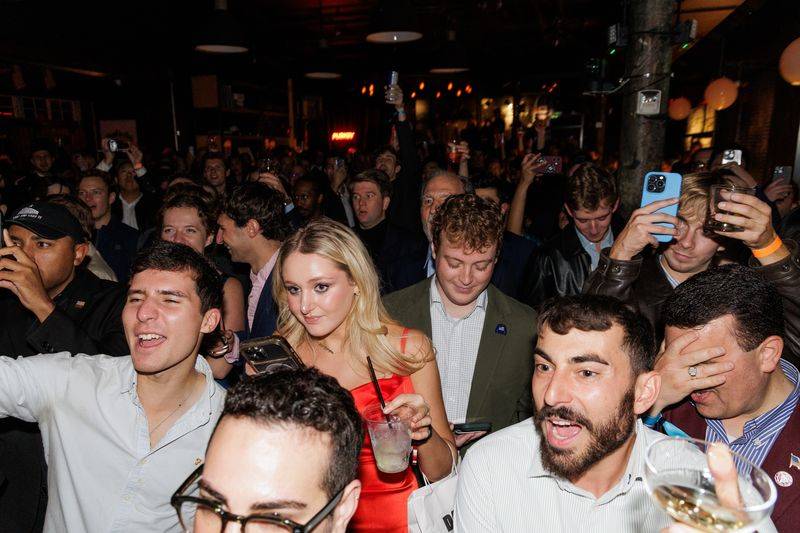
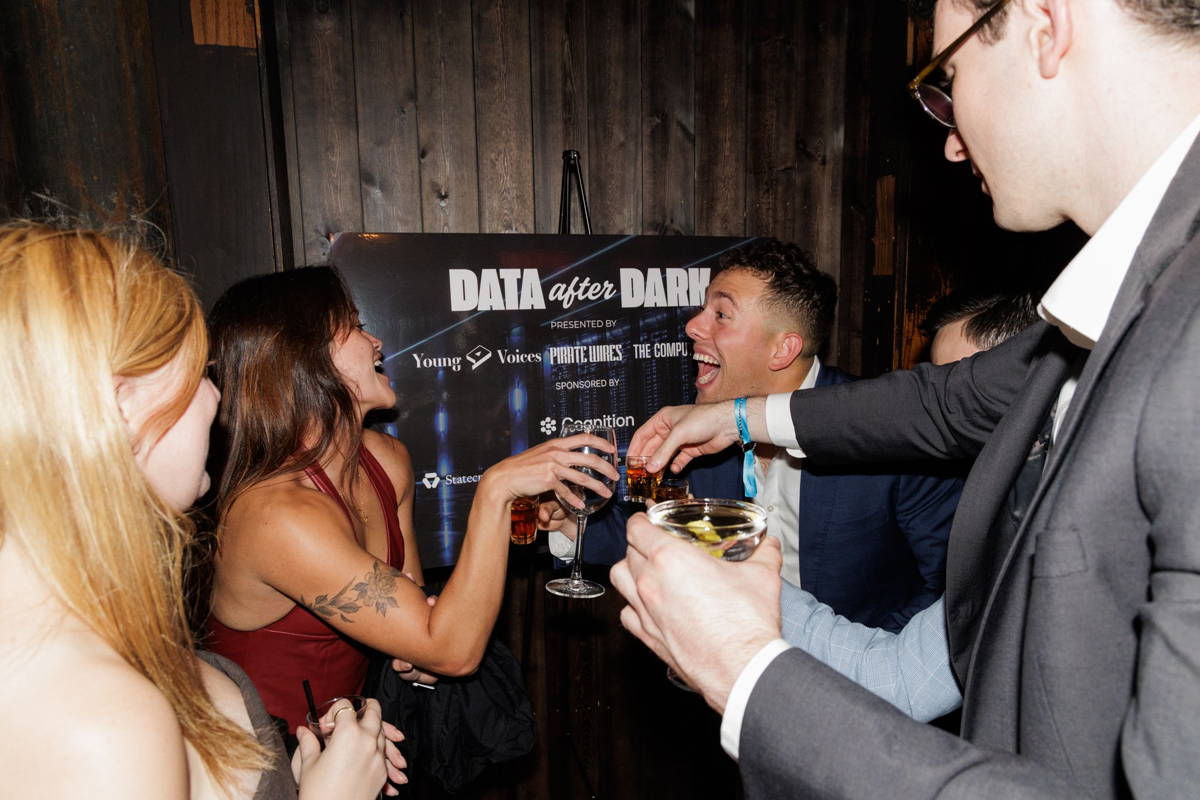
Enter Data After Dark, tech bros’ attempt at making data centers sexy. With the permission of the organizers, I invited Taylor Frazier McCollum, a newly inspired anti-data-center activist from Prince George’s County, Maryland, to be my date. Last year, when she found out that a hyperscale data center was going to be built one mile from her grandparents’ home, she started researching and learned of a community near Memphis that faced significant air pollution after Elon Musk’s xAI (now called SpaceXAI) built natural gas turbines to power its data center nearby. (Vanity Fair has reached out to SpaceXAI for comment.) She started a petition, which reached over 25,000 signatures, to fight data center construction in her own county and has since quit her job as a cosmetologist to spend more time organizing across the country. I meet up with Frazier McCollum at a bar, and she arrives wearing a T-shirt that reads, “If my mouth doesn’t say it, my face will.” When we enter PubKey, also known as the Bitcoin bar cofounded by crypto enthusiast Thomas Pacchia, we quickly realize that everyone is dressed much better than us, the men in crisp suits with baseball caps that say “Let Data Reign” and the women in slinky silk dresses and kitten heels. We walk past a DJ and a large screen playing an endless loop of Tony Stark, Ana de Armas as the platonic ideal of an AI girlfriend in Blade Runner 2049, and stylized shots of blinking servers. On the dance floor, it’s a ratio of six men to one woman. We duck into a side room—a macho “whiskey bar” with leather couches and a large American flag—and strike up a conversation with Neeraja Deshpande, a conservative writer who tells us she’s concerned by what she sees as the prevailing national sentiment that “growth and human flourishing are at odds with each other.” “It’s not just an imaginary thing that’s happening,” Frazier McCollum responds. She cites studies that show Maryland could face rolling blackouts due to data center energy consumption; she’s watched data centers crop up in the counties around her, and she’s afraid that, if she doesn’t fight these projects, her community won’t have air conditioning, her schools won’t have constant electricity. “But I think that’s a zero-sum vision of energy in general,” Deshpande says. In her eyes, many of the concerns raised by anti-data-center activists are either overblown or solvable, and she points to nuclear reactors as a solution that would address energy issues without increasing emissions. “I would oppose nuclear as well,” Frazier McCollum retorts. Her and Deshpande are arguing on different grounds: Frazier McCollum cares about her immediate access to clean water, pollutant-free air, and affordable electricity, while Deshpande speaks in decades, forgiving the follies of today if they pave the way for future abundance. The conversation is respectful, but it’s clear to me that there is a chasm between their points of view that won’t be bridged today. At 10 p.m. it’s time for speeches, which amount to little more than rally cries. One speaker who runs a pro-AI political firm blames the “Chinese” for convincing us that AI is an energy-guzzling, bill-raising monster. Another speaker, Manhattan Institute fellow Daniel Di Martino, derides the “crazy” and “Luddite” arguments against data centers, before reassuring the crowd that “the good guy with a gun beats the bad guy with a gun.” Frazier McCollum raises her eyebrows as if to say, “Would that make me the bad guy with the gun here?” Then a protester, a young man in a suit, bursts onto the stage and yells something about water usage. I can’t hear him because everyone is already talking over the speeches anyway. But once the crowd registers it’s a protester, they join together in a feral chant: “USA! USA! USA!” The next speaker, Adam Thierer from the R Street Institute, says, “We know who doesn’t believe in freedom. It’s the kind of freaks who were just up here.” By this point, Frazier McCollum has had enough. “Booooooo,” she shouts. I see what happens next in a slow-motion-car-crash kind of way: The besuited blond man in front of us turns around and looks right at her. “Are you booing or mooing? I can’t tell,” he says, his friends cackling. A few minutes later, Frazier McCollum decides it’s time to go. I feel embarrassed for bringing her, for putting her in that position around these men. The whole premise of the event is that AI companies are failing to make a cultural argument, and that someone has to show that it could be cool, even sexy, to embrace technological growth. AI will affect every single American. Is there no way to create a pro-tech movement that’s neither cruel nor uncool? After Frazier McCollum leaves, I go downstairs to find some friends in attendance who regale me with tales of their own experiences. One of them is Pakistani, and, in line for the bathroom, a guy took one look at him and said, “Who is this Latin douche?” Having overheard the interaction, another South Asian guy leaned over and whispered to my friend, “White dudes always go mask off in a place like this.” In the end, my friend was less bothered by the racism than by the stunning lack of information about data centers at the event, which we stayed at until nearly the end. “Before I forget,” he texts me at 2:30 am. “There was notably NOTHING OF SUBSTANCE said about data centers today. Acute lack of specificity.” It doesn’t matter. The party went viral on X. The hosts announced there’ll be more in San Francisco, New York City, Miami, Austin, and Los Angeles. I received a Partiful invitation from Bock for a Deport-o-Ween party next month. The sun rises again. |
|