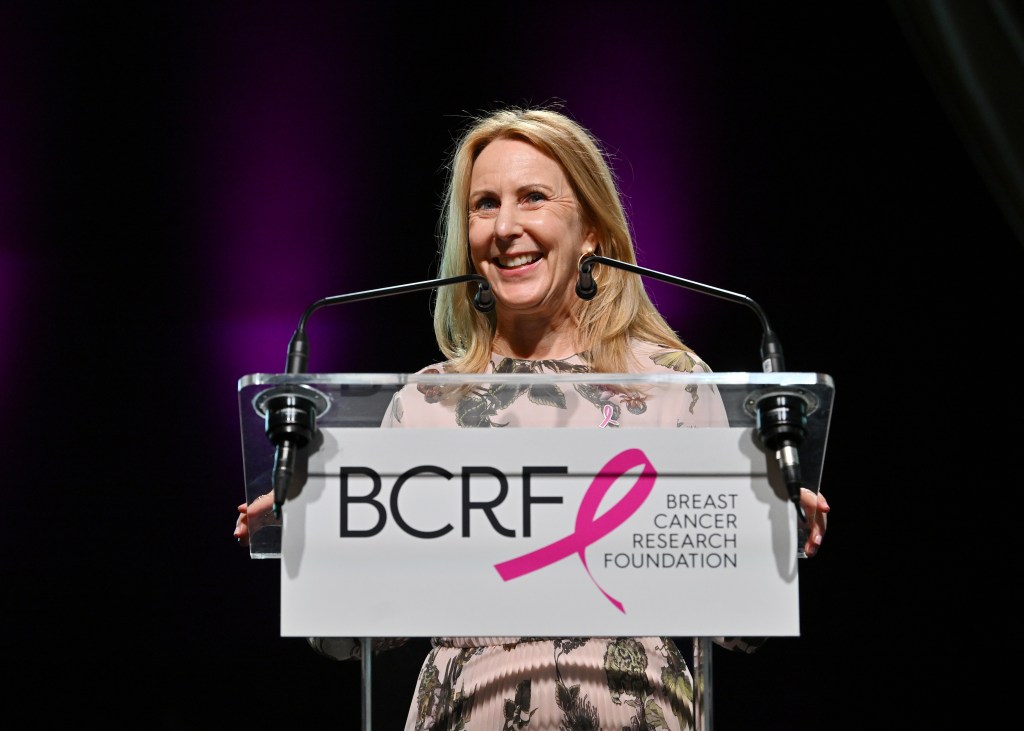
For more than 30 years, the Breast Cancer Research Foundation has been funding innovative research that changes the course of women’s lives. Today, the organization founded by Evelyn Lauder is revealing the next step in its philanthropy—one that brings it closer to the private sector.
BCRF is kicking off a $100 million venture philanthropy fund that will invest in startups advancing breast cancer research,
Fortune is the first to report. Crucially, any returns from the organization’s investments will go back to the organization and the fund to be invested in even more companies.
I talked to BCRF president and CEO Donna McKay about this new fund yesterday afternoon, just before she was set to announce it at the Clinton Global Initiative today. McKay was joined by Karen Hale, a philanthropist and BCRF’s board chair. Hale and her husband Rob Hale’s $11 million donation is kickstarting the new fund. Another $12 million is coming from a surprise bequest from a donor that the organization did not have a relationship with (that bequest has yet to be revealed by the nonprofit; not all of it will be used on this fund).
BCRF will be out fundraising the other $77 million to reach its goal of a $100 million fund over five years. It’s aiming for a portfolio of 20 to 30 companies across diagnostics, targeted therapies, immuno-oncology, and other emerging technologies.
McKay told me that philanthropists are excited by the venture philanthropy model. “There are probably donors who would be as excited or more to fund this than traditional philanthropy,” she says. “It’s appealing [to them] that this fund could be evergreen and could be able to continue funding new initiatives over and over again.”
BCRF will be appointing an investment committee with experts in both business and science that will decide which checks to write. Its first investment is in Clarity Inc., whose platform Clarity Breast uses AI to analyze mammograms and not only detect cancer, but predict a patient’s five-year risk of developing breast cancer.
The purpose of the fund is to invest in technologies like these that fall in what McKay calls the “valley of death.” In commercial biopharma, most funding is going toward later stage companies. Early-stage companies in the sector are seeing their share of funding decrease. And women’s health has always been under-funded. The purpose of a venture fund is “to be able to step in and fund the next area in between basic science but before capital venture capital funds are likely to put resources in because these investments might be too early or they might be too risky,” she explains.
BCRF expects to start writing more checks in early 2027 (and interested founders can look out for more information then). For Hale, the cause is personal. “The money all goes to research,” she says of her support of BCRF, “and now it’s going to go one step further.”
Emma Hinchliffeemma.hinchliffe@fortune.comThe Most Powerful Women Daily newsletter is Fortune’
s daily briefing for and about the women leading the business world.