| | In this edition, the fintechs who once proclaimed the end of banking all want to be banks now, and i͏ ͏ ͏ ͏ ͏ ͏ |
| |  | Business |  |
| |
|
 - AI’s great sucking sound
- Paramount’s next hurdle
- Agents iced out
- Kalshi sets course for Wall Street
- Pangram’s profit plan
|
|
 “This is the beginning of a bankless world,” proclaimed a 2016 ad for SoFi, which embodied the sneering disdain its generation of fintech startups had for the banks they were out to dethrone. SoFi is now a bank, the 46th biggest in America. So are Klarna and PayPal. Chime is the latest to bite the bullet, announcing the acquisition of a bank earlier this month. Revolut, whose CEO was once quoted saying “I just don’t like banks,” has also applied for a license. Block, which got a skinny banking license in 2021, wants another one. Contempt for banks was hard-coded into these companies’ DNA. Now they all want to be one. Why? First, the real money to be made in financial services is in lending, especially as the young tech-savvy customers they courted through YOLO brokerage, crypto trading, and money transfers grow up and want to buy a house. In the lending business, controlling your funding is important, and there’s no cheaper funding in the world than savings accounts. Relying on bank partners to fund the loans you want to make is risky, as LendingClub found out the hard way, which is why it bought a bank in 2020 and is now a full-fledged bank called Happen. These companies’ pivots are also an acknowledgement that their hypergrowth stage is over. Regulators don’t like banks growing too quickly because they tend to screw up when they do, which is why Robinhood abandoned its pursuit of a license in 2019. A reminder: We had “Robinhood becomes a bank” on our 2026 Semafor Business bingo card. We might be early, but I don’t think we’re wrong. |
|
AI trade gets lumpy as IPOs delayed |
 A Meta data center in Ohio. Eric Cox/File Photo/Reuters. A Meta data center in Ohio. Eric Cox/File Photo/Reuters.Two companies in the AI ecosystem have delayed their IPOs, the latest sign that investor appetite for the trade is uneven at best. SoftBank’s energy business and nuclear company Holtec put off their listings after investors balked, The New York Times reported. At the same time, SoftBank’s junk-bond offering, which will fund its investment in OpenAI, appears to have healthy demand. The first-order AI trades — frontier labs and chipmakers — are holding up, but a fragility is emerging further down the chain among smaller deals. That’s a bad sign for private-equity firms sitting on $3.8 trillion of unsold companies, Thoma Bravo’s Orlando Bravo told Semafor’s Compound Interest this week. (Stay tuned: we’ll be bringing that episode to you when we return from hiatus early next month.) “Look at this pipeline: SpaceX, Anthropic, OpenAI, maybe Databricks, these monster companies” heading toward IPOs will “crowd out” smaller offerings, Bravo said. “It’s not a capital issue, it’s a time issue. Who’s going to pay attention to this stuff when they have to make big decisions on this enormous capital?” — Rohan Goswami |
|
Paramount readies debt for Warner Bros. deal |
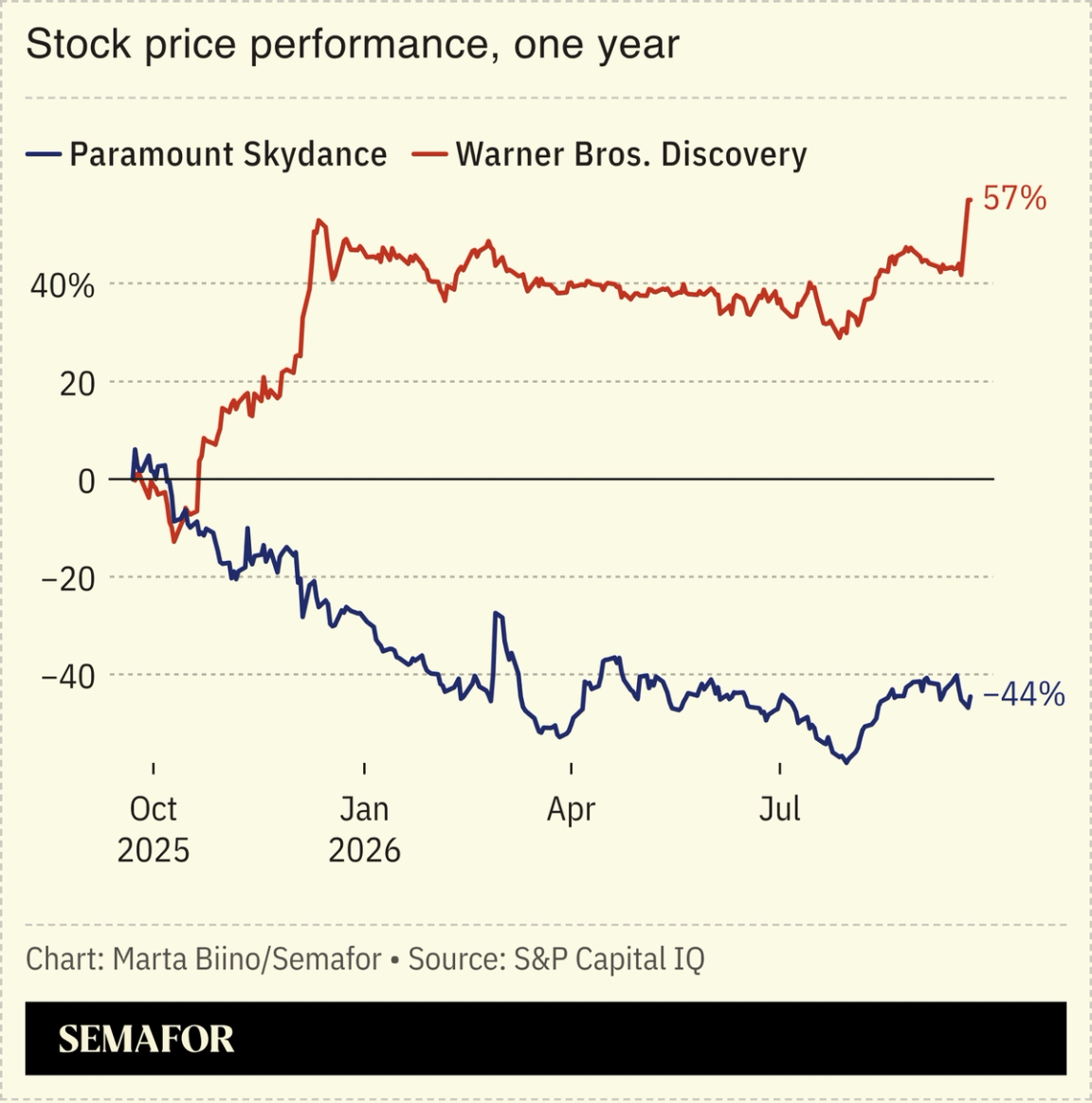 David Ellison fought the law and won. Now he has to pony up the cash for his prize. Now that Paramount reached an agreement with state attorneys general to close its $110 billion takeover of Warner Bros. Discovery, all eyes are on the $49 billion of mostly loans and bonds, nearly all of it expected to be rated investment-grade, that Paramount’s bankers will put together in the coming weeks. It’s one of the most highly anticipated credit launches this year — a genuine new issuance in a sea of refinancings, and one that has nothing to do with data centers. Massive media deals have gotten love from investors in the past, including when Electronic Arts went private and lined up $20 billion of debt last year. The settlement also defangs the idea that state AGs would step in as a counterweight to the Trump Justice Department’s light-touch antitrust enforcement. Even California’s Rob Bonta settled for far less than he wanted, and Connecticut’s AG said he was “deeply disappointed that we could not do more.” — Ellen DiMauro and Rohan Goswami |
|
AI agents find themselves boxed out |
 Courtesy of Meta Courtesy of MetaAI agents are here. Will internet gatekeepers let them in the door? Amazon banned Meta’s Muse assistant, while Shopify welcomed it in, the first sign of battle lines being drawn in the way we spend money online. As they sharpen, expect a rough sorting. On one side will be retailers like Amazon, which want to keep control of human eyeballs that can be sold to advertisers and pitched on add-on purchases. On the other will be e-commerce enablers like Shopify, whose primary relationship is with merchants, and which makes money from licensing storefront software, fulfillment services, and financing. Less obvious is how companies that care a lot about customer loyalty but don’t depend on impulse purchases, like airlines, will treat bots. (My efforts to rebook a Delta flight via Muse this weekend ran into a bot-blocker.) — Rohan Goswami |
|
 Kalshi’s CEO Tarek Mansour. Lexi Critchett/Semafor. Kalshi’s CEO Tarek Mansour. Lexi Critchett/Semafor.Kalshi will let users juice their bets with borrowed money — but only some, showing where the prediction-markets platform thinks its future lies. Kalshi asked the Commodity Futures Trading Commission to let it extend margin loans to customers, but is excluding sports, mentions, and culture bets from the product. That leaves the categories most attractive to institutional investors looking to wager on, or protect themselves from, big global events like elections and commodity prices. Kalshi and Polymarket need to decide whether they want to be key players in the financial markets or degen OTBs. They are worth far more, I wrote this spring, as the place where Meta locks in AI compute pricing, Home Depot hedges its lumber risk, and investment firms manage the effect of a midterms surprise on their portfolios than as a betting parlor for US black-op nighttime raids. In that light, today’s announcement carries risks — leverage always does — but suggests Kalshi has made its choice. Polymarket, meanwhile, has some growing-up to do. — Liz Hoffman |
|
Can you make money policing AI slop? |
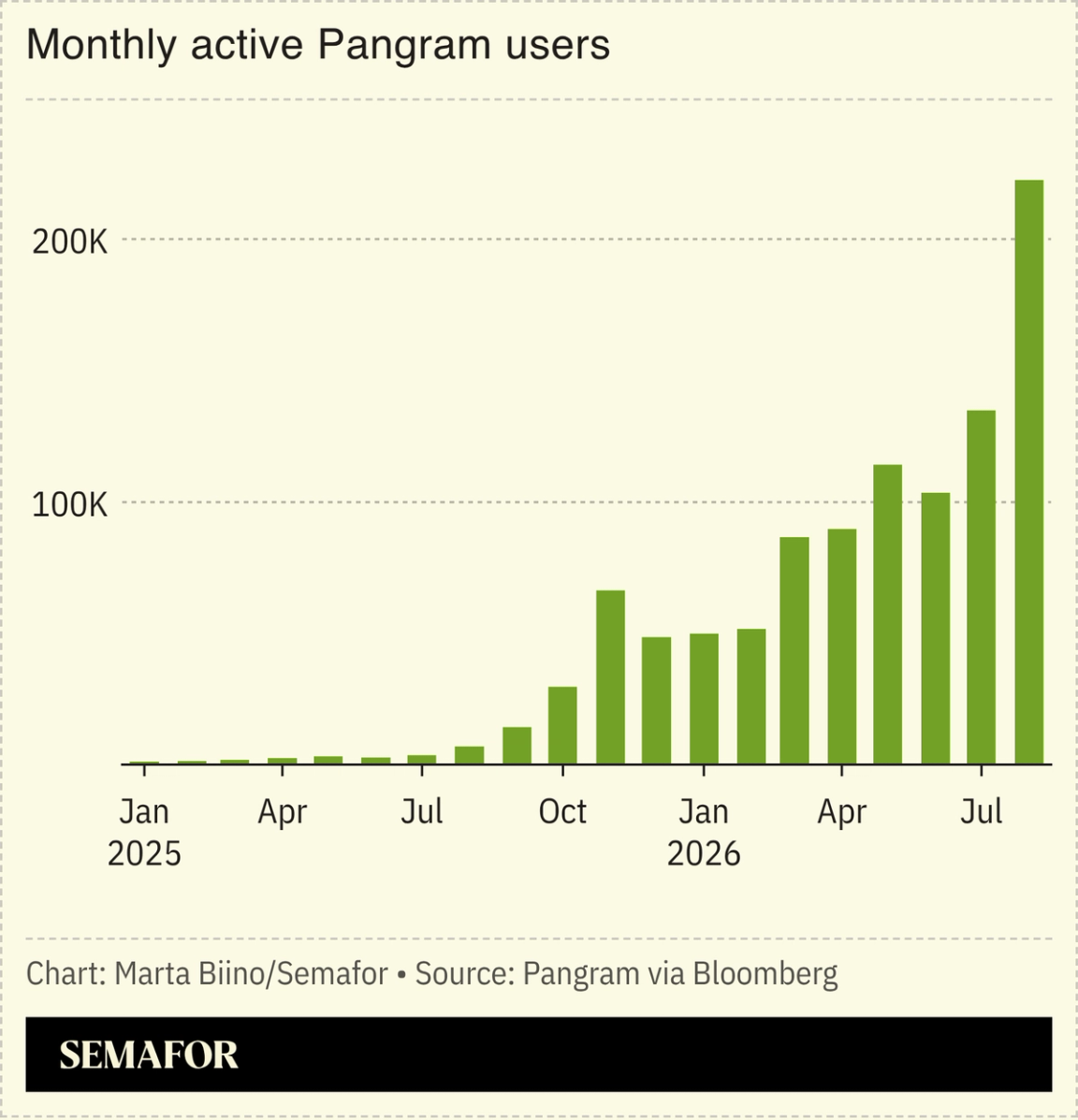 Pangram, the AI-detection tool, thinks there’s profit in serving both consumers desperate to de-slopify their feeds and big companies keen to avoid the backlash. Pangram, which raised $9 million in venture funding in July, is trying to turn its viral tool into a business. “There’s going to be more internet users who need something like this to navigate the internet as it’s just increasingly filled with bots,” CEO Max Spero said on Semafor’s Mixed Signals show. “And we’re trying to build up this enterprise motion. We want Pangram to be integrated in every internet platform, every law firm, every school.” Query whether anyone would be outraged that a McKinsey report or JPMorgan analyst note was written with AI, but the anti-slop backlash is a risk for companies in the content business, which is seemingly all of them these days. Spero said “all media companies should be using Pangram” to point their audience toward what he thinks will be “the scarcest resource” — a human touch. We asked Semafor’s editor-in-chief, Ben Smith, whether we’d be an early customer: “TBD. Max did sell me on a personal sub, and I’m glad to report that an internal memo I was a little suspicious about came back 100% human.” |
|
 Today, Semafor hosts The Next 3 Billion in New York City, bringing together global leaders to explore how AI, energy, and emerging technologies can connect the 3 billion people still offline and expand opportunity across the world’s fastest-growing regions. The Next 3 Billion features interviews with Kristalina Georgieva, Managing Director, IMF; Sasha Baker, Head of National Security Policy, OpenAI; Josh Parker, Head of Sustainability, Nvidia; Makhtar Diop, Managing Director, International Finance Corporation; James Manyika, SVP, Research, Labs, Technology & Society, Google-Alphabet; and more to explore how AI, energy, and global development can expand access, unlock opportunity, and drive inclusive growth across the world’s fastest-growing regions. Sept. 22 | New York City | Watch Now |
|
➚ BUY: Water towers. Paramount’s deal will keep two of the most iconic studio backlots running in California through at least the end of 2031. ➘ SELL: Water coolers. Unionized Barclays employees in the UK are revolting over a new return-to-office mandate slated for October. |
|
 Companies & Deals- Sputtering out: Porsche, once Volkswagen’s crown jewel, has become an albatross.
- Homegrown hero: Alibaba says it’s launched China’s most powerful AI chip yet as Beijing faces import bans on advanced US semiconductors.
- Big men, small campus: The Silicon Valley crowd has its own deal math, its own quasi-religion, and now its own school. WSJ reports on the Andreessen Horowitz Academy, a two-year unaccredited college alternative.
- Keep calm and carry on: Revolut’s CEO tells the FT he can build a bank “with zero risk” through the magic of securitization.
Markets |
|
|


