| | In today’s edition: Saudi’s East-West pipeline restarts, Masdar’s CEO says red tape is the biggest o͏ ͏ ͏ ͏ ͏ ͏ |
| |  | Gulf |  |
| |
|
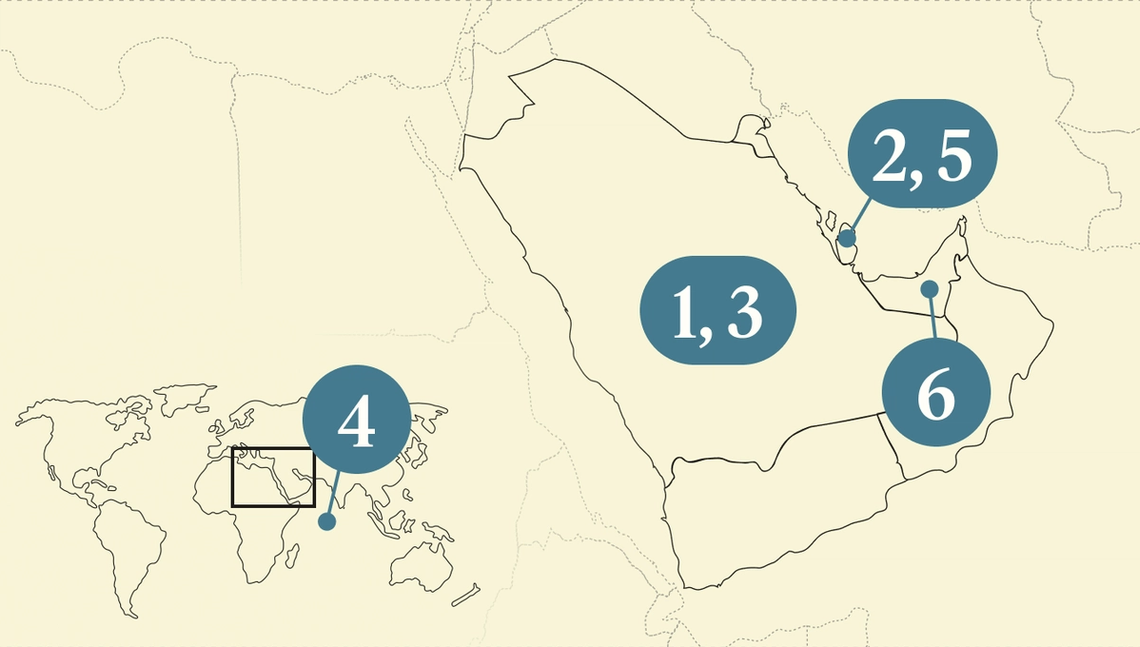 - Saudi restores pipeline
- Mediators under fire
- Saudi EVs debut
- Alabbar tees up Maldives
- QIA’s $20B JPMorgan pact
- Masdar blames red tape
 Big cat diplomacy. |
|
Saudi Arabia restarts pipeline |
 Planet Labs PBC/Reuters Planet Labs PBC/ReutersSaudi Arabia has restarted its East-West Pipeline and could resume crude exports from the Red Sea port of Yanbu today, Reuters reported, though flows were still low. The port has been targeted by Yemen’s Houthis, and the kingdom issued new alerts warning of attack on Monday as the conflict escalates. Britain has offered support for Saudi military efforts and France to secure energy infrastructure. For its part, the US has proposed a multibillion-dollar fund to rebuild energy facilities across the Gulf, The Wall Street Journal reported, but has so far declined to back Riyadh’s campaign against the Houthis, according to The New York Times. Iran, meanwhile, has reportedly offered a path to reopening the Strait of Hormuz within a week if Washington eases military pressure and lifts its blockade of Iranian ports, according to Reuters. Trump will address the UN General Assembly today and meet Gulf leaders in New York as part of a diplomatic push to end the war. |
|
Negotiating with incentive |
 Inter-Services Public Relations (ISPR)/Handout via Reuters; Suzanne Plunkett/Reuters; Iranian Foreign Ministry/WANA (West Asia News Agency)/Handout via Reuters Inter-Services Public Relations (ISPR)/Handout via Reuters; Suzanne Plunkett/Reuters; Iranian Foreign Ministry/WANA (West Asia News Agency)/Handout via ReutersThe countries trying to broker an end to the Iran conflict — Oman, Pakistan, and Qatar — are themselves facing military attacks and economic strain from the war, making their mediation all the more urgent. The countries are pushing to resume talks during the UN General Assembly this week: Qatar is conveying messages between the parties, its prime minister said on Sunday. But a dynamic that can shift daily is “changing the course of the negotiations,” he said. “There is no clear master strategy that we are following in order to put an end to this. And that’s basically what we are missing today.” With the continued risk of Tehran targeting Gulf energy infrastructure and economic livelihoods, efforts to de-escalate are a priority for the three countries. In this conflict, the mediators have skin in the game. — Lauren Morganbesser |
|
Saudi’s CEER unveils first EVs |
 Ibraheem Abu Mustafa/Reuters Ibraheem Abu Mustafa/ReutersSaudi Arabia’s auto manufacturing startup CEER unveiled its first cars, two luxury electric vehicles that will go on sale early next year, as the kingdom doubles down on a bet that the industry can help drive its economic diversification. The futuristic Exobot sedan and SUV have gull-wing doors and sweeping windscreens that stretch into the roof, a design that was personally picked by Crown Prince Mohammed bin Salman. The cars will be built at a new production plant on the kingdom’s west coast, north of Jeddah, capable of producing 240,000 vehicles. CEER was launched by the kingdom’s sovereign wealth fund in 2022. Production will begin in early 2027 and the first deliveries to customers are expected in March, chief executive Jim DeLuca told Semafor. “Our mission is to ignite that industry,” he said. — Matthew Martin |
|
Eagle Hills lands in the Maldives |
 Courtesy Eagle Hills Courtesy Eagle HillsThe Maldives is the next coastline for UAE real estate developer Mohamed Alabbar, who signed an agreement with the archipelago’s government for a $12 billion waterfront and marina development near the capital Malé. The project will be run through his Abu Dhabi-based firm Eagle Hills, which has close ties to the emirate’s ruling family; Dubai-based Emaar, also headed by Alabbar, may invest too, he told Reuters. Alabbar, who made his name with Downtown Dubai, was expanding abroad even before the US-Iran war as the UAE market became saturated. Eagle Hills’ portfolio spans at least 18 countries; for the Maldives, the project marks its largest-ever investment. Earlier this year, Eagle Hills said it would move forward with a multibillion-dollar plan for housing and tourism developments along Syria’s Mediterranean coast. |
|
QIA deepens US ties with JPMorgan |
 The Qatar Investment Authority and JPMorgan’s asset management arm agreed a $20 billion partnership spanning public and private markets, as the Qatari fund keeps dealmaking despite the US-Iran war. The deal includes a $15 billion customized public equities portfolio managed by the US bank and a $5 billion private markets initiative to fund mid-sized US companies in industrials, services, health care, and technology. The agreement deepens QIA’s ties to Wall Street’s biggest firms and follows its pledge, made during President Donald Trump’s visit to Doha last year, to invest $500 billion in the US. In January, it set a target of investing $25 billion with Goldman Sachs, while the US bank agreed to expand its presence in Doha. — Matthew Martin |
|
Masdar CEO: Capital constraints test buildout |
 Christophe Van Der Perre/Reuters Christophe Van Der Perre/ReutersBureaucratic barriers that impede the flow of capital, rather than problems with supply chains or local grid infrastructure, have become the biggest obstacle to building more renewable energy projects in developing countries, the CEO of Masdar told Semafor. Mohamed Jameel Al Ramahi, who leads the Abu Dhabi-based renewables firm, said it is “absolutely” on track to meet its goal of reaching 100 gigawatts of low-carbon generating capacity in its portfolio by 2030, up from about 65 now. Much of that growth will need to happen in developing countries, but many lack a regulatory structure for credible long-term offtake deals with developers, key requirements for banks to put up financing. Masdar is working with development banks to solve the problem. In the meantime, Al Ramahi said the company plans to expand its US portfolio, despite antipathy to renewables from the Trump administration: “In the US, renewables were built prior to the tax credits, and they will continue to be built and operated post tax credits.” — Tim McDonnell |
|
 Today, Semafor hosts The Next 3 Billion in New York City, bringing together global leaders to explore how AI, energy, and emerging technologies can connect the three billion people still offline and expand opportunity across the world’s fastest-growing regions. The Next 3 Billion features interviews with H.E. William Samoei Ruto, President, Republic of Kenya; H.E. Judith Suminwa, Prime Minister, Democratic Republic of the Congo; Dr. Ngozi Okonjo-Iweala, Director-General, World Trade Organization; Sanda Ojiambo, Assistant Secretary-General, CEO and Executive Director, United Nations Global Compact; James Manyika, SVP, Research, Labs, Technology & Society, Google-Alphabet; and more to explore how AI, energy, and global development can expand access, unlock opportunity, and drive inclusive growth across the world’s fastest-growing regions. Sept. 22 | New York City | Watch Now |
|
 Construction- India’s state-run engineering firm Engineers India expects more Gulf work as Saudi Arabia and the UAE build pipelines, oil terminals, and storage to bypass the Strait of Hormuz. Orders from the region have slowed, but “the conflict has opened more opportunities for us,” its chairman said. — Reuters
Energy- ADNOC Distribution is planning a $1 billion expansion in Egypt that would add roughly 400 fuel stations to the 245 it already runs there. The Abu Dhabi fuel retailer bought Shell’s South African downstream business for $1 billion in July. — Bloomberg Asharq
- Abu Dhabi’s Mubadala is leading talks to invest in Italian gas turbine maker Ansaldo Energia, as AI-driven electricity demand lifts interest in power-generation equipment. Italian state investor CDP Equity, which owns 99.6% of the company, would keep majority control. — Bloomberg
Tech- Saudi AI company HUMAIN signed a final contract with Riyadh-listed Al Moammar Information Systems, which has minted two billionaire brothers, to build 250 megawatts of AI data centers, five times the size of the original deal. The contract is worth almost seven times MIS’ 2025 revenue.
|
|
|


