| | Saudi oil exports rise, hundreds of wind energy megawatts on hold, and the renewables investment gap͏ ͏ ͏ ͏ ͏ ͏ |
| |  New York City New York City |  Riyadh Riyadh |  Vilnius Vilnius |
 | | | Climate Week Edition |
| |
|
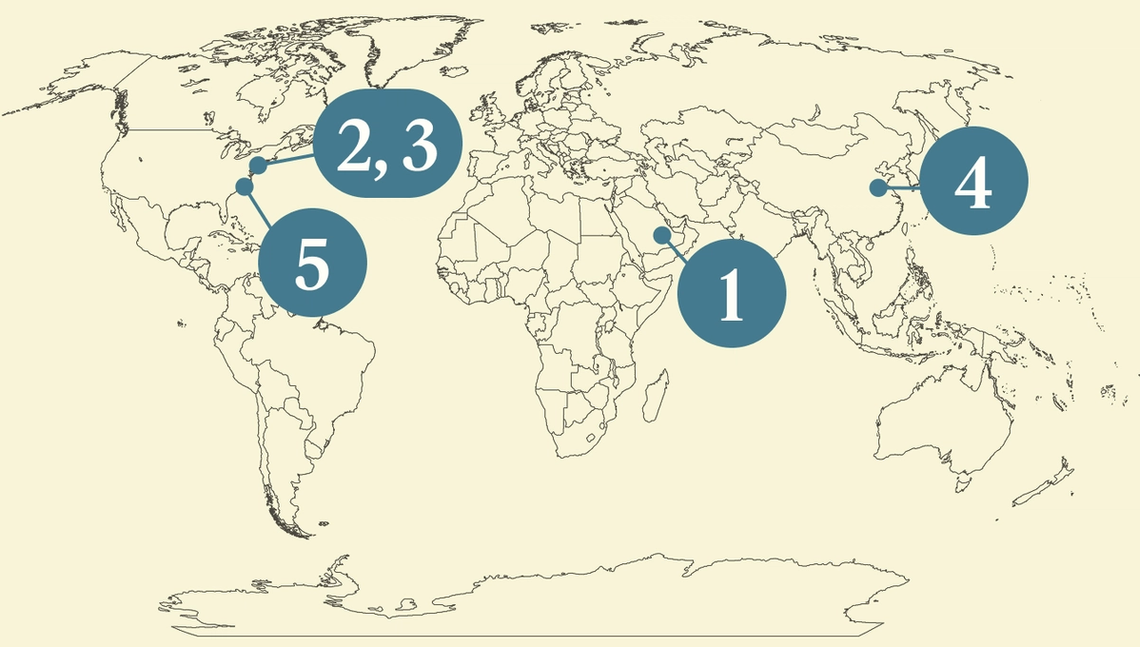 - Exports pick up
- Wind on pause
- LNG for Lithuania
- Renewables gap
- Permitting hope fades
 EU sticks to Arctic drilling ban, and Macron calls for a delay on methane restrictions. |
|
 Clean energy executives are an increasingly nervous bunch. I moderated a lunch discussion under Chatham House rules at New York Climate Week yesterday made up of leaders from large-scale renewables developers, equipment manufacturers, and tech companies, as well as energy financiers and lawmakers. We were focused on the practical challenges of building the low-cost clean energy the US grid is crying out for, but not getting at sufficient scale. They all seemed to share a similar perspective: In theory there’s never been a better time to be in this industry, but in practice many potential projects are frozen, raising the risk that investors will miss out on the biggest boom of their careers. Power companies “are excited and scared at the same time,” one participant said. “We’re operating with phenomenal demand and the capital is there, but unfortunately the execution is really difficult,” another added. “There’s no long-term investment horizon, and you can’t build infrastructure like that.” Many of the challenges were familiar. Permitting reform legislation is perennially a hair’s breadth out of reach (the situation again this week, as my colleague Burgess reports below). The queue to connect to the grid sprawls interminably, as do delivery times for essential hardware. No one seemed particularly bothered about the erasure of tax credits, but plenty were concerned about other steps taken by the Trump administration to impede individual renewables projects, including the Defense Department blockade of onshore wind farms and deals to withdraw leases for offshore wind. Participants were also afraid of the mounting public backlash against data centers, complained that hyperscalers have been “uniquely incompetent” in engaging local communities near their projects, and warned the backlash will get far worse once the more tangible effects of AI proliferation — job loss and cyberattacks, if not a robot apocalypse per se — kick in. One outcome of all this is that there’s increasing competition for a scarce pool of new, clean electrons. The biggest tech companies are still able to sign deals to get major clean energy projects built, and are doing so at a record pace. But many other potential buyers of clean energy have been priced out of the market — an indication that retail power prices will continue their upward trajectory. Overall, I found the lunch more depressing than I expected, and revealing of the extent to which the government remains the grid’s worst enemy. “We need to be flooring it,” one participant said. “Instead, there are so many feet on the brakes.” We’ll be landing in your inbox every day this week, so stay tuned. And if you’re in town, don’t forget to join our Thursday evening happy hour! → |
|
|
 Mohammed Benmansour/Reuters Mohammed Benmansour/ReutersSaudi Arabia is ramping up crude exports from Gulf terminals, signalling a partial recovery of shipments following an attack by Iran-backed Houthis on the kingdom’s pipeline to the Red Sea. Shipping data shows Saudi Aramco loaded 14 million barrels of crude on seven supertankers on Sunday. At the same time, the company told several Asian refiners they would soon be able to pick up oil from the Red Sea port of Yanbu, with no details on a timeline, Bloomberg reported. Expectations of higher export volumes helped to lower the price of crude below $100 a barrel. International support to accelerate the recovery of oil shipments is on the horizon. France says it is ready to help secure Saudi energy infrastructure in Yanbu and the East-West pipeline, while the US has reportedly proposed $5 billion to kickstart a fund to help rebuild energy infrastructure damaged in the conflict. The proposal is under discussion with Middle East countries, including Saudi Arabia and the UAE, whose representatives are due to meet US President Donald Trump on the sidelines of UN meetings today. |
|
 Nick Oxford/Reuters Nick Oxford/Reuters“Several hundred megawatts” of planned onshore wind farms in the US remain on indefinite hold because of opposition from the Trump administration, Miguel Stilwell d’Andrade, CEO of Portuguese developer EDP, told Semafor. Last month, a federal judge ordered the Department of Defense to move forward with processing applications for wind farm licenses that had been held up over ostensible national security concerns. But EDP has held up its own projects, d’Andrade said, over fear of wasting capital if future administrative blockages appear. “We have several projects we’d like to move forward with, but we can’t take the risk,” he said. “It’s unfortunate because they are good projects that would contribute a lot to reducing the cost of energy.” Still, he said, the company has no plans to pull back on its long-term $5 billion investment target for the US: “We’ve ridden out various different political and economic cycles before, and we’ll continue to be here for the long run.” |
|
 EQT, one of the largest US natural gas producers, is expanding its LNG export operations and plans to charter up to a dozen new tankers to bring its gas to buyers across Europe and Asia into the 2030s, CEO Toby Rice told Semafor. The company signed a deal this week with the government of Lithuania to provide one LNG tanker per year for the next 10 years, adding up to roughly 10 terawatt-hours of gas to help the Baltic country replace its dependence on Russian supplies. Under the deal, the gas will be priced for the first few years against the European TTF benchmark — now at its highest point since 2022 — and then transition to the US Henry Hub benchmark. The deal will not only provide EQT with a healthy profit and serve as a proof of concept for similar deals with other buyers, Rice said, but also liberate Lithuania from European gas prices that are far higher and more volatile than the US. |
|
Tripling renewable capacity |
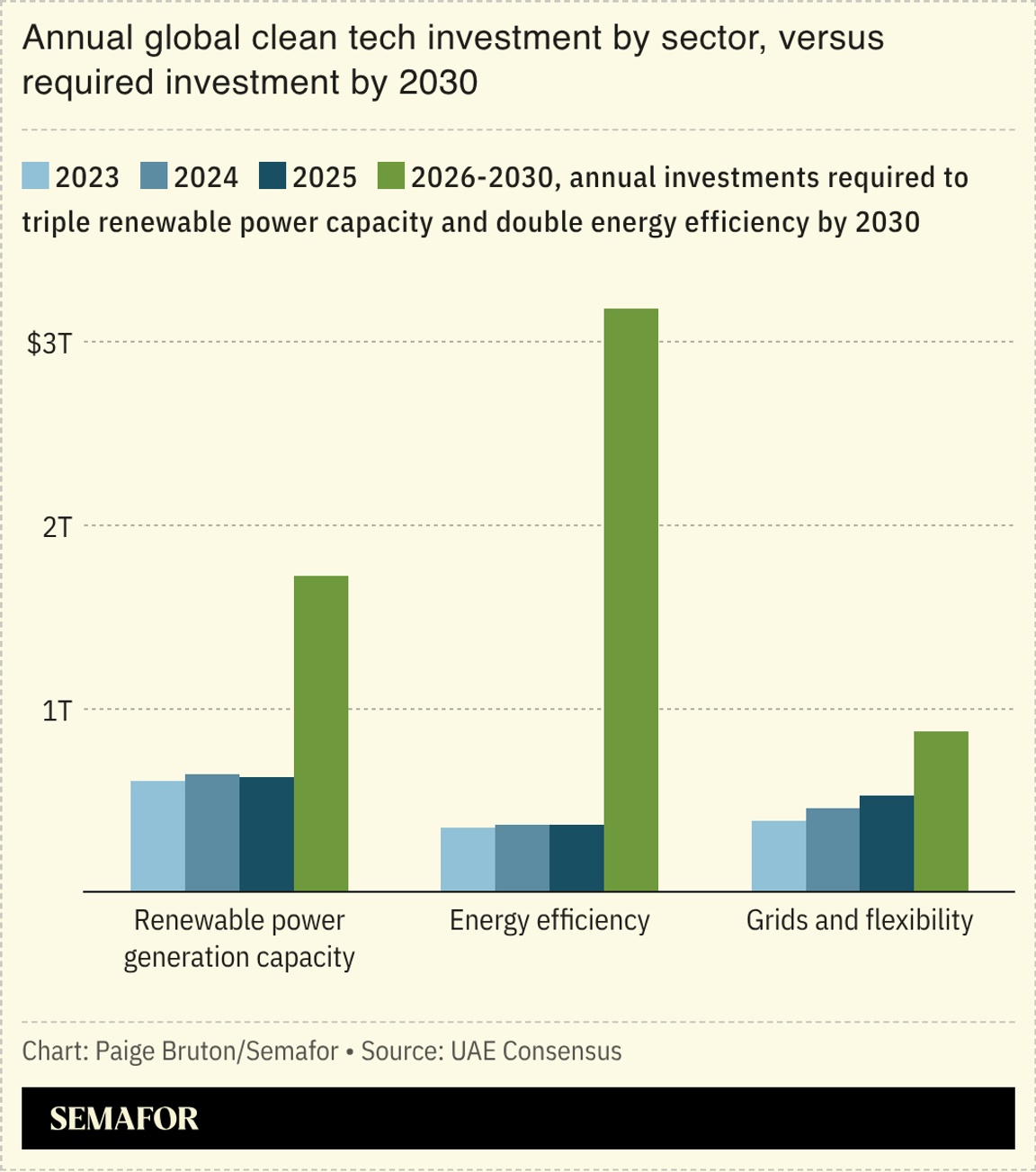 The world must build more than 6 terawatts of renewable power in the next five years — more than all previous years combined — to deliver on a goal to triple global renewable energy capacity by 2030, according to a new report. At COP28 in the UAE in 2023, countries agreed to collectively reach 11.2 TW of installed renewable capacity by 2030. Last year, clean power representing a record 693 GW of new capacity was added, but that pales in comparison to the 1,200 GW needed on average every year to 2030 to meet the goal, according to the report by the International Renewable Energy Agency, the Global Renewables Alliance and the COP31 Presidency. Delivering the extra capacity requires an additional $8.6 trillion in investment over 2026-2030, the report found. To enable the additional renewable capacity to come online, investment to expand, modernize, and build flexibility on the grid must average up to $1 trillion a year, up from $525 billion in 2025. |
|
Permitting reform talks stall |
 Shelby Tauber/Reuters Shelby Tauber/ReutersBipartisan talks to speed up permitting approval for federal energy and infrastructure projects have hit a wall, raising doubts about whether lawmakers can clinch a long-sought deal before the US midterms, according to multiple people familiar with the talks. Senate Republicans wanted to have a deal at the start of this week in time to put a bill to the Senate before the November polls. That hasn’t happened and both parties are growing increasingly bearish on a breakthrough. A post-election deal is still possible, but a similar scenario in the last midterms saw both sides reject bipartisan permitting legislation. Republicans have long sought faster permitting for pipelines, mines, and other energy projects, while the Democrats see reform as necessary to accelerate clean power generation. Growing power demand from AI data centers has heightened the need for reform: Morgan Stanley estimates a 57 GW power supply shortfall for data centres in the US to 2028. — Burgess Everett |
|
 - The president of Türkiye, COP31’s host, gives a speech at the UN General Assembly.
- The IEA hosts ministers for a high-level energy transition dialogue with COP31 leadership and UN officials.
- The AI Forum discusses scaling sustainable infrastructure with representatives from BCG, Schneider Electric, and Hitachi Energy.
|
|
 Today, Semafor hosts The Next 3 Billion in New York City, bringing together global leaders to explore how AI, energy, and emerging technologies can connect the three billion people still offline and expand opportunity across the world’s fastest-growing regions. The Next 3 Billion features interviews with H.E. William Samoei Ruto, President, Republic of Kenya; H.E. Judith Suminwa, Prime Minister, Democratic Republic of the Congo; Dr. Ngozi Okonjo-Iweala, Director-General, World Trade Organization; Sanda Ojiambo, Assistant Secretary-General, CEO and Executive Director, United Nations Global Compact; James Manyika, SVP, Research, Labs, Technology & Society, Google-Alphabet; and more to explore how AI, energy, and global development can expand access, unlock opportunity, and drive inclusive growth across the world’s fastest-growing regions. September 22 | New York City | Watch Now |
|
 New Energy Jim Urquhart/Reuters Jim Urquhart/ReutersFossil Fuels |
|
|


