| | In this edition, the stage is set for the meeting between President Trump and Chinese leader Xi Jinp͏ ͏ ͏ ͏ ͏ ͏ |
| |  | | | Global Capital Edition |
| |
|
 - An AI ‘red phone’
- Kai-Fu Lee’s new warning
- ‘Made in Mecca’
- Semafor’s Next 3 Billion
- Platinum diplomacy
- How Atlassian handles AI hype
 What’s happening this week, and Novo hopes a rebrand will save its balance sheet. |
|
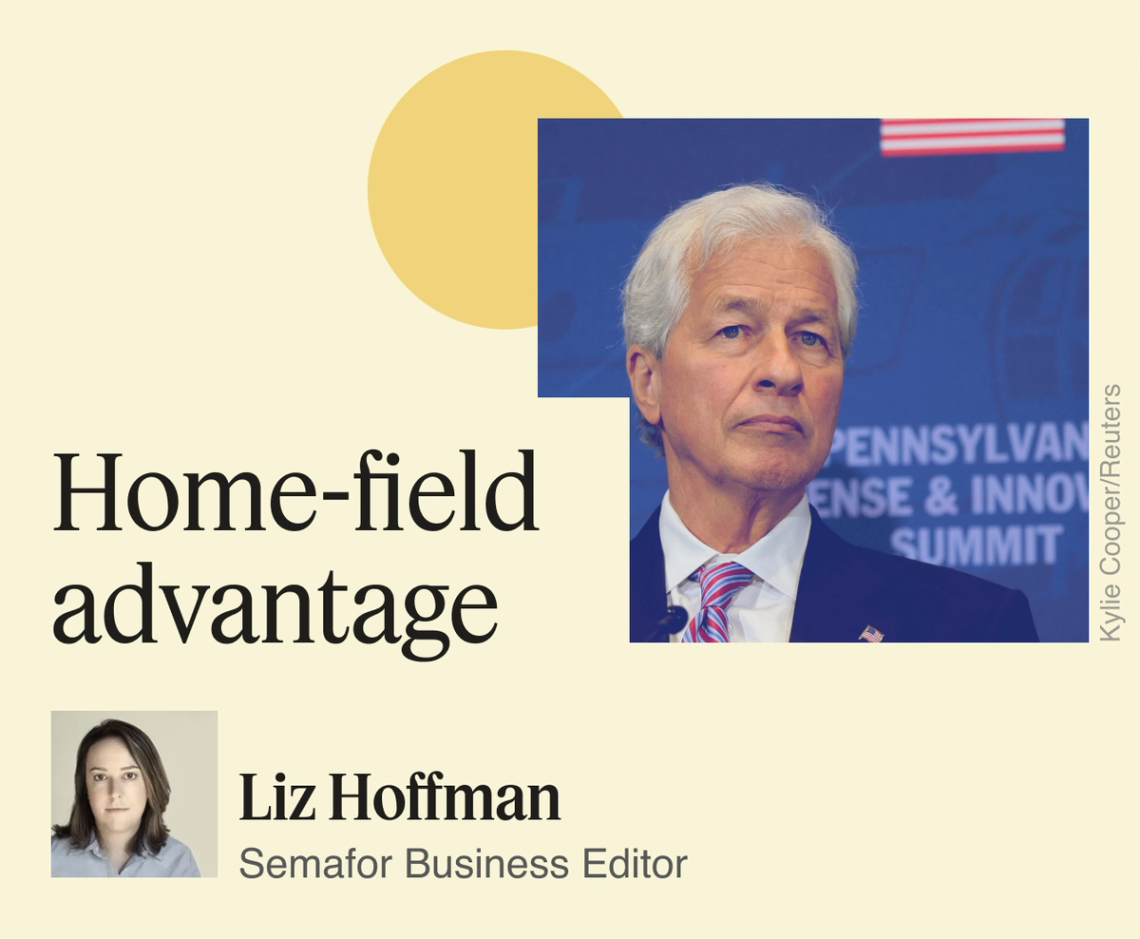 New York City has plenty of fancy conference rooms, even when the UN is in town. So what to make of JPMorgan hosting talks between Treasury Secretary Scott Bessent and Chinese Vice Premier He Lifeng — talks on which quite a bit is riding, and which Wall Street is watching closely? Officials were quick to note that JPMorgan wasn’t shaping or participating in the talks, merely providing a venue. But Jamie Dimon’s new headquarters is a gleaming monument to the strength of the US financial system. China just pumped more than $50 billion into its banks and other financial companies, on top of previous efforts to replenish their capital. Profits at China’s biggest banks are stabilizing but being squeezed by low interest margins, which have tied Beijing’s hands on cutting interest rates. US banks are as strong as they’ve been at any time since the financial crisis, despite fears about widening risk from AI financings. Bessent hosting He at one of the strongest, most profitable banks in the world is a home-field advantage. |
|
Trump, Xi to meet as AI debate rages |
 US President Trump and Chinese leader Xi Jinping during their meeting in May. Maxim Shemetov/Pool/Reuters. US President Trump and Chinese leader Xi Jinping during their meeting in May. Maxim Shemetov/Pool/Reuters.Bessent said the US had proposed an emergency “notification mechanism” for the US and China to share information on AI incidents that could affect national security. The talks set the stage for President Donald Trump and Chinese leader Xi Jinping to meet Thursday, where AI is likely to feature. The president has resisted calls for a slowdown in model development: “We’re leading China in AI… and frankly I want to keep it that way,” he said last week. AI tensions have strained what had been improving relations between the two superpowers, which had both stepped back from last year’s all-out trade war. Other differences, notably over trade and Taiwan, remain deep. One analyst’s “baseline expectation” is merely for “a prolongation” of the countries’ truce, while investors surveyed by Goldman Sachs said they expected the talks to be mostly symbolic. |
|
Kai-Fu Lee on the US-China AI rivalry |
 Kai-Fu Lee in 2010. David Gray/Reuters. Kai-Fu Lee in 2010. David Gray/Reuters.Kai-Fu Lee, whose 2018 book AI Superpowers predicted the tech battle between the US and China, said the US’s AI edge won’t last forever. “It would be a terrible mistake to underestimate the capabilities of Chinese companies,” he told Semafor’s Andrew Edgecliffe-Johnson. “If you look at the top 1,000 people in AI in the US, they are significantly better than the top 1,000 people in China. However, if you look at the top 100,000, the two countries are very comparable.” He predicts China’s domestic chip manufacturing will be “completely self-sufficient” within two to three years, so export restrictions like those enacted by the Trump administration won’t guarantee the US stays ahead. Even some American CEOs, he said, acknowledge that Chinese labs aren’t simply coasting on US labs — a technical piggybacking called “distillation” that has drawn criticism and cast doubt on Chinese companies’ abilities to compete on the AI frontier. “Distilling alone cannot lead to the success that DeepSeek and Moonshot have had.” Commercial tailwinds for open-weight models will also boost Beijing’s contenders in the AI race. Lee is now chairman of Beijing-based VC firm Sinovation Ventures and founder of 01.AI, a Chinese “AI tiger” focused on helping companies deploy the technology, similar to Anthropic-backed Ode and OpenAI’s DeployCo. Read Andrew’s full conversation with Lee, which includes how he would reframe Amodei’s “pacing the frontier” recommendation, and the fate he sees for middle managers. → |
|
|
How a Gulf fund navigates the war |
 Courtesy of BlueFive Capital/Semafor illustration Courtesy of BlueFive Capital/Semafor illustrationThe Middle East conflict hasn’t slowed dealmaking in the Gulf, the head of one of the region’s fastest-growing investment firms said. “I’m surprised that there’s no difference in the pace and scale of investment, particularly in those strategic sectors that continue to accelerate”: technology, agriculture, infrastructure, Hazem Ben-Gacem, founder and CEO of Abu Dhabi-based BlueFive Capital, told Semafor in an interview. BlueFive has opened an office in Beijing and invested $1.2 billion in China, with an eye on tech transfer to the Gulf, he said. The firm, with $15 billion in assets under management, sees automation as crucial to its investment strategy, given the Gulf’s reliance on expat labor, especially in services and tourism. Ben-Gacem also plans to open an office in Jakarta to tap demand for Islamic finance, which is offered through a portfolio company based in Saudi Arabia. “The same way I feel good having a ‘Made in Italy’ label on my suit, when I’m in Jakarta or Kuala Lumpur, and I buy a Sharia-compliant product I want to have a ‘Made in Mecca’ label,” he said. |
|
Semafor’s The Next 3 Billion |
 Semafor’s The Next 3 Billion summit kicks off today, asking global leaders the big questions hanging over economic growth, unsustainable debt loads, and the development of an equitable AI that doesn’t leave the developing world behind. Tune in here to see IMF chief Kristalina Georgieva, Kenyan President William Samoei Ruto, WTO Director-General Dr. Ngozi Okonjo-Iweala, and more, interviewed by Semafor’s journalists. |
|
| | Semafor Next 3 Billion • Exclusive |  | |
South Africa’s platinum diplomacy |
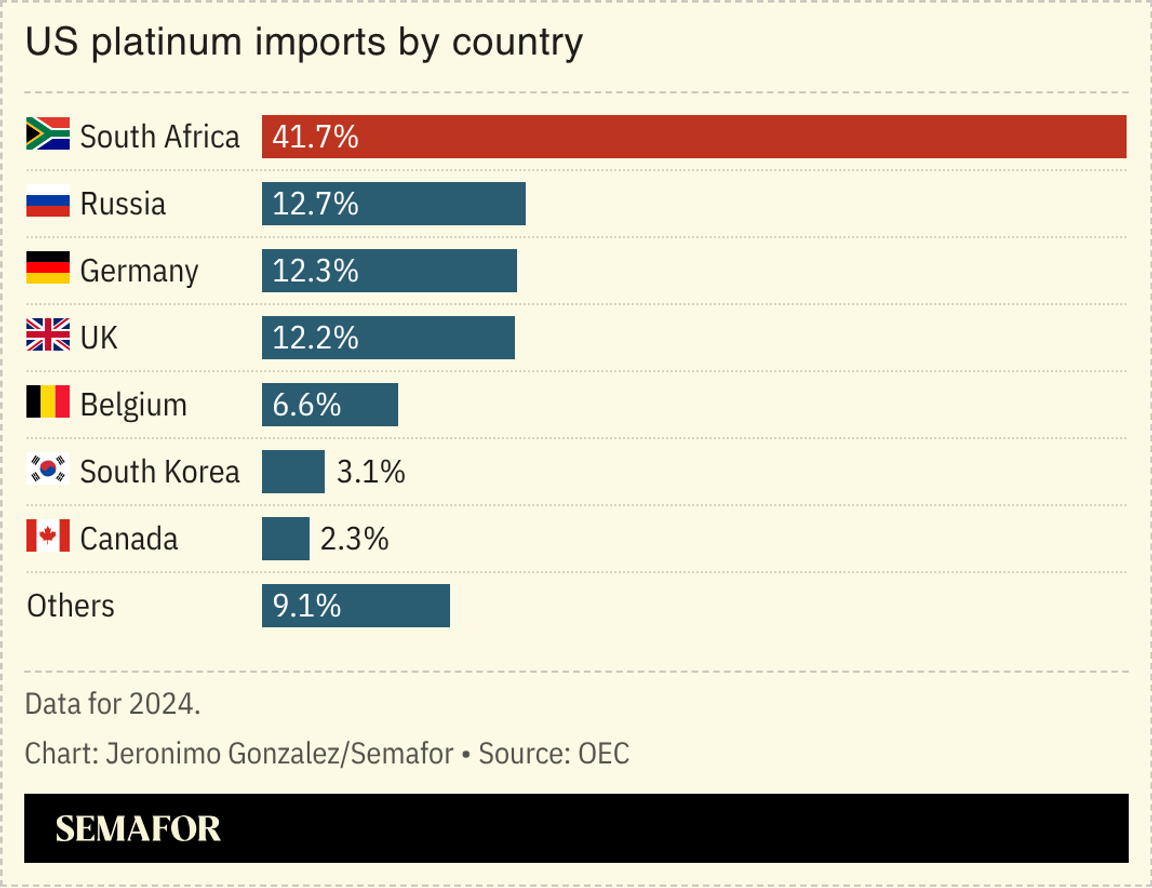 About 150 miles north of Johannesburg, under a cavernous expanse of jagged gray rock, lies a mineral treasure trove that could play a pivotal role in the global power balance. This platinum lode is South Africa’s springboard to rebuild a humiliating relationship with Washington — complicated by Trump’s focus, boosted by Elon Musk, on the treatment of white Afrikaners — and bolster a budding one with Beijing. A Semafor review of government documents and data shows South Africa is pitching itself to both rival powers as a supplier of platinum, a critical mineral used in everything from AI data centers to defense equipment to green hydrogen plants. This leveraging of platinum — South Africa holds some 80% of the world’s known reserves — reflects the way many African countries are managing the scramble for minerals and navigating the rival pulls of the US and China. — Alexis Akwagyiram, Tiisetso Motsoeneng, and Sam Mkokeli |
|
How Atlassian avoids ‘froth and bubbles’ |
 Brendan McDermid/Reuters Brendan McDermid/ReutersThe AI bubble isn’t just financial. It’s cultural, and staying outside of it has helped Atlassian avoid the “froth and bubbles” of the tech moment, CEO Mike Cannon-Brookes said in an interview. “There’s a lot of technology that’s applicable between San Francisco and San Jose, and nowhere else in the world,” Cannon-Brookes told Semafor’s Andrew Edgecliffe-Johnson from his home office in Australia. “We take the ideas from Silicon Valley, and we try to make sure those ideas apply in Sydney, which is a proxy for every other big city in the world… We’re fast adopters of technology, but we’re not super technology-driven.” Distance from the hype doesn’t provide perfect protection from it, though: Atlassian has been caught up in US investors’ mood swings over whether AI will hurt or help software companies. Its stock has more than tripled from lows last spring, but is still 60% below its 2021 peak. Check out the full Q&A for why Atlassian advises CEOs to make big bets on AI, even though they won’t all pay out. → |
|
|
 - Sept. 21: World leaders and CEOs converge on New York as the UN General Assembly opens, with Climate Week running alongside it, putting green-energy discussions against the backdrop of $100 oil.
- Sept. 24: The CEOs of JPMorgan, Nvidia, Microsoft, and OpenAI will join President Trump at a White House state dinner for Chinese leader Xi Jinping.
- Sept. 24: August’s new-home sales data won’t capture the impact of the Fed’s rate hike last week, but will be the first read on whether mortgage rates at nearly 7% are biting.
- Any day now: SoftBank will price up to $11 billion of junk bonds to fund its committed investment in OpenAI after wrapping an investor roadshow last week. It will be a test of whether credit markets will keep funding AI at these levels.
|
|
|


