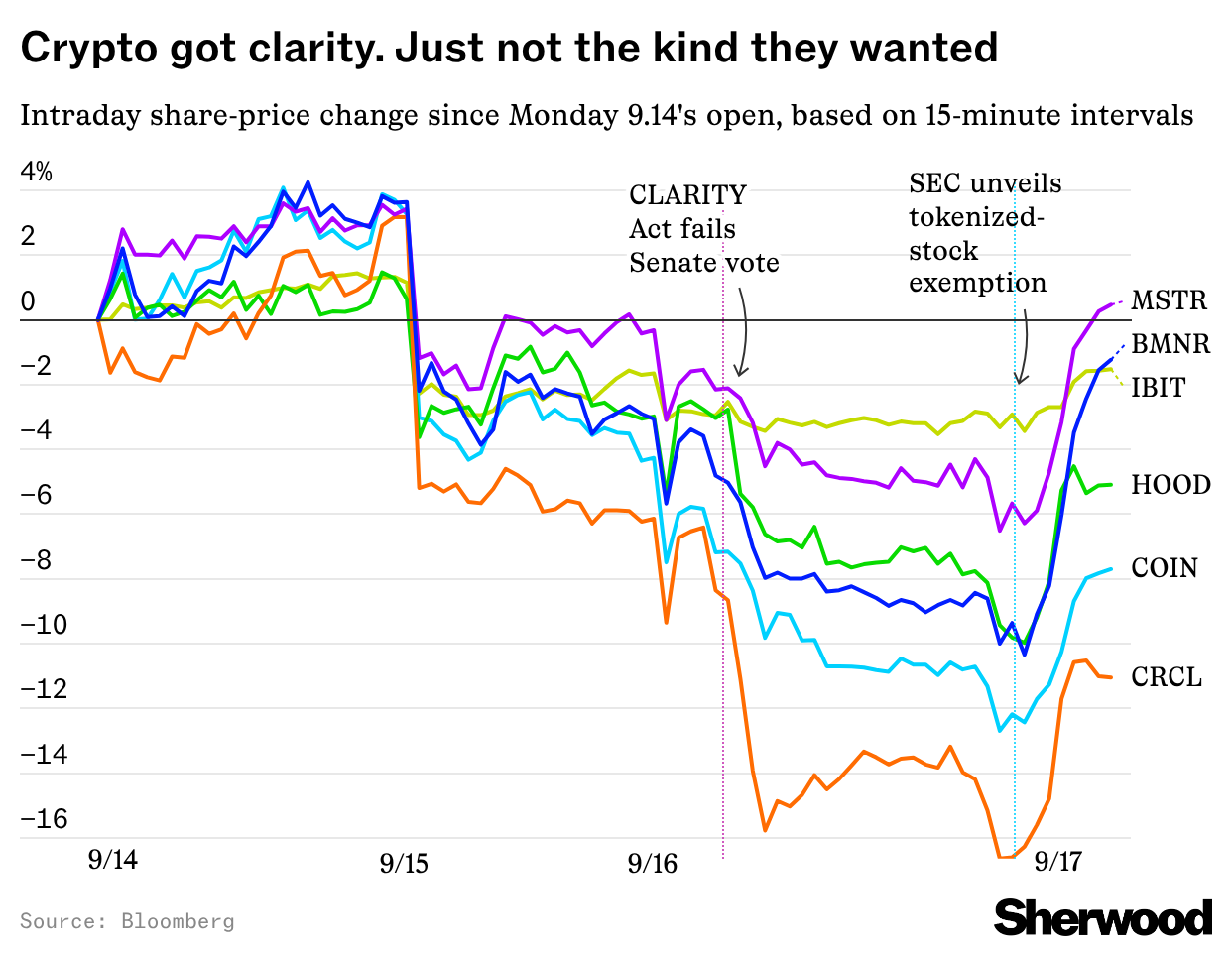
The Senate Tuesday failed to advance the CLARITY Act, falling short of the 60 votes needed to move it forward, per Reuters. The bill would have put more of the current crypto regulatory framework into federal law, including clearer lines around which digital assets fall under the SEC versus the CFTC. Instead, much of that work now stays with regulators themselves. A major sticking point was ethics, with Democrats objecting to legislation backed by an industry in which President Donald Trump and his family have significant financial interests. Republicans added tougher ethics provisions before the vote, while disagreements over stablecoin rewards and other parts of the bill also remained.
And Thursday offered a pretty good illustration of what that means in practice.
The SEC unveiled a five-year exemption allowing approved platforms to trade tokenized versions of US stocks, potentially clearing a path for companies including Coinbase and Robinhood* to expand tokenized-equity products in the US. The exemption also gives certain liquidity providers relief from dealer-registration requirements. Crypto-linked stocks rose alongside the broader market Thursday.
That sounds like good news for the industry, and in the near term it is. But it also highlights the distinction CLARITY was supposed to address. The SEC can loosen rules, create exemptions and open new regulatory pathways. Those decisions are still agency actions, though. This particular exemption lasts five years, and a future commission or administration could revisit the broader regulatory approach. A framework written into federal law would be much harder to unwind.
That creates a funny split for Wall Street. Firms that already have big crypto businesses may not have much reason to change course immediately. But the calculus gets trickier for investments that haven’t happened yet like acquiring a crypto exchange, building a new custody business, or spending heavily to expand in the US. These all require a longer view of the rulebook. And companies may be less willing to tolerate it when deciding where to put billions of dollars, buy a business or build infrastructure meant to last a decade.
Markets have reflected some of that whiplash. Coinbase, Circle and other crypto-linked stocks sold off after Tuesday’s Senate vote. On Thursday, crypto-linked shares rebounded as the SEC announced the tokenization exemption and Treasury yields retreated.