An ‘Unprecedented’ Squeeze on Oil |
By Ivana Saric
Digital Editor, Council on Foreign Relations |
The Iran war has disrupted energy flows through the Strait of Hormuz. Now, fears are surfacing about the Bab-el Mandeb Strait—a global chokepoint at the mouth of the Red Sea that has become increasingly vital.
This week, Yemen’s Iran-backed Houthi rebels made gains in and along the Red Sea, tightening their control over Bab-el Mandeb. They have exchanged strikes with Saudi Arabia, long the world’s largest oil exporter, which relies on the Red Sea to get millions of barrels of oil to market.
“It is unprecedented that both of these outlets should be under threat,” CFR’s Vijay Vaitheeswaran told the Daily Brief. Oil flows haven’t fallen to zero, but amid “other dark winds,” that possibility “is changing the sentiments of oil traders, clearly pushing oil prices up,” he said.
Making matters worse, Saudi Arabia has shut down the East-West pipeline, a land conduit for bringing the kingdom’s oil to the Red Sea, following drone attacks launched from Iraq.
The Daily Brief asked CFR’s Steven Cook how the worsening situation in the Red Sea could affect the region overall. The Houthis have largely abided by claims that they are only targeting Saudi ships and don’t intend to close the waterway entirely, Cook said. But that may be a “cold comfort.” The militia is “not exactly reliable,” and “commercial shipping lines and, importantly, their insurers may prefer that shippers avoid the Red Sea.”
So far, the United States has declined to intervene on Saudi Arabia’s behalf, leaving Riyadh isolated. “The most dangerous dimension of this is the fact that Saudi Arabia, the kingpin of oil, often called the central bank of oil, is now alone in this,” Vaitheeswaran said.
Previous U.S. administrations had pledged a security guarantee to the Gulf kingdom in exchange for access to a steady supply of oil. Now, Washington is declining Riyadh’s calls to intervene, which “makes oil traders incredibly nervous,” Vaitheeswaran said. A weakened alliance creates more risk by imperiling the Saudi oil supply and possibly inducing the kingdom to shift alliances, he added.
But while the United States hasn’t intervened yet, it would likely do so in certain scenarios. As Cook put it: “I suspect that if the Houthis target U.S. military personnel, whether on the high seas or in bases in the region, the United States would respond with force.” The Daily Brief will continue bringing you the latest on global oil strains as it comes. |
|
|
|
Questions About the Red Sea Crisis? |
Send us your most pressing questions and we’ll ask CFR’s experts to answer as many as possible. Reach us at dailybrief@cfr.org. |
|
|
|
Q&A: CFR’s Will Freeman on the Cuba Pressure Campaign |
The Trump administration’s military activities in Iran and Venezuela have dominated headlines this year. Meanwhile, it has targeted Cuba with a different kind of pressure campaign.
The Trump administration has levied tariff threats on countries supplying oil to the island, suggested the United States would “take” Cuba, and his administration has held secret talks with the Castro regime and urged political and economic reforms. Meanwhile, the humanitarian crisis on the island nation has continued to worsen.
CFR’s Will Freeman, an expert in Latin America, recently traveled to Cuba to study the situation firsthand. He recounted what he saw in a new piece in Foreign Affairs, and caught up with the Daily Brief to share more.
The administration pressured Cuba, but hasn’t taken direct action. What could push the administration to go further? To what end or benefit?
Cuba is an oppressive dictatorship and failing economy, but it is not—by any stretch of the imagination—a major U.S. national security threat. Nor does it hold much in the way of natural resources or hugely lucrative prospects on par with those of Venezuela before a long and costly reconstruction. Trump thus has only three conceivable reasons to escalate to military action: to please South Florida voters, to become the president who finally ousts the regime (that is, his legacy), or to shift the domestic public’s focus away from some other issue. None seem compelling enough, for now, to outweigh the obvious risk: entanglement in yet another foreign intervention, when Iran remains unresolved and managing Venezuela is itself a full-time job.
Your Foreign Affairs article describes Cuba as an “authoritarian anarchy.” What would it take for Cubans to challenge the status quo?
It would take a breakdown in the regime’s coercive apparatus: its network of informants, counterintelligence operators, police, and soldiers. It’s difficult to say how likely that would be in the face of a mass public protest, since Cuba hasn’t seen one since July 2021. If the tens or hundreds of thousands of Cubans again took to the streets, and badly paid soldiers and police hesitated to act, the regime might start to unravel. The problem is the population’s demographics and disorganization: the young population, most likely to protest, has shrunken through emigration, and there are no mechanisms to coordinate street protests. People expect they will be jailed for protesting, which keeps protests small and local and becomes a self-fulfilling prophecy.
If Cuba does become a failed state, what are the U.S. policy options? Why should Cuba matter to the United States?
If that happens, Cuba really will become more of a national security threat—cartels could gain a foothold, and maritime migration could rise—but it will still not be that strategically important, and Washington will be able to afford to deprioritize it (just look at Haiti: another failed state island in the neighborhood, and hardly a major focus). In this worst case scenario, it’s not clear to me the United States will know how to put Cuba back together, or even less, that the U.S. public will be willing to commit the resources. That would not be a disaster from a U.S. strategic perspective, but it would be bad for the country’s global image, and far more importantly, a tragedy for the Cuban people.
|
These answers represent the views solely of the author. The Council on Foreign Relations is an independent, nonpartisan membership organization, think tank, and publisher, and takes no institutional positions on matters of policy. |
|
| |
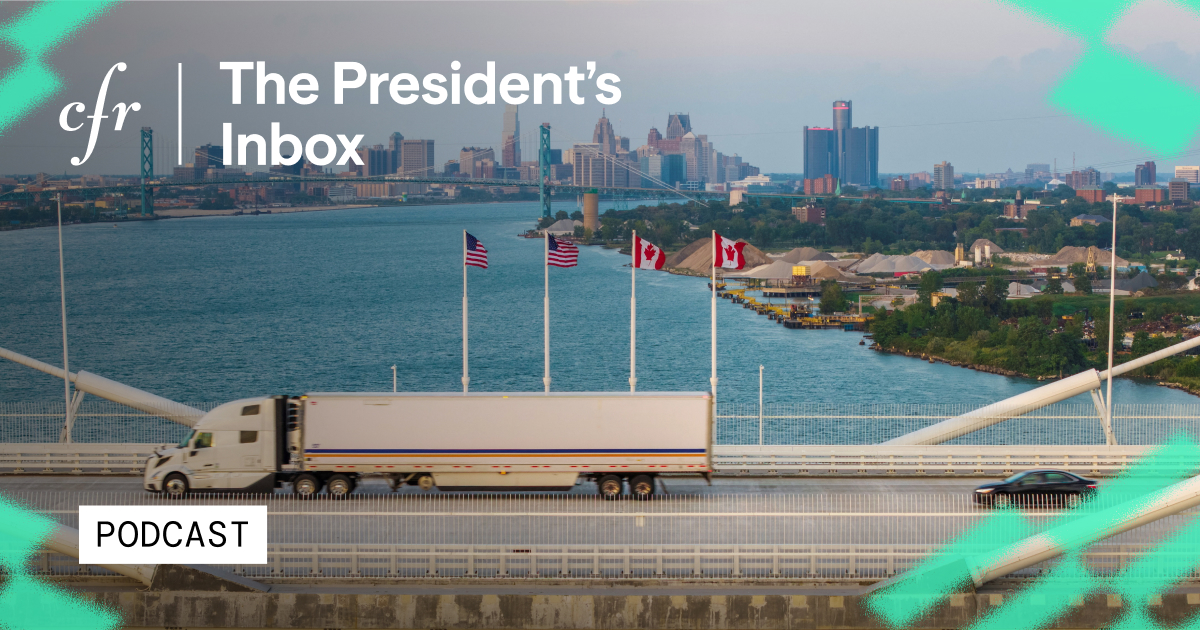
As the U.S.-Canada trade war deepens, CFR’s James Lindsay sat down with Rohinton Medhora, a professor at McGill University in Montreal, Canada, for the latest episode of The President’s Inbox.
Medhora said the dispute is fundamentally reshaping a once-trusted partnership. “It’s not just a question of saying ‘we had a trade deal, it wasn’t perfect, so we’re revisiting it,’” Medhora explained, arguing that there is now a deeper shift in how the two neighbors see each other. Alluding to Trump’s national security justification for recent tariffs, he added: “[For Americans] to see us as a security threat isn’t a transition in thinking, it strikes us as a rupture.”
|
|
|
|
Every day, the Daily Brief brings you a curated list of the top stories from around the world. |
-
Reuters: United States Makes Major Uranium Investment in Niger. The U.S. government has green-lit up to $414 million in financing for a uranium project. The step comes just two years after the West African nation kicked out U.S. forces.
- BBC: Abducted South African Journalist Found Dead. Broadcaster Owen Ndlovu was found dead with gunshot wounds after his car was hijacked near Johannesburg. An investigation is ongoing.
|
-
Major Trump Supporter Inks Venezuela Oil Deal. Harold Hamm’s Continental Resources firm has signed a deal with Venezuela’s national oil company to develop and operate a 126,000-acre area in the country.
-
Trump Scorns Proposed Canada-EU Partnership. The U.S. president threatened to halt trade with the European Union (EU) and called the idea of Canada becoming an associate EU member “laughable” in comments to reporters yesterday.
|
- Japan PM Reshuffles Cabinet. Prime Minister Takaichi Sanae retained some key ministers, but changed the makeup of her cabinet to combat her government’s diminished popularity.
- Australia Cracks Down on Student Visas. The move bars international students from bringing family members on their visa and introduces stricter rules for backpackers. It is part of a broader push to curb migration.
|
- Russia to Hold Wartime Parliamentary Elections. Three days of voting begin tomorrow. The Kremlin has cracked down on dissent and opposition, and is poised to maintain its hold on power.
- Swedish PM Resigns. The country’s center-right prime minister, Ulf Kristersson, stepped down today after the center-left narrowly won a tightly contested election.
|
-
Palestinian Officials Denied U.S. Visas for UN General Assembly—Again. For the second year in a row, officials from the Palestinian territories will not be granted entry to the United States to attend the annual high-level meetings.
- UN Mission Finds the United States May Have Committed War Crimes in Iran. A fact-finding panel said it had “grounds to believe” that the U.S. military had struck a school and a sports facility in February—and that those actions could have been war crimes.
|
|
|
|
Host: Ivana Saric
Editor: Xian Chiang Waren
Email Operations: Eric Rojas
Editorial Director, News: Phil McCausland
Editor-at-Large: Robert McMahon
Chief Digital Content Officer: Millie Tran |
|
|
|
58 East 68th Street, New York, NY 10065 |
1777 F Street, NW, Washington, DC 20006 |
|
|
|
|