| | In this edition: The rise of the Luddite Democrats, taking stock of the incumbent bloodbath, and dec͏ ͏ ͏ ͏ ͏ ͏ |
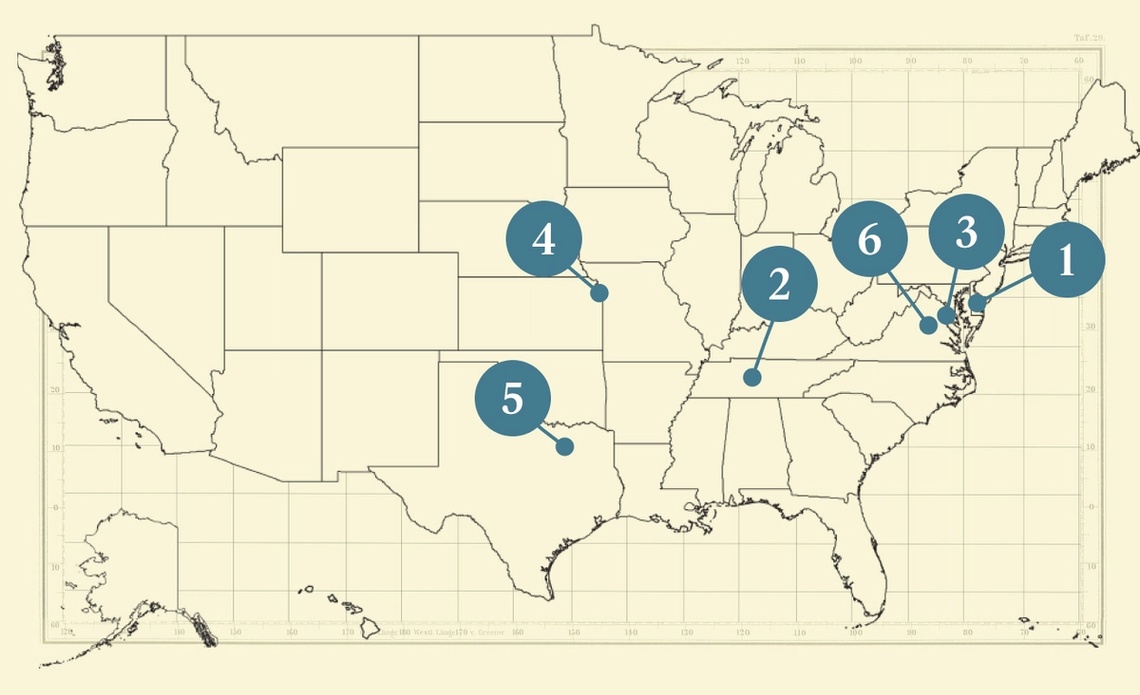
| |  AUSTIN, TX AUSTIN, TX | KANSAS CITY, MO | DOVER, DE |
 | Americana |  |
| |
|
 - The final primaries
- Record primary wipeout
- Mail ballots continue
- ‘Skin suit’ line
- Gender’s game
- Fear the future
|
|
 If you don’t appreciate how quickly Democrats are entering attack mode against AI, just count the groups they’ve started since our last edition alone. There’s Tomorrow Together, the new PAC formed by veterans of the Bernie Sanders and Kamala Harris campaigns, working to make theirs “the party that wins on AI.” There’s Who Decides, launched by New York state legislator Alex Bores in the wake of his failed House bid, which became a proxy war between AI industry PACs. Joining the list today: The Stop Bleeding the Future pledge. Developed by an array of progressive groups, it commits candidates to “refuse all money from” the most active AI industry PAC and to “condemn its efforts to stop commonsense AI laws.” Its first signatories include Rep. Greg Casar, D-Texas, who had warned for months that the party needed AI policies that weren’t written by the companies. QuitGPT, the coalition that wrote the pledge, began circulating it in May. “We want to make them irrelevant and toxic,” Michael Baick, one of its organizers, said when we talked yesterday. “We want any politician or staffer who gets an email from these guys to think: This is bleeding the future.” They might not need much pushing. In the year since I covered voter anger at data center construction in Virginia, AI angst has moved from the political frontiers to center stage. I spent most of Tuesday at the Pro-Human Assembly, where Steve Bannon and Sen. Bernie Sanders, I-Vt., anchored a day of nervous programming about the dangers of AI and the need for “guardrails” built by an accountable government. “I don’t think a pledge should be limited to [the Leading the Future AI industry PAC], because they’re already finding ways to shift their money,” Bores told me. “But they’re toxic to this debate.” |
|
Delaware progressives notch wins on the state level |
 Erica Dischino/Reuters Erica Dischino/ReutersSix months of primaries ended last night in Delaware, where progressives made gains by ousting incumbent state legislators and winning in open seats. That followed years of local organizing by the Working Families Party and other progressive groups — and the passage of legislation last year that loosed state corporate governance rules, after Elon Musk led a small parade of executives quitting Delaware and risking a reliable source of funding from incorporations. In the state legislature, progressives knocked off Sens. Ray Seigfried, Rep. Franklin Cooke, and Rep. William Carson, taking six of their eight targeted House races and one of their Senate races. Their opponents were supported by First State Future PAC, created to defend more moderate Democrats who supported Senate Bill 21, which passed when Musk was still working for the Trump administration at the head of DOGE. Those wins followed a local progressive wave in Rhode Island’s primaries last Wednesday, led by David Morales, a socialist state legislator who unseated the mayor of Providence. |
|
Incumbent defeats this year top the Tea Party wave |
 Elizabeth Frantz/Reuters Elizabeth Frantz/ReutersSeven incumbent House Democrats and four incumbent House Republicans lost their primaries this year — the highest number of primary defeats this century, easily outpacing the Tea Party wave of 2010. Mid-decade redistricting played a direct role in two losses and a supporting role in three others. Texas Democratic Reps. Al Green and Julie Johnson lost after Republicans redrew their maps, forcing Green into the same Houston district as new Rep. Christian Menefee; former Rep. Colin Allred, who left his Dallas-area seat to run for Senate in 2024, beat Johnson in a district that included much of his old territory. Those same maps put Texas GOP Rep. Dan Crenshaw in a new district, most of it represented in Austin by state legislator Steve Toth, who easily beat the congressman by running as a more Trump-loyal conservative. Tennessee’s Trump-ordered redistricting gave new territory to Rep. Andy Ogles, making him more vulnerable to a challenge — a situation that green energy investors took advantage of by funding his opponent. In Florida, GOP Rep. Cory Mills pushed off calls for his resignation over a myriad of ethics problems, only to lose his new seat. The cycle’s other losers competed in their current districts and were swept out: Kentucky Rep. Thomas Massie, New York Reps. Dan Goldman and Adriano Espaillat, Colorado Rep. Diana DeGette, Michigan Rep. Shri Thanedar, and Connecticut Rep. John Larson. |
|
Supreme Court delays Trump’s mail balloting |
 Evelyn Hockstein/Reuters Evelyn Hockstein/ReutersThe president’s effort to restrict mail voting this year hit a snag this week in the Supreme Court, where seven justices sided with lower courts that have prevented new rules from affecting this year’s voting. At issue is the White House’s claim that the executive branch has full authority over the Postal Service, and therefore over what standards can be applied to mail ballots. Justices Samuel Alito and Clarence Thomas agreed with that interpretation; Justice Brett Kavanaugh suggested that he did, too, but that there wasn’t time to implement a new restriction with voting underway in some states. The majority got a digital tongue-lashing from the president, but it’s all what Democratic litigators were expecting. Secretaries of state and election clerks have warned that no jurisdiction is ready to impose new standards on mail ballots, and that they’ve faced voter confusion after headlines about the president’s orders. |
|
GOP wields new attack line against progressive Christian Democrats |
 Mark Schiefelbein/Pool via Reuters Mark Schiefelbein/Pool via ReutersDemocrats with progressive Christian views are hearing a strange new attack line from Republicans: That they’re using their religion as a “skin suit” to dupe voters. The line rolled out at last week’s midterm GOP convention in Dallas, where Senate nominee James Talarico was one of the most popular targets. In his speech, north Texas Rep. Brandon Gill went after Talarico’s progressive views on gender — some of which the Democrat has recanted as “cringe” — and said that the candidate wanted to “hollow out your most deeply held Christian faith and wear it like a skin suit.” On Monday, when Vice President JD Vance campaigned in Kansas, he used the same idea to portray Senate nominee Adam Hamilton as a phony Christian. Democrats, Vance said, nominated a United Methodist pastor without realizing how left-wing his church was. Hamilton’s Church of the Resurrection had once sponsored PrideFest in Kansas City. That, in Vance’s view, equated to support for the transgressive Sisters of Perpetual Indulgence, a left-wing group that parodied nuns and disrupted services. “He’s okay with supporting groups that spit on God-fearing Americans and mock everything that we hold dear,” Vance claimed. “That is not Christianity. That is left-wing radicalism dressed in the skin suit of our religion.” |
|
How new Musk ads go after Democrats on transgender rights |
 The return of Elon Musk’s America PAC has meant — already — tens of millions of dollars spent on messaging against transgender rights. When the wealthiest man on earth says he’ll attack the “woke mind virus,” he means it, and ads directed at the Democratic Senate candidates in Alaska, Iowa, Maine, New Hampshire, Ohio, and Texas have attacked them over letting “boys play girls sports” and “men in women’s locker rooms.” (Some of the “men” are generated by AI.) In most states, the ads cite Democrats’ opposition to some of the anti-transgender bills introduced by Republicans after 2020. In Michigan, the ads focus on what Abdul El-Sayed told Fox News about his refusal to ban (or debate a ban about) sex reassignment surgeries for minors. Musk has company. Texas PAC, one of the Senate Leadership Fund spinoffs now spending against Talarico, packs a few of the candidate’s pro-trans votes together for “For They-Them,” a not-that-subtle callback to the Trump campaign’s 2024 advertising about Kamala Harris’ stance on sex reassignment surgeries for prisoners. Texas Rep. Gina Hinojosa, the Democratic nominee for governor, cast the same votes; after Gov. Greg Abbott began calling her “Gender Bender Gina,” “Pronouns,” her response ad, dismisses Abbott for trying to make the campaign about “woke,” and says that her “pronouns are mom, Texan, and soon to be governor.” (Scoffing about gender pronouns with a joke that isn’t really about pronouns is a bit of a tradition.) |
|
Data center divergence starts appearing |
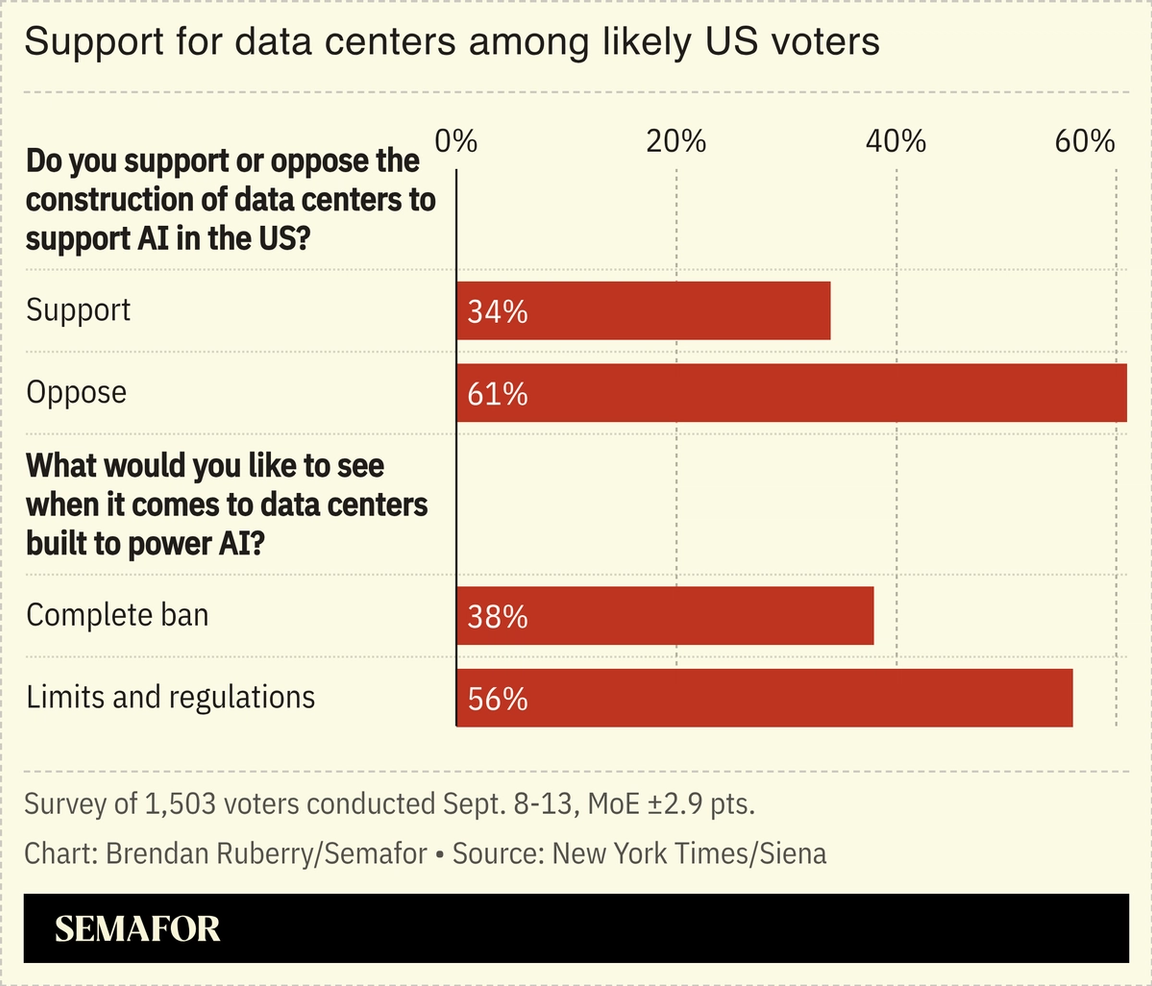 Beneath these topline numbers, we are beginning to see some partisan divergence on AI and data centers, downstream of the president’s unapologetic, patriotic AI boosterism. A majority (52%) of Trump supporters in this poll back more data center construction, and 35% want the sort of moratorium that Sen. Bernie Sanders has campaigned for. One likely reason: They heard that Sanders and other left-wing politicians had that position. Any Democrat who disagrees with Sanders needs to explain that position to his or her voters. A supermajority (77%) of Democrats want a ban, and a majority (53%) “strongly” support a ban. That opinion is most popular among the youngest voters, who moved toward Republicans in 2024, but have been moving back. Just 19% of voters under age 30 support the construction of more data centers, compared to 38% of voters over age 65. People leaving the workforce, and more likely to have savings and own their own homes, are less concerned than people just starting their working lives. |
|
 Semafor is expanding its coverage of healthcare with a new weekly briefing led by veteran healthcare journalist David Lim. At the intersection of politics, policy, and business, Semafor Healthcare will bring clarity to the forces shaping the industry, explaining how decisions in government affect the private sector and global economy. The briefing will go beyond the headlines to show what is really driving health policy in the US and around the world. Each week, readers will get original reporting, scoops, and analysis on the people and institutions driving change across healthcare, from policymakers and major companies to scientists, investors, and technology leaders. |
|
|


