| | In today’s edition: Holy trinity under threat, Gulf airlines bet on a rebound, and a wartime alert b͏ ͏ ͏ ͏ ͏ ͏ |
| |  | Gulf |  |
| |
|
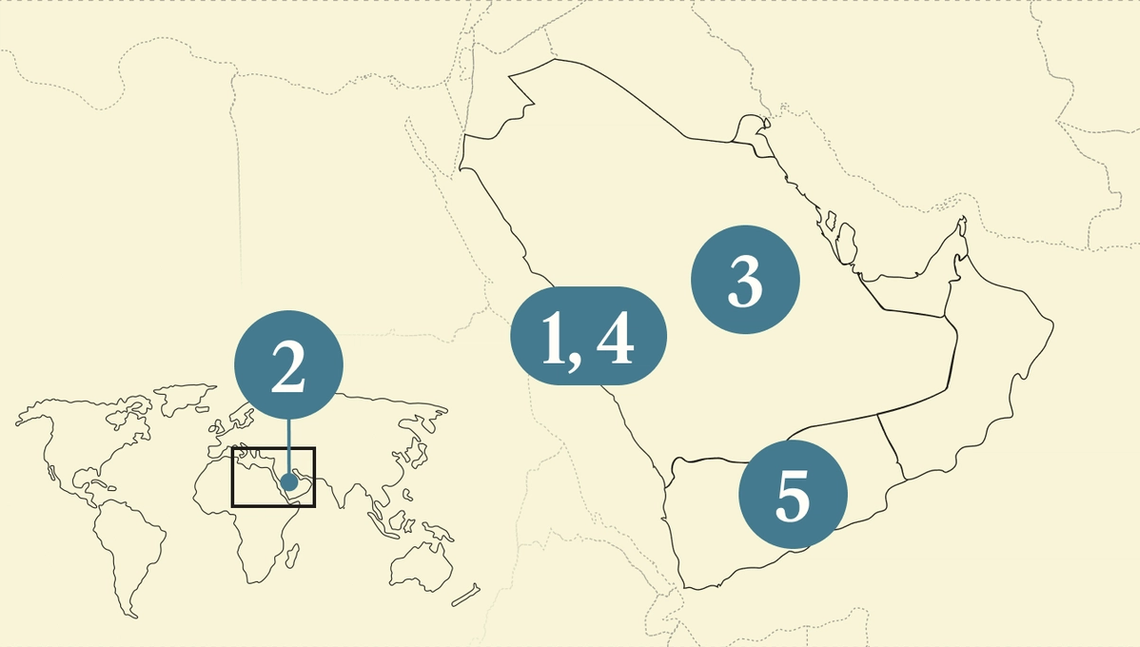 - Saudi is under attack
- Gulf aviation flexes
- Riyadh’s $853M village
- Mecca’s taboo is broken
- Houthis’ cooperation case
 An oil slick doubles in a day. |
|
Growing war threatens Gulf plans |
 The Saudi Arabia East-West pipeline after an attack on Sept. 11. Vantor/Handout via Reuters. The Saudi Arabia East-West pipeline after an attack on Sept. 11. Vantor/Handout via Reuters.The Iran war is widening, threatening all that is precious in the region: religion, oil, and data centers. Riyadh said it intercepted a Houthi drone near Mecca last night. The Yemeni group denied the charge and said it downed a Saudi fighter jet. While the claims can’t be verified, the actions point toward further escalation. Saudi Arabia’s military spokesman said the security of Mecca is a “red line.” Many countries have condemned the attack, though Saudi Arabia hasn’t received commitments of fresh military support. Still, coordination with the US hasn’t stopped, and Axios reported that Israel joined Gulf and other Middle Eastern countries in a meeting with US officials in Germany. The war has exposed the risks to the Gulf’s economic model and global energy flows, and may slow the region’s bet on becoming a global leader in AI infrastructure. Amazon Web Services said damage from Iranian strikes means it won’t restore one of its three UAE availability zones or its Bahrain network. That complicates a regional effort to turn abundant energy into computing power and AI tokens. AI data centers are larger than previous cloud facilities, making them easier targets, according to The Wall Street Journal. They are also much more expensive, with each fully equipped gigawatt of capacity costing at least $50 billion. — Mohammed Sergie |
|
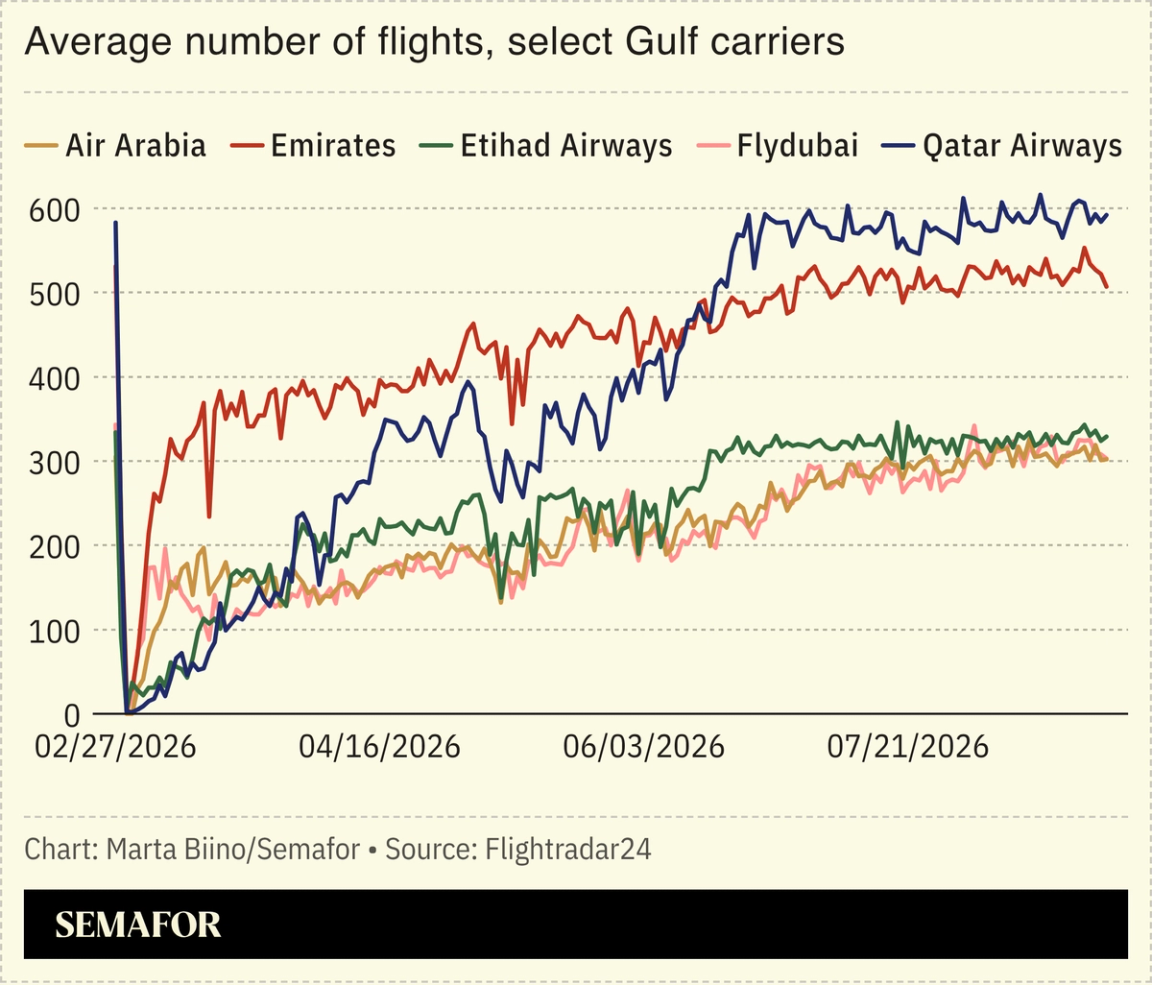 Gulf airlines are coming out swinging after a brutal year, fending off opportunistic European rivals and instability at home. Nowhere is this clearer than in Dammam, where Saudi Arabia has ordered a new budget airline and an expansion of King Fahd International Airport. Run by an Air Arabia-led consortium, it will fly Airbus A320s on domestic routes to Riyadh, Jeddah, and Madinah. In long-haul, Emirates won a coveted Berlin slot this week, strengthening its Europe-Asia foothold. Some European airlines have opened new Middle Eastern routes this year, which Emirates President Tim Clark called “a little bit sad,” and an attempt to exploit the Iran war. The Dubai carrier expects to restore full prewar seat capacity by the end of 2026, returning “hard and fast” if the conflict subsides. Abu Dhabi’s Etihad is taking the same muscular approach, adding more than 20 aircraft and new routes to Europe, Africa, and China as other long-haul carriers have pulled back. |
|
Riyadh’s Expo 2030 builds its village |
 Riyadh is putting 3.2 billion riyals ($853 million) into an “Expo Village” that will house 5,500 delegates from 197 countries across 2,300 homes ahead of Expo 2030. The project will become a permanent neighborhood of northern Riyadh after the Expo closes in March 2031, with more residential deals planned on the same model. The kingdom’s spending priorities have been reshuffled over the past year, as Public Investment Fund, whose assets shrank by $10 billion last year, scales back gigaprojects and turns toward its events calendar instead. The Expo is aiming to draw 42 million visitors starting October 2030, four years before the kingdom is set to host the World Cup. |
|
War tests Mecca’s sacred shield |
 An AI-generated Snapchat story of Mecca saying “God protect the people of the western region.” Albanderi Alyamani/Snapchat. An AI-generated Snapchat story of Mecca saying “God protect the people of the western region.” Albanderi Alyamani/Snapchat.WhatsApp groups and social media across Saudi Arabia lit up on Tuesday with variations of the same message: The Houthis are attacking Mecca. Photos of the Kaaba and prayers of “God protect this country” spread after Saudi civil defense issued an alert for Islam’s holiest city, the first since the war began, before lifting it minutes later. Some questioned whether it was an error or a test, while others condemned their “fellow Muslims” for threatening what is holy. Over the past six months, there was a sense that Mecca would provide a shield for western Saudi Arabia. As sirens went off over Riyadh and the Eastern Province, people in the Hejaz assumed no one would dare approach what all Muslims deem sacred. Tuesday’s alert punctured that logic. While nothing was hit — Saudi authorities said a drone was intercepted — the taboo has been broken. Nothing is holy in war. — Manal Albarakati
|
|
View: Coalition needed to stop Houthis |
  European Union/Copernicus Sentinel-2/Handout; Houthis Military Media/Handout; Al Masirah/Handout via Reuters European Union/Copernicus Sentinel-2/Handout; Houthis Military Media/Handout; Al Masirah/Handout via ReutersThe Houthis for too long have not been taken seriously. Now they must be confronted head-on. “This is the moment for the Gulf states, the US, Israel, and their allies to take advantage of a ripe opportunity to act together,” Jason D. Greenblatt, US President Donald Trump’s former Middle East envoy, writes in a Semafor column. “Iran seeks regional dominance by setting Muslim against Muslim, country against country, and everyone against Israel,” Greenblatt wrote. “To some degree, its pressure is producing the opposite. Regional countries are increasingly coordinating against Iran and its proxies, building a habit of cooperation that will ultimately lead to normalization.” |
|
 Diplomacy- Abu Dhabi renewable energy firm Masdar is making a further push into Azerbaijan, where it already has several solar projects, through an agreement with Azerbaijan Green Energy Company to explore new developments, including battery storage. UAE National Security Adviser Sheikh Tahnoon bin Zayed stood alongside the president of Azerbaijan for the signing.
EnergyFinance- Bankers who flocked to the Gulf for its post-pandemic IPO boom are now looking to Egypt, India, and Türkiye for deals as the Iran war accelerates a slowdown in listings. Sub-Saharan Africa has already raised more than the Gulf from IPOs this year, even before Nigeria’s Dangote Petroleum Refinery completes its IPO of at least $1.6 billion. — Bloomberg
Real Estate- Riyadh’s rent squeeze is easing: Households now spend about 15% of their income on lease payments, down from more than 17.5% a year ago, a shift the kingdom’s real estate regulator called the first measurable impact of Crown Prince Mohammed bin Salman’s push to cool the market. New supply is on the way too, with agreements signed this week to develop four residential projects in northern Riyadh. — Argaam, Al-Eqtisadiah
|
|
The Iranian crude carrier RIESCO burns in the Gulf of Oman after a US strike last week. The oil slick from the attack doubled in size in a day to about 400 square kilometers, according to Greenpeace, and now sits between seabird breeding islands in Oman’s Musandam and Iranian mangrove forests.  US Central Command/Handout via Reuters US Central Command/Handout via Reuters
|
|
|


