|
Hello, I’m Vanity Fair senior Hollywood correspondent Rebecca Ford, subbing in for this week’s A Billion to One. In the past couple weeks, I’ve watched a lot of movies that all share one thing in common: a tech villain. This fall, four very different films will center on real-life Silicon Valley entrepreneurs: Sam Altman, Mark Zuckerberg, Elon Musk, and Elizabeth Holmes. What they have in common is their attempt to examine a fascinating and controversial figure and their influence on society. At the Telluride Film Festival, I was one of the lucky 600 people to get the first look at You Can See Everything, Nathan Fielder and Lance Oppenheim’s riveting documentary about Theranos creator Holmes. Their access is incredible—Fielder even lived with Holmes in the days leading up to her turning herself in for her prison sentence—but it’s the way Fielder grapples with his own understanding of Holmes that makes this almost three-hour documentary so impactful. “Truly, to this day, I don’t quite know what I went through,” Fielder said onstage after the screening. “But what we really tried to do with the project is convey our experience and really try to make it reflect how it felt to be there at every moment without telling you what to think.” While Holmes very much signed up to be the subject of a film, the other three tech founders did not. Musk has spoken out on social media about his distaste for Alex Gibney’s nearly four-hour documentary about him (“Dogshit is worth more respect than Gibney,” he wrote). Altman, who is played by Andrew Garfield in Artificial, has not yet made any public remarks about the movie, but his brother Jack Altman did comment on social media after the release of the first trailer, saying that “the only thing they got right is the walk.” And Zuckerberg, who has been through this before with The Social Network, also has not weighed in, but The Social Reckoning’s writer-director, Aaron Sorkin, told me Meta’s lawyers said to “be careful.” I’ll be curious to see how these larger-than-life disruptors react once the public sees these films, or if they attempt to just ignore it all. But the bigger question will be whether this deluge of movies affects the consensus on these controversial characters. Stay tuned. Mentioned in this issue: Elon Musk, Sam Bankman-Fried, Luca Guadagnino, Andrew Garfield, Sam Altman, Jack Altman, Aaron Sorkin, Alex Gibney, Nathan Fielder, Lance Oppenheim, Frances Haugen, Elizabeth Holmes, Jordan Belfort, Alex Spiro, Mark Zuckerberg, and many more… |
|
|
|
| |
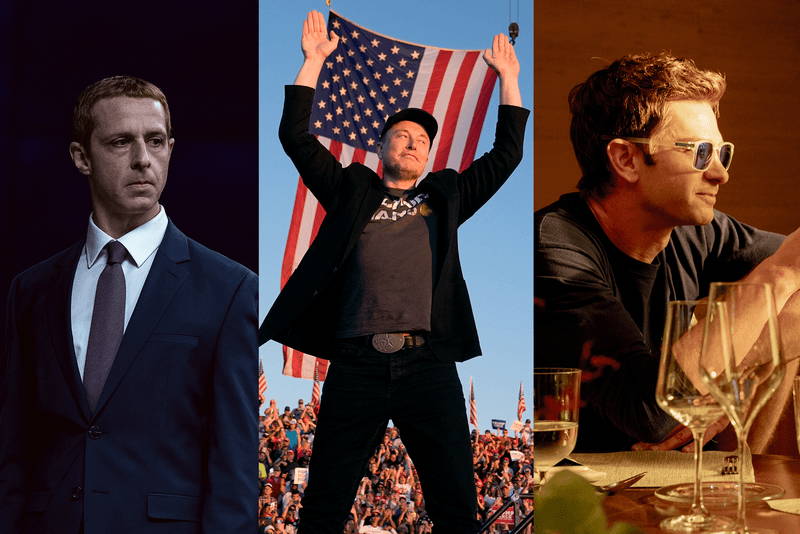
The Social Reckoning, Musk, Artificial. Sony Pictures, TIFF, Neon. | |
Hollywood’s Fall Villain Is the Tech Billionaire Sam Altman, Mark Zuckerberg, Elon Musk, and Elizabeth Holmes all get the big-screen treatment as filmmakers examine these controversial characters (and Sam Bankman-Fried gets a small screen consideration). By Rebecca Ford |
Villains in movies used to move in the shadows, cloaked in black, a scar hinting at some violent history. Now they’re wearing a quarter-zip fleece or a soft-shell vest and lurking behind a laptop. As the power and influence of tech billionaires—and the threat that AI could kill off humanity—draw the world’s attention, Hollywood is examining the real-life individuals who have become such larger-than-life characters that they warrant a two-hour (or, in one case, nearly four-hour) movie. Four films landing in theaters or at festivals within weeks of one another center on controversial individuals who rose to achieve power and wealth in Silicon Valley. There is Aaron Sorkin’s The Social Reckoning, a companion piece to The Social Network, another film he wrote (based on Ben Mezrich’s book The Accidental Billionaires); in the new project, Jeremy Strong takes over the role of Mark Zuckerberg from Jesse Eisenberg, for a story about the whistleblower, Frances Haugen, who exposed some of Facebook’s darkest internal research. There is Artificial, Luca Guadagnino’s film that stars Andrew Garfield, chronicling the crisis that ensued after OpenAI’s board fired Sam Altman, only to reinstate him five days later. There is Musk, Alex Gibney’s nearly four-hour documentary on the world’s richest man and his metastasizing hold on global power. And there is You Can See Everything, the wild, top-secret Nathan Fielder and Lance Oppenheim documentary in which Elizabeth Holmes, 34 days from entering federal prison, invites a camera crew into her life. (And Sam Bankman-Fried, the FTX founder who was convicted of wire fraud and conspiracy to commit fraud, will get the small screen treatment in The Altruists, a miniseries hitting Netflix in November.) The films may be in different genres, but they all showcase how these tech founders are worth examining in this exact moment due to the outsize influence they have over politics, culture, society, and the future. Their personalities are enigmatic—often they’re a weird mix of brilliant ideas and poor social skills—and their lifestyles are eccentric, making them perfect subjects for a movie. But in all four of these films, it’s their alleged intentions to control and manipulate that cast them as baddies onscreen. Sorkin first put a tech bro under the microscope back in 2010 with The Social Network. The film, which starred Eisenberg as the Facebook CEO and Garfield (now Guadagnino’s Altman) as cofounder Eduardo Saverin, was a hit amongst audiences and during awards season, ultimately earning eight Oscar nominations. Not everyone was a fan. Zuckerberg criticized Sorkin’s characterization of his reason for creating Facebook. “Basically, the framing is that the whole reason for making Facebook is because I wanted to get girls, or wanted to get into clubs,” he said to an audience at Stanford in 2010. “They [the film’s creators] just can’t wrap their head around the idea that someone might build something because they like building things.” But in the end Zuckerberg was a good sport about it publicly, crashing Eisenberg’s Saturday Night Live appearance in 2011 and calling the movie “interesting” when Eisenberg asked what he thought of it. Will he be as good a sport when it comes to The Social Reckoning, which hits theaters on October 9? Sorkin told Vanity Fair back in June that he hadn’t been contacted directly by the Facebook cofounder. “We haven’t heard from anyone except their lawyers, just saying, ‘Be careful,’” he said. Elon Musk has already been vocal about his portrayal in Gibney’s documentary on his social media platform, X. After Musk debuted at the Venice Film Festival, the Tesla cofounder replied to an X user’s post by writing, “Dogshit is worth more respect than Gibney.” He also claimed that the filmmaker “just assembled a hit list of people who either have an axe to grind or don’t even know me (but still have an axe to grind).” Musk went so far as to have attorney Alex Spiro send the film’s production company a letter alleging that the film falsely suggested Musk had influenced the 2024 presidential election. “You are on notice, before release, that the insinuation is false, that the material refuting it is public, and that you chose not to be told the rest,” Spiro wrote to Jigsaw Productions on September 3. (In response, Jigsaw released a statement saying, in part: “Alex Gibney’s films are consistently recognized for their in-depth, fact-driven explorations of influential figures and corporations, coupled with his bold and engaging directorial style…. The right to engage in open debate and fact-based examinations of powerful public figures is protected by the First Amendment.”) Gibney isn’t new to the world of Silicon Valley drama; he previously made a 2019 doc on Holmes, The Inventor: Out for Blood in Silicon Valley. He told Vanity Fair at the Venice Film Festival that he saw similarities between Musk and Holmes, specifically in the way that the two have seemingly bent the truth to serve their impulses. “They create this fantasy that people are willing to invest in,” he said. To read the rest of this story, click here. |
|
|
|
$17,100,000,000: the maximum amount Meta agreed to pay in order to settle a landmark suit with a coalition of states over the safety of the company’s tech platforms, particularly for kids and teenagers. |
This e-mail was sent to you by VANITY FAIR. To ensure delivery to your inbox (not bulk or junk folders), please add our e-mail address, vanityfair@newsletter.vf.com, to your address book. View our Privacy Policy | |