| | In today’s edition: Middle East investors struggle to find the exits, Tabby raises $233 million as f͏ ͏ ͏ ͏ ͏ ͏ |
| |  | Gulf |  |
| |
|
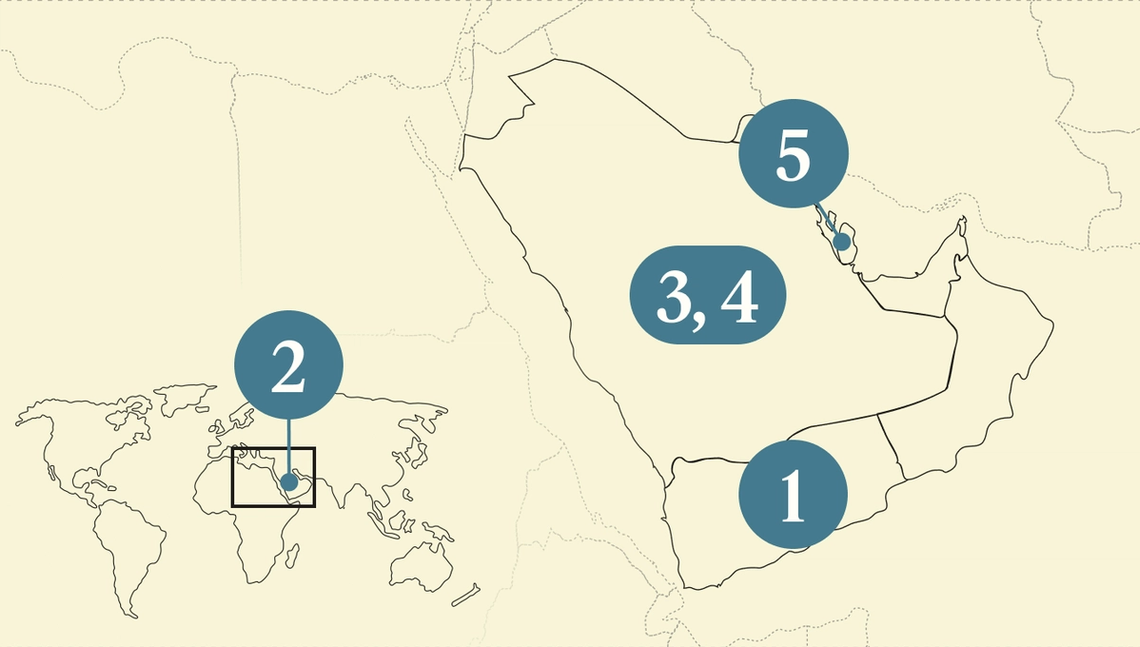 - Saudi’s Yemen puzzle
- Dire exit scene in 1H but…
- …mega deals are steady…
- …and infra lures investors
- Qataris win stadium job
 Mykonos party spot goes sober in Saudi. |
|
Saudi Arabia under attack |
 Houthi Media Centre/Reuters Houthi Media Centre/ReutersSaudi Arabia is coming under increased military pressure on its northern and southern borders, testing Crown Prince Mohammed bin Salman’s efforts to save the kingdom from the worst of the Iran war. The closure of the East-West Pipeline and a barrage of missile and drone attacks from the Tehran-aligned Houthis in Yemen over the past week have turned the kingdom from one of the Gulf’s most insulated countries into one of its most vulnerable. Riyadh isn’t getting help from Washington and lost the UAE — its only partner in Yemen — last year, leaving it with few options other than revisiting a war that, in its previous iteration, became a costly, decade-long quagmire. The kingdom has sought international support, but nothing has been promised at the scale required to reverse the Houthis’ recent advance toward Bab el-Mandeb. Prince Mohammed travels to Egypt today to meet President Abdel Fattah El-Sisi as Riyadh considers its options. Barbara Leaf, a former senior US diplomat, told The New York Times that she expects Saudi Arabia to turn to diplomacy, potentially working with other Gulf countries and Iran to reach an “ugly set of arrangements” to end the war. — Mohammed Sergie |
|
No exit signs for MENA investors |
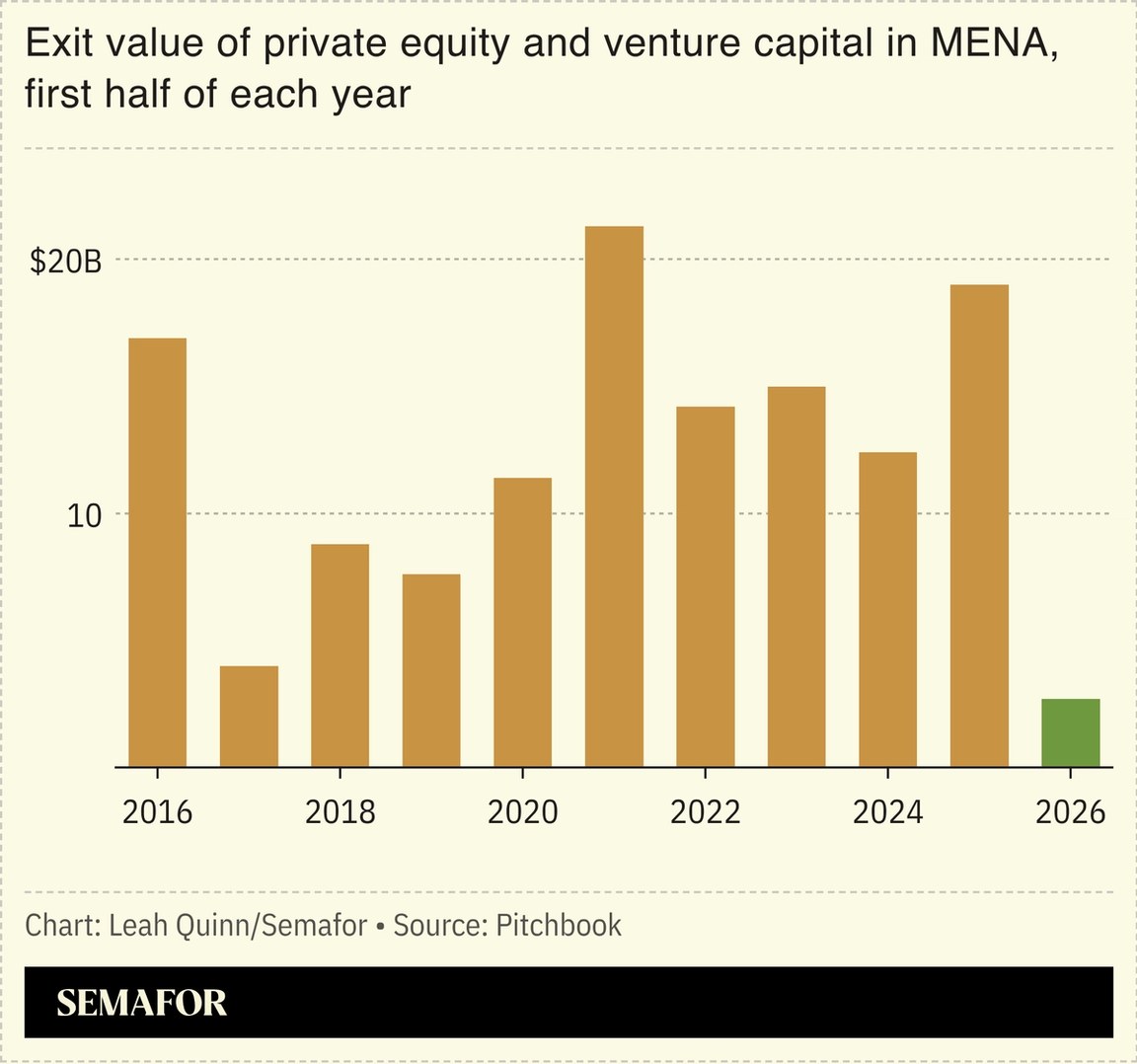 For investors looking to cash out, it’s getting harder to find the exits in the Middle East as stock market listings have collapsed in the wake of the Iran war. IPOs accounted for less than 10% of private equity exit value in the first half of this year, compared to around 61% in 2025, according to PitchBook. Saudi budget carrier flynas has become the market’s cautionary tale: It listed with a $3.3 billion valuation in June 2025, but slid to $2.2 billion by the end of August. This is having a chilling effect, according to Nalin Patel, the director of research for EMEA private capital at PitchBook. Money is still flowing into startups, though it’s heavily concentrated. The UAE took two-thirds of venture capital and has already passed its full-year 2025 total. But it was thanks to three mega-rounds that accounted for the majority of this year’s fundraising. — Kelsey Warner |
|
Tabby value shoots up by $2B |
 Fintech company Tabby has raised $233 million in its latest round at a $6.5 billion valuation, showing that investors are still willing to pay top dollar for profitability and scale in the Gulf. The valuation is $2 billion higher than when the “buy now, pay later” company last raised funds 13 months ago, and tops that of listed rival Klarna. The Saudi firm plans to use the money to push into longer-term consumer loans and business working capital in the kingdom, as well as a debit-account alternative in the UAE. The sector has been a rare bright spot in a Gulf startup market that has otherwise stalled: Regional venture funding fell by more than a fifth in the first half, per Magnitt. Saudi Arabia is pushing aggressively into fintech, targeting more than 500 such companies licensed by 2030, up from fewer than 300 in 2025. |
|
Building boom powers Saudi startup |
 Courtesy of BRKZ Courtesy of BRKZSaudi building materials startup BRKZ has raised $31 million to fuel an AI-powered expansion during the kingdom’s construction boom. Aramco’s Wa’ed Ventures and US-based 500 Global co-led the equity round, while India’s Stride Ventures committed $18 million in debt financing. BRKZ supplies contractors working on Public Investment Fund-backed projects including Diriyah, King Salman Park, Qiddiya, Red Sea resorts, and ROSHN — developments that remain priorities as Saudi Arabia prepares for Expo 2030 and the 2034 men’s soccer World Cup. The company expects revenue to triple this year after more than doubling in 2025. Building materials are a highly fragmented global industry that is consolidating while facing competition from startups using technology to challenge incumbents. BRKZ plans to use the new funds to expand its AI-powered pricing and fulfillment technology, and deepen sourcing from China, India, and other markets. — Mohammed Sergie |
|
Qatari billionaire wins Saudi stadium contract |
 Courtesy of Estithmar Holding Courtesy of Estithmar HoldingThe family that built much of Qatar’s World Cup is now working on Saudi Arabia’s. Estithmar Holding, chaired by Qatari billionaire Moutaz Al-Khayyat, won an 829 million riyal ($221 million) contract for the heating, ventilation, and air conditioning systems at the Prince Mohammed bin Salman Stadium in Qiddiya, a flagship 2034 venue. It is their largest in the kingdom; the Al-Khayyats earned billions in Qatar’s infrastructure boom last decade, and are partnered with Jared Kushner on a contested resort in Albania. The stadium sits atop a 200-meter cliff outside Riyadh, and features a retractable roof and movable pitch, increasing capacity from 47,000 to 60,000 as the venue switches between football, concerts, and other sporting events like boxing matches. Saudi Arabia must deliver 11 new stadiums among the 15 promised in its bid, and venues remain a priority as the kingdom trims spending elsewhere. |
|
 Checking In- Etihad Airways unveiled new cabins for its 15 newly ordered Airbus A330s at the Arabian Travel Market in Dubai, with four first suites per plane — featuring closing doors, 32-inch screens and space for a companion to dine — set to join its fleet over five years. The UAE carrier says it is spending $20 billion on passenger experience, adding first class to its short- and medium-haul routes where regional competitors opt for recliners.
 Courtesy of Etihad Airways Courtesy of Etihad AirwaysDeals- Abu Dhabi-based International Holding Company and Adani Group agreed to invest $25 billion across 14 projects in India, spanning critical minerals and rare earths, health care, petrochemicals, renewable energy equipment, and tourism. The two conglomerates are also planning an $11.5 billion aluminum venture. — The National
Diplomacy- US President Donald Trump nominated Wesley Hunt, a Republican congressman from Texas, to be the ambassador to Saudi Arabia. A former US Army Apache helicopter pilot, Hunt was deployed twice to the kingdom as a diplomatic liaison officer. — Houston Chronicle
Logistics- flydubai will launch dedicated freighter operations on Oct. 1, rolling out three wet-leased Boeing 737-800 freighters from Al Maktoum International across a network of more than 125 destinations. Each aircraft can carry 23,000 kg of cargo.
Telecoms- The UAE’s Space42 and Californian satellite company Viasat committed up to $1 billion in initial equity to co-found Equatys, a satellite platform that will sell direct-to-device capacity to mobile operators the way tower companies lease masts. The venture has relationships with more than 400 carriers and is designed to scale to 2,800 satellites.
|
|
 Courtesy of AMAALA Courtesy of AMAALANammos is putting on its abaya and trading bottle service for wellness on Saudi Arabia’s Red Sea coast. The Mykonos beach club opened a resort this week at tourism destination AMAALA, featuring 110 rooms which each come with a butler, an eponymous restaurant set on its own private island, and a regenerative spa where the degenerative party used to be. Anyone who knows the brand will find the idea of going to Nammos for wellness almost ridiculous: Its baseline state is champagne with sparklers and dancing on tables. The opening is part of the kingdom’s bet on ultra-premium tourism. For locals, the pitch is that they will no longer need Cannes or Dubai for their favorite beach club. Whether Nammos without the party — but plenty of overpriced crab tartare — will suffice remains to be seen. — Manal Albarakati |
|
| |  | | | You’re receiving this email because you signed up for briefings from Semafor. |
|


