| | US President Donald Trump could be hastening the end of the oil age. ͏ ͏ ͏ ͏ ͏ ͏ |
| |  | Energy |  |
| |
|
 - Houthi escalation
- New coal peak
- Winter gas arbitrage
- Hydrogen ceiling
- Refining rush
 Ukraine’s drones reach new depths of Russia, and trouble brews at the IPCC. |
|
 One lesson from the return of crude oil prices back above $100 per barrel is that US President Donald Trump seems to be hastening the end of the oil age. Apart from the psychological impact of that extra digit on US voters, there’s nothing intrinsically special about the $100 threshold. But Wall Street, which has spent most of the Iran war feeling decidedly bearish about oil prices, is clearly getting anxious about the latest round of mutual tanker attacks. All the big banks, and even the US Energy Information Administration, raised their 2027 price forecasts this week, and several issued research notes making similar arguments about a “new normal” of prolonged disruption in the Strait of Hormuz. It’s intuitive that oil prices will jump up when the supply is constrained. And assurances by the Trump administration to the contrary notwithstanding, the supply is definitely constrained: In a report Thursday, S&P Global Energy concluded for the first time since the war started that it “does not project Middle Eastern crude oil production to return to prewar levels by the end of 2027.” But the demand side of the equation is also changing, which could produce a more counterintuitive effect. As former White House official Bob McNally describes in his timely book Crude Volatility, oil prices tend to swing more widely than other commodities because demand is assumed to be highly inelastic. Slightly cheaper gasoline doesn’t make people rush out to buy new cars, but once you have a car and need to drive it to work, you have to pay up for fuel even if it’s slightly more expensive. In order for the oil market to be physically in balance, a supply shortfall must produce prices high enough to make people stop buying fuel. Yet what we have seen over the last six months is that the number required to achieve that effect may be lower these days than many analysts realized, thanks to the proliferation of alternative energy sources that have apparently left businesses and consumers with a lower tolerance for pricey oil products. Natasha Kaneva of JP Morgan, in a note this week, observed that since the war started, oil demand has run about 5 million barrels per day below last year, and that “demand has absorbed the largest share of the [price] shock.” Some of this demand destruction is not related to prices, but due to the physical destruction of Russian refineries by Ukrainian air strikes and to reduced runs at Gulf refineries that have no way to export products. Still, price is the key factor, and if the strait remains in its current state of semi-closure, Kaneva predicts demand next year will fall to its lowest point since 2019. In other words, rather than being Big Oil’s biggest booster, Trump could be dragging forward the moment of peak consumption. |
|
Red Sea disruption drives oil prices |
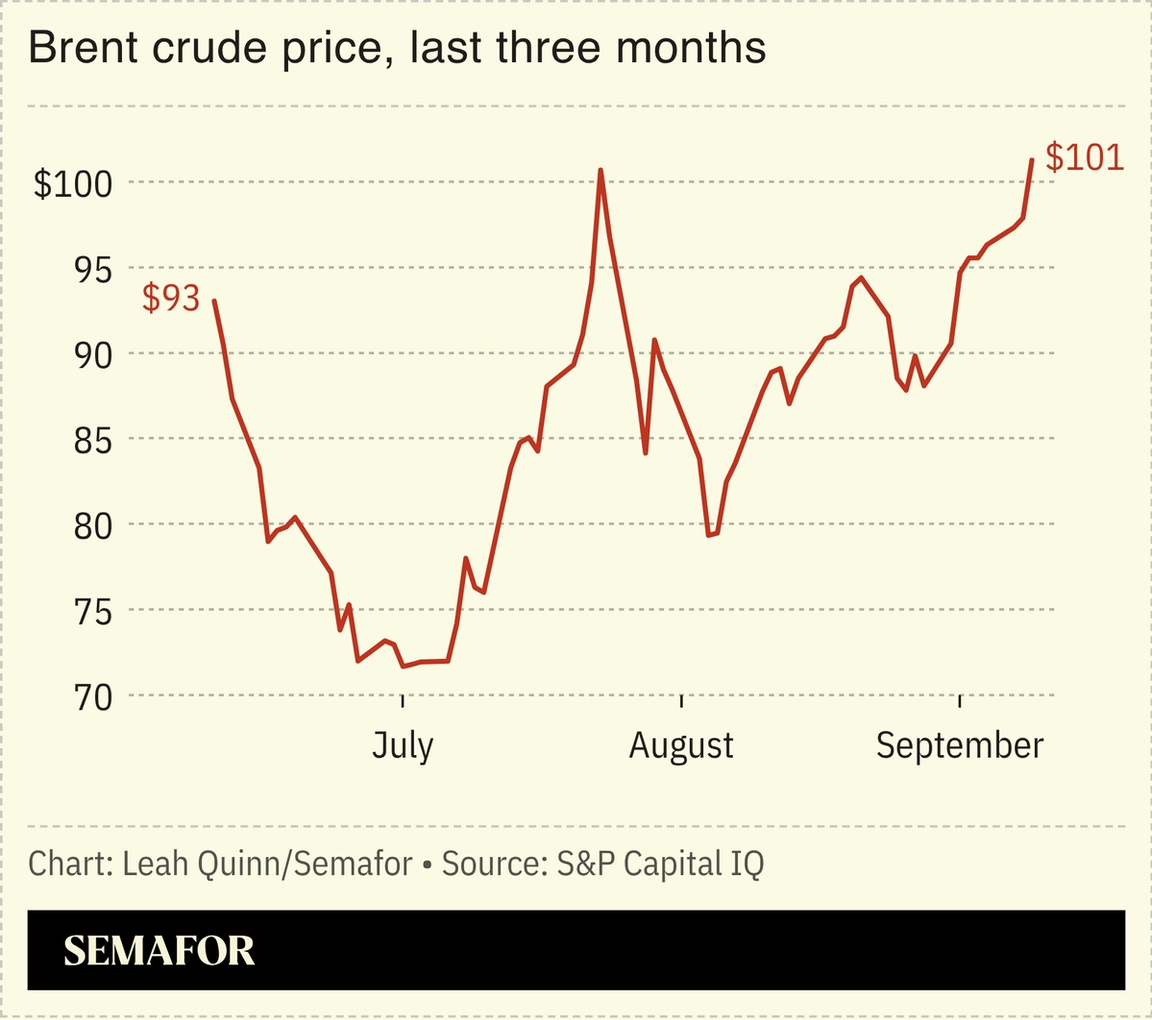 A renewed push by Yemen’s Houthis to disrupt Red Sea oil exports helped to push oil prices to their highest point since July. The Iranian-backed militia has struck military and energy targets in Saudi Arabia, prompting dozens of counterstrikes from Saudi forces in Yemen on Wednesday, and its maritime blockade is also choking shipping in the Bab al-Mandeb Strait. Saudi Arabia, a key price stabilizer in the market as a major exporter, is running out of ways to get crude out, The New York Times reported. Its oil exports fell last month to 3.2 million barrels a day, the lowest level in at least 13 years, according to data from Kpler. Meanwhile, with Iranian exports at zero, refineries in China are scrambling for alternative sources and willing to pay a rising premium — even for barrels from Russia. |
|
 Rising natural gas prices wrought by the Iran war will boost global coal consumption to a new record of nearly 9 billion metric tons this year, the International Energy Agency reported. China remains by far the world’s coal heavyweight: Its power sector alone consumes one-third of the world’s coal. Yet although China and India both saw rising demand this year, “for the first time in 50 years, both countries generated less electricity from coal than the year before,” the IEA reported. In the US, where natural gas remains very inexpensive, coal demand is expected to drop 7% this year, reversing gains from 2025. As for whether coal will reach a new peak next year, the report says, it all depends on the resumption of LNG trade out of the Persian Gulf. |
|
 Lisi Niesner/Reuters Lisi Niesner/ReutersDespite attacks by Russia on its natural gas production fields, Ukraine has moved to a gas surplus and is angling to increase exports to Europe this winter, the CEO of the country’s top private energy company said. Ukrainian energy companies spent much of the last few years scrambling for gas imports, including several LNG cargoes from the US. “Now the situation has dramatically changed,” DTEK’s Maxim Timchenko told journalists: The company will continue to shop for LNG imports, but aims to leverage Ukraine’s vast gas storage facilities far from the front line to make lucrative arbitrage trades with Europe. However, the country’s supply of coal, which is the main fuel for its thermal power plants, has been pushed to deficit by Russian attacks on mines and supply lines. After roughly €300 million in reconstruction costs for Ukraine’s power grid over the past few years, and a renewed push to build anti-drone barriers around substations, Timchenko said, it could be hypothetically possible to pass the coming winter with no heat or power cuts. But as Russia builds out its arsenal of more powerful drones, he warned Ukrainians should brace for another season of darkness: “We learned a lot in the last winter. Unfortunately, as much as we are better prepared, Russians have more tools to destroy our preparations.” |
|
Hydrogen investment ceiling |
 Global investment in low-carbon hydrogen will reach a new high this year, but the nascent industry is close to hitting a bureaucratic cap on its growth, an industry group report warned. Cumulative investment since 2020 in projects to manufacture hydrogen using either renewable energy or natural gas paired with carbon capture will reach $130 billion, spread across nearly 600 projects, of which 90% are under construction, according to the Hydrogen Council. But the pace of new investment slowed this year, and the report concludes that the total volume of hydrogen production currently under construction is greater than the volume of demand currently supported by policy, given that tax credits, clean fuel standards, or other forms of government intervention are required to make most clean hydrogen economically competitive with normal natural gas. “A much larger pool of demand sits close to competitiveness,” the report concludes, “but would require an acceleration of supply cost reductions, additional policy action, and extensive build out of connective trade infrastructure to unlock.” |
|
 Siphiwe Sibeko/Reuters Siphiwe Sibeko/ReutersSouth Africa announced plans to at least triple its oil refining capacity, the latest country on the continent to make moves to boost its energy independence. The war in the Middle East has exposed Africa’s reliance on energy imports, which account for around 70% of the continent’s refined fuel needs. In response, several countries have made moves to boost their refining capacity: Africa’s richest man recently announced he would build a mega-facility in Kenya modeled on the continent’s biggest refinery in Nigeria — which he owns. Countries have also boosted their adoption of renewable energy, helping millions access reliable electricity for the first time. Think tank Ember projected Africa’s adoption of solar panels would rise by 45% this year. |
|
 New EnergyFossil Fuels- Capital spending by the top US oil and gas companies plummeted in 2025 from the prior year as a wave of mergers and acquisitions collapsed, research by EY found. Still, production continued to increase.
 FinanceTechPolitics & PolicyScienceNew York Climate Week |
|
|


