|
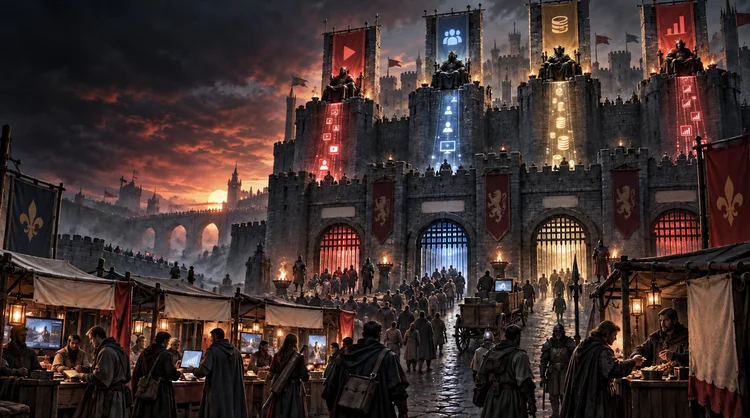
Alan Wolk has spent a good part of this year mapping how feudal media broke the mass-audience playbook for publishers and platforms — the monoculture split into loyal, self-contained fiefdoms that barely know what's happening outside their own borders. What gets less attention is what that same fragmentation does to the business of renting access to those fiefdoms: sponsorship, licensing, entertainment IP. The short version: the industry is still selling, and buying, a metric built for a kingdom that no longer exists.
For years, branded entertainment sold brands one exact promise: leave the advertising that interrupts and step inside the story. Become part of a narrative, a show, a cultural moment, instead of standing outside it.
I know this world well. I spent a large part of my career building these kinds of projects inside television and media companies.
And looking back, I keep asking myself a question that only now makes sense to ask: did we really create value for brands, or did we just find a better way for media owners to monetise their audience?
Because the economics, for the publisher, the broadcaster or the rights holder, were always crystal clear. A standard ad slot has a price. Add access to a talent, an editorial integration, production, exclusivity, a major IP or a bespoke activation, and that price goes up. The project looks more curated, more special, certainly less invasive.
But does it really build a stronger relationship between the consumer and the brand? We rarely knew. And, to some extent, we still don't.
The measurement gap
The industry has become far more sophisticated in how it builds branded entertainment. Measurement hasn't evolved at the same pace.
In Italy, data from the Osservatorio Branded Entertainment shows companies invest mainly in brand awareness (61%), brand image (53%) and consideration (44%). Trust drops to 24%, advocacy to 20%, loyalty to just 12%.
Globally, the picture doesn't change. A 2025 WFA/Lumency study, covering over $8.2 billion in sponsorship investment, found that nearly three in four practitioners consider ROI measurement a major challenge. 84% measure awareness, 65% consideration; commercial attribution lags far behind. Less than 1% of sponsorship budgets is typically allocated to measurement.
There's a detail in that same study that goes almost unnoticed: of all the metrics measured, advocacy is tracked the least — just 6% of brands follow it, down from 15% two years earlier. While awareness climbs to 84%, the one metric that actually tells you whether someone has adopted you is being measured less and less.
It isn't distraction. It's the need for data you can put in front of a board or a CFO — data that assumes advertising, deep down, isn't sexy enough on its own.
Awareness was the right metric for a world of media monoculture: broad and generic enough for a single audience, reachable with one message, where being noticed by enough people was all that mattered. Alan Wolk calls it feudal media: that world broke, and in its place came fiefdoms — podcasts, Substacks, TikTok channels, streaming communities — each with its own loyal audience that's largely unaware of what's happening outside its own borders.
If that's true for news and entertainment, why wouldn't it be true for advertising? In a feudal landscape, aggregate awareness measures loyalty to a kingdom that no longer exists. Advocacy — being remembered and recommended inside a specific fiefdom — is the metric that tells you whether a brand has actually entered a community. And it's exactly the one the industry has stopped watching.
The Sponsorship Effectiveness Forum, analysing 92 public case studies from sports sponsorship — the most mature, most measured segment of the industry — found an even sharper pattern: brand effects are reported five times more often than sales effects. And yet, among the best-designed, most rigorously measured cases, 73% generated sales effects and 54% business effects. If that's true in the segment that measures best, it's reasonable to assume the gap in branded entertainment is at least as wide, if not wider.
That detail matters. It says partnerships aren't inherently incapable of generating real value. The problem is that most were never designed to — or never measured as if they should.
Even award-winning branded content confirms it. A 2026 academic analysis of 23 Cannes-winning campaigns found that 43% relied exclusively on audience metrics, while sales metrics appeared in roughly 30% of cases. The formats changed enormously over 10 years. The sophistication of the metrics, much less.
Which opens an uncomfortable possibility: a large part of branded entertainment has become very good at proving that people watched, noticed, liked or remembered something. But that isn't the same as proving the brand became more important to them.
The stronger the IP, the easier it is for the brand to disappear
This becomes especially interesting when the partnership involves a very powerful entertainment IP.
Spider-Man doesn't need help being culturally relevant. Neither do Star Wars, Frozen or Stranger Things. They already have narratives, symbols, characters, rituals and fandoms that people carry with them for decades.
For whoever owns the IP, that's an enormous asset. Disney figured this out long ago: the story becomes fandom, the fandom becomes merchandising, the merchandising becomes experience, the experience feeds the fandom again. The commercial flywheel is extraordinary.
But what happens when a consumer brand steps into that flywheel? Put Spider-Man on a package. Launch a limited Stranger Things edition. Build an activation around Star Wars. You can grab attention, create scarcity, even generate meaningful incremental sales.
But one question remains: once the IP disappears, what's left for the brand?
The fan still loves Spider-Man. Still loves Stranger Things. But does he now care more about the pasta, the soda, the sneakers or the phone that happened to be there too?
This is the paradox: the stronger the IP, the higher the potential value — but also the higher the risk that the brand becomes a temporary accessory to someone else's culture. It can be a beautiful campaign, work for three weeks, win an award. And then disappear.
Meanwhile, the media environment changed
The problem gets more interesting because the way cultural influence works has changed.
For most of the mass-media era, cultural influence was hierarchical: a handful of broadcasters, publishers, celebrities and major entertainment IPs sat at the top. The audience watched from below.
Technology and fragmentation broke that hierarchy. The creator economy didn't just produce millions of extra pieces of content: it created a different kind of cultural authority.
Today you can become influential by talking obsessively about mechanical keyboards, Korean skincare, running shoes, Roman history, vintage watches or a single video game. And the relationship that forms is often different from the one people once had with a distant celebrity.
The creator feels like someone who shares my exact passion. I watch because I do that thing too. I recognise myself. I comment. I recommend. I disagree. I remix. I participate.
This explains why affinity has become such a powerful economic force. But I think there's a step beyond affinity.
From affinity economy to participation economy
Affinity explains why I gravitate toward a person, a community or a cultural world. Participation explains what happens once I start contributing to it.
The difference matters economically. Affinity is emotional capital. Participation turns it into productive capital.
Look at businesses built on this logic from day one, instead of grafting it onto a campaign. WeRoad is an interesting case: the formal product is organised travel, but most of the real experience is created by the people who take the trip. The company provides infrastructure, itineraries, coordinators and the brand; the travellers produce most of the value — relationships, shared experiences, stories, rituals, social connection.
The model has reached real scale: WeRoad in Europe, reports more than 300,000 people have travelled with the company since launch, 100,000 in the last year alone, with a community of over 4,000 coordinators. Its WeMeet platform generated 2,000 events and 50,000 participants in 2025.
The point isn't that every brand needs to become WeRoad. It's that participation can be part of the product, not just a marketing mechanic.
LEGO Ideas applies a similar principle to product creation. Fortnite and Roblox apply it to entertainment. Creator platforms apply it to culture. Community-led brands apply it to product, recommendation and distribution.
In all of these systems, the consumer is no longer just someone who receives value. They become one of its producers.
But can an FMCG brand do this?
Here comes the obvious objection. Participation works for Fortnite, fine. It works for LEGO, fine. But a pasta company? A biscuit? A detergent? Barilla certainly can't let the internet decide what Barilla is.
Probably not. But maybe that's the wrong definition of participation.
A brand doesn't have to give up control of the brand. It can give up agency. There's a difference.
A pasta company still has to control food safety, product quality, manufacturing, trademark, margins and core brand principles. It doesn't necessarily need to control every interpretation of how pasta lives in culture.
It can let creators show how pasta genuinely exists in their lives, without scripting every message. A community can invent rituals, recipes, occasions. Creators and consumers can propose formats, designs, limited editions. The community can signal demand before a product ever reaches industrial production. The company still decides what actually gets manufactured.
This isn't brand anarchy. It's a controlled transfer of agency. The brand stops approving every single cultural output and starts designing the rules within which others can create value around it.
And we already know this can work commercially. PepsiCo's Do Us a Flavor programme lets consumers propose and vote on new Lay's flavours, becoming a repeatable international platform and generating meaningful incremental sales in multiple markets. The real innovation wasn't the contest itself — it was redistributing one piece of product development: the company kept control of manufacturing and brand, consumers got agency over invention and selection.
Now put a powerful IP into that system
This is where brand partnerships could get a lot more interesting.
Traditional model: Netflix owns the IP. The brand rents it. The agency builds the activation. The audience consumes.
Now imagine a different architecture: whoever owns the IP opens a cultural world. The brand defines a playground inside it. Creators and fans build things. The community selects, remixes or adopts. The brand turns some of those things into real products or experiences. Participation continues even after the media moment has passed.
The difference is profound. The audience is no longer the destination of the partnership — it becomes one of its producers. And the IP no longer simply lends fame to the brand: it gives the brand permission to create something together with a community that already genuinely cares.
Maybe that's the missing step. Not a transfer of affinity. A transfer of participation.
From renting fandom to earning a role inside it
This also changes the strategic question a brand should ask before buying a partnership.
Not: how visible will my brand be? Not even: how engaging will the activation be? But: what can this brand let this fandom do that it couldn't do without us?
It's a much harder question. And maybe a much better one.
Because if the answer is just a limited edition, some custom media and a QR code, the partnership can still work perfectly well — but it's still essentially advertising and licensing.
The more interesting opportunity is when the consumer brand earns a role: it enables creation, enables access, enables status, brings people together, turns fan creativity into real products, helps a community perform the culture it already loves.
At that point, the consumer doesn't just associate the brand with an IP. The brand has done something inside the consumer's relationship with that IP. And that's potentially far more valuable.
The afterlife test
Maybe every major brand partnership should have to pass one final test: what survives once the IP is gone?
If the answer is views, recall, awareness, purchase intent, a short-lived sales spike, then we probably built a very successful campaign. There's nothing wrong with that.
But if the goal was belonging, community or cultural relevance, we should expect more. Did people come back? Did they keep interacting? Did the brand gain new first-party relationships? Did creators keep producing? Did a ritual survive? Did customers buy again? Did the brand create an asset that still exists once it stops paying for the IP?
These are much more demanding measures. And they're also much closer to the economic promise branded entertainment has been making for decades.
The next partnership economy
The old media-partnership model was born in an era of scarce distribution and hierarchical culture. Media owners controlled the audience. Brands paid for access.
Today culture is increasingly fragmented, participatory, bottom-up. Generative AI will accelerate that break even further, making the production of content, images, video and ideas far more abundant.
What becomes scarce isn't content. It might not even be attention. What becomes scarce is voluntary participation: people's willingness to put time, identity, creativity and social capital around something they actually care about.
This changes the opportunity for brands. The next generation of partnerships won't be about finding ever more sophisticated ways to slot brands inside powerful entertainment IP. It will be about using that IP to build systems where people participate — and making sure part of that relationship belongs to the brand too.
A great IP can lend a brand attention. It can lend it affinity. But maybe the real opportunity starts one step later.
The old partnership model rented attention. The next one will have to earn participation. And the brands that learn how to do that will discover something far more valuable than a successful campaign: influence that remains even after the media spend ends.
|