| | Big Oil is facing a test of its ability to navigate geopolitical risk. ͏ ͏ ͏ ͏ ͏ ͏ |
| |  | Energy |  |
| |
|
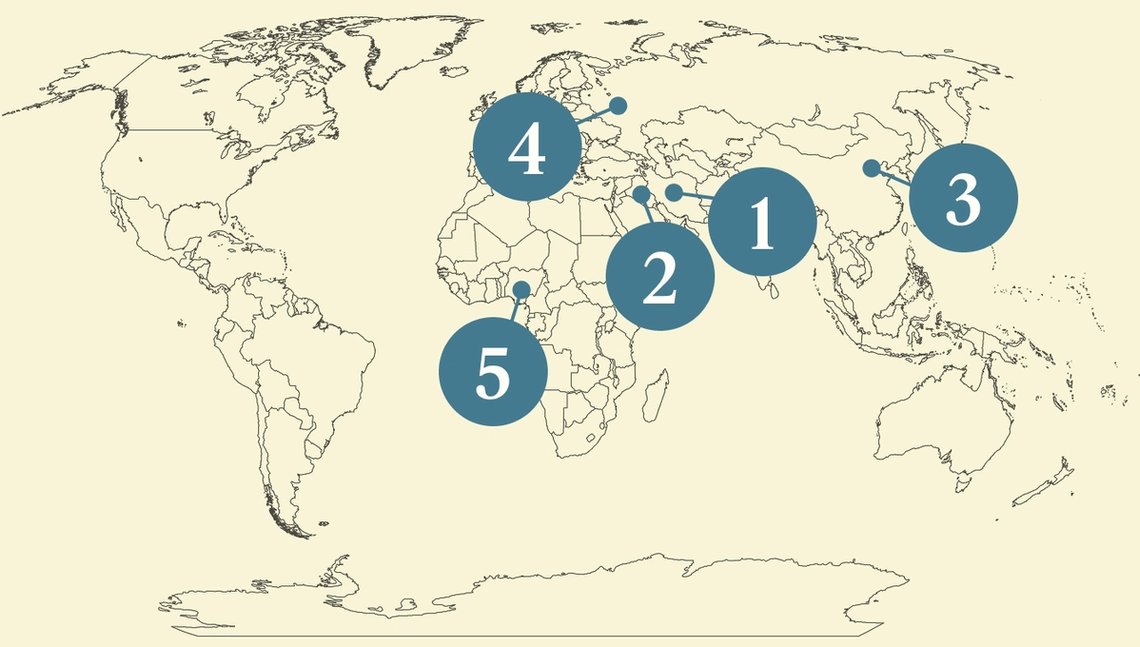 - Crude and fuels surge
- Barrel-sized budget holes
- China’s coal plateau
- Russian EV sales
- Africa’s energy vulnerability
 Dangote’s $14 billion refinery expansion, and South Korea’s $22 billion gas plant in Texas. |
|
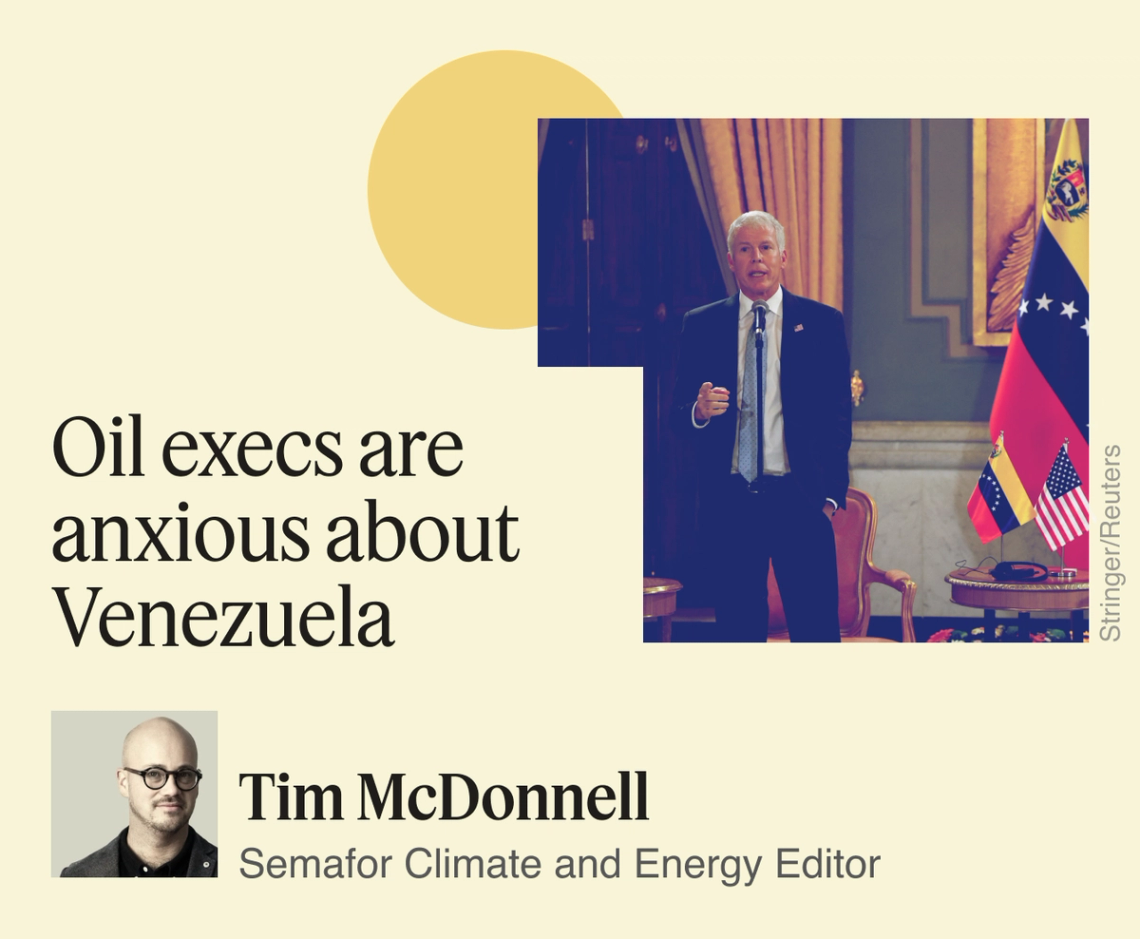 Big Oil companies have always moonlighted as geopolitical risk assessment firms. That capability faces a big test now. It takes guts to thrive in the oil business, where the wipeouts can be as spectacular as the slam dunks. Molecules are in the ground where they are, and engineering is not the only hurdle: Sometimes, a highly sophisticated navigation of political risk is required to get them out. Patrick Pouyanné, CEO of TotalEnergies, told me this year that he considers his company “not so risk-averse.” But he still won’t put its money anywhere that lacks “an economic framework and ecosystem where we feel comfortable” — a description he’s willing to apply to Iraq, for example, but not yet to Venezuela. For the past decade, most Big Oil companies have kept their growth in check, doubled down in their existing strongholds, and tried to give more cash back to their shareholders — not exactly the wildcat spirit of yore. But now they’re under pressure, in large part because of geopolitical upheaval, to consider ventures that dial the risk variable back up. And when it comes to the Trump administration’s new drilling regime in Venezuela, “the real risk is not technological, it’s not geological,” said Vincent Piazza, senior energy analyst at Bloomberg Intelligence. “It’s exclusively political.” The scene in Caracas over the past week indicates that oil execs remain highly allergic to political risk. The city had a celebratory atmosphere, an industry insider who just returned from there told me, as US Energy Secretary Chris Wright led a delegation of American and European energy executives and flaunted a new deal for the Pentagon to take partial ownership of one of the world’s largest oil reserves. But the real excitement around private sector-led deals for companies like Chevron and GE Vernova to expand their operations there was offset by “a lot of apprehension” about the Trump administration deal, the insider said. Oil executives are still confused about how it will work, what the US government’s role will be, and whether it will use the deal to open new doors for them — or if the operation will be run more or less exclusively by and for Venezuelan oil magnate and Trump ally Alejandro Betancourt López. It makes sense to be cautious when getting it wrong will cost you tens of billions of dollars. If political leaders in both Washington and Caracas expect more companies to go out on a limb before a more stable “ecosystem,” to use Pouyanné’s word, is in shape, they’ll likely be disappointed. “I think it’s a wise move to sit back,” Piazza said. “You have only two years of this administration. What happens next?” |
|
Crude surges amid Houthi attacks |
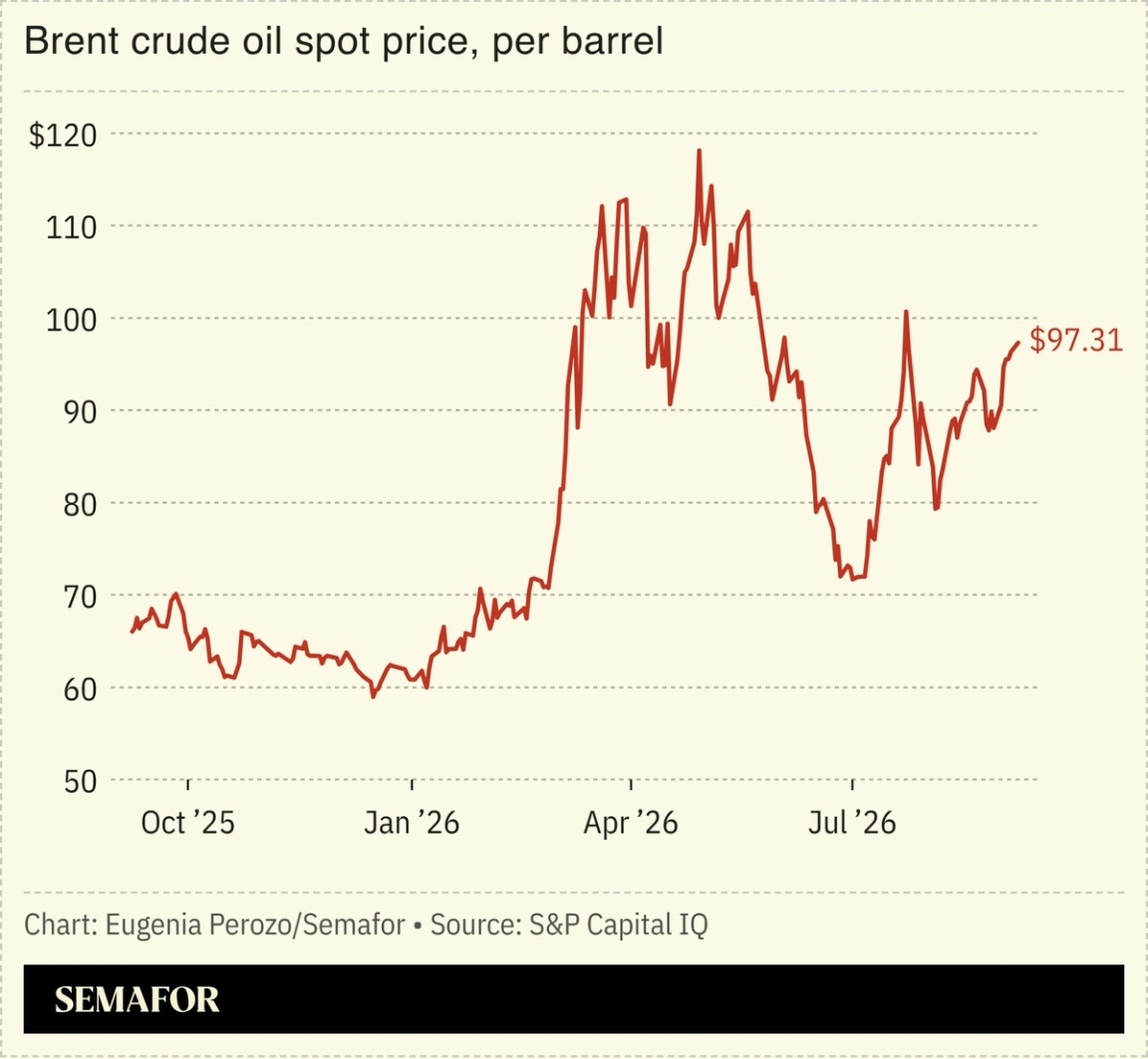 Attacks by Yemen’s Houthis against Saudi energy infrastructure drove oil prices towards the $100 a barrel mark. The latest round of attacks forced some Saudi oil facilities to suspend operations, and more could be forthcoming: The Gulf’s energy infrastructure is “sprawling, accessible, and exposed,” Iran’s lead negotiator wrote Monday, and “American oil and gas companies … share that exposure.” OPEC countries agreed this weekend to hold off on further production increases, a sign that exports from the Gulf remain constrained. Goldman Sachs raised its oil-price forecast, warning that prices next year could reach above $120, “reflecting our new assumption that Mideast shipping disruptions continue into 2027.” And Americans continue to feel the pain at the pump, with diesel and gasoline prices reaching record highs for this time of year. Beyond the Gulf, another factor driving crude prices up is a resurgence of demand in China. |
|
Barrel-sized budget holes |
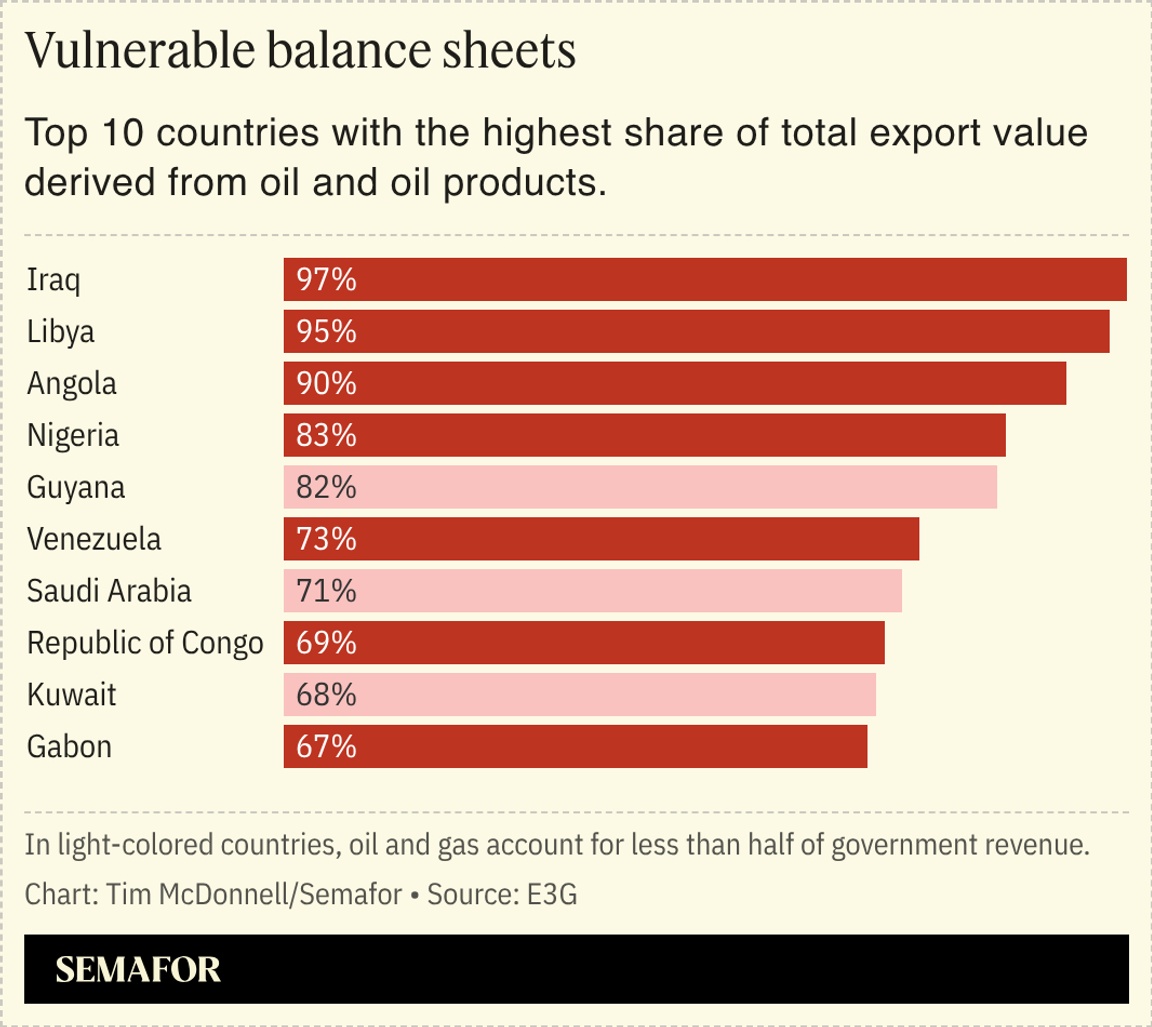 Maritime shipping lanes may not be the most important chokepoint facing the global oil market. The evidence of the past few months suggests that most oil-importing countries are less economically vulnerable to supply disruptions than previously assumed, Barclays analysts wrote on Tuesday, with the most important lesson of the war being that “diversification can go a long way in securing them against geo-economic bullying.” A bigger risk to global security could stem from the other end of the oil trade, the research group E3G argued in a new paper: Declining state revenue for major oil exporters, as global demand begins to contract, “brings risks that countries worldwide are not yet acknowledging or preparing for,” the report concludes. “In the oil endgame, security architecture will increasingly determine which producers can access shrinking markets, which trade routes remain insurable, which sanctions regimes hold, and how producer fragility is contained.” |
|
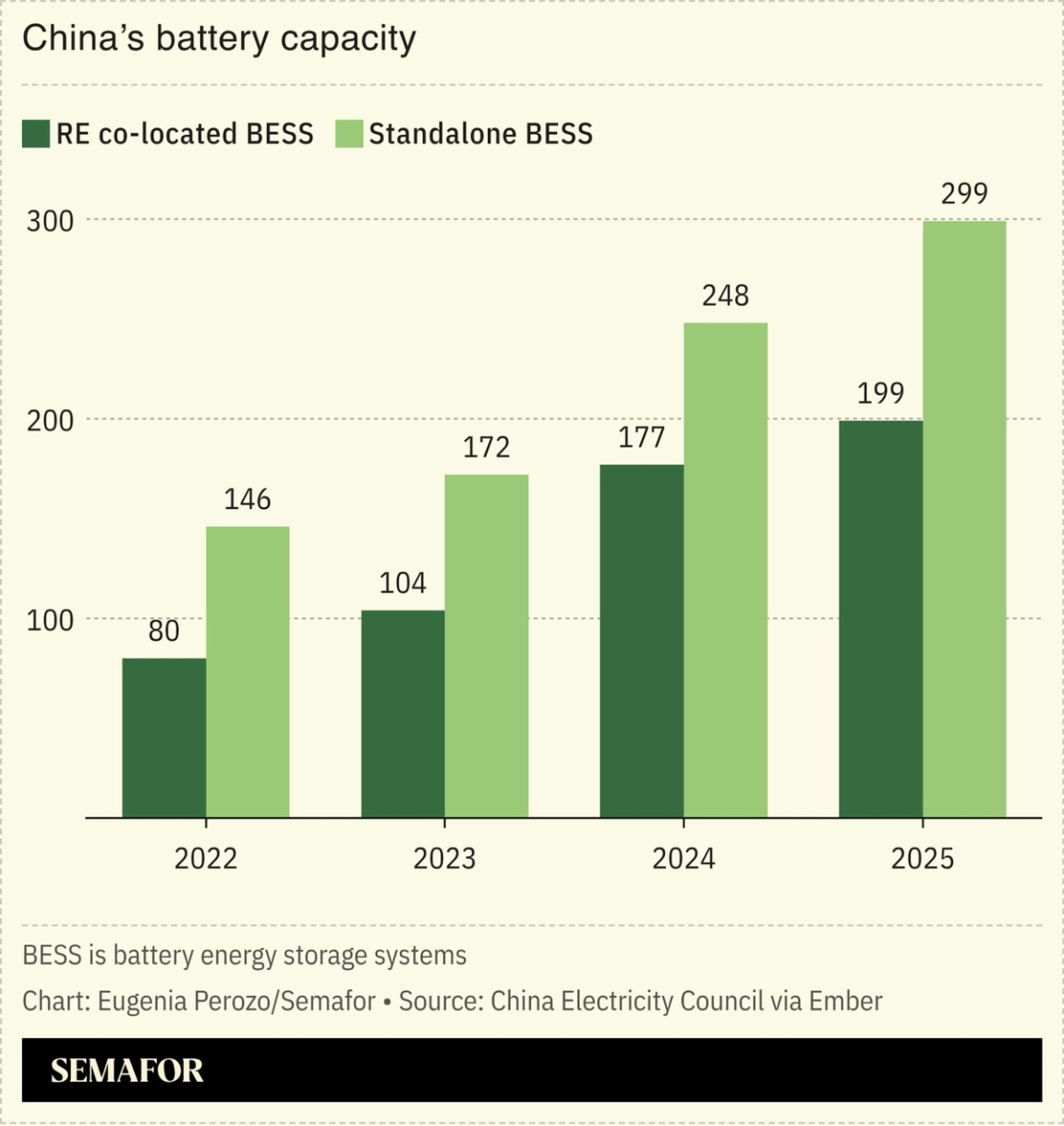 Fossil fuels are starting to plateau in China, as renewables drive more power generation in a new phase for the country’s energy transition. Coal generation has stopped growing in 17 out of 26 Chinese provinces and regions, and fossil fuel use is reaching its peak in eight out of 11 industrial sectors, according to a new report by energy think tank Ember. The decline is not a sign of deindustrialization, but rather of a rise in the country’s electrification, particularly in more demanding parts of the economy, Ember analysts said: China is now “building while breaking” — dismantling old energy systems while building new ones. A peak in China’s fossil fuel demand also weakens the assumption on which some of global fossil fuel investment rests — that demand will keep climbing. For “those economies whose public budgets and development plans rest on fossil fuel export revenues,” the president of the International Society of Energy Transition Studies warned, “the time to plan [...] is now, while the revenues are still there.” — Eugenia Perozo |
|
 Sales of EVs in Russia reached nearly 30,000 over the past three months, twice the number sold in the same period last year. Extensive Ukrainian airstrikes on oil refineries, which continued on Monday, have brought Russia’s refining capacity to its lowest level in decades, able to cover only about 70% of domestic demand. Fuel export restrictions and increased imports from India haven’t been able to close the gap, leading to hours-long gas station lines. The wars in Ukraine and Iran have been tailwinds for EV sales worldwide. But in Russia, a vast country with a limited charging network, they remain a tiny minority, accounting for less than 5% of car sales. |
|
Africa needs to rethink energy security |
  Stringer/Reuters Stringer/ReutersAfrican economies need to build energy systems for resilience rather than simply respond to the next crisis, a former Biden White House official argues, as the Strait of Hormuz disruption exposes the continent’s vulnerability to external energy shocks. African governments should use the moment to improve inefficient grids, diversify energy sources, expand domestic refining, and treat energy volatility as a financial risk, writes Nana Menya Ayensu, an energy strategy investment executive. Even oil producers such as Nigeria have struggled to turn domestic resources into reliable local supply, while countries dependent on imported fuel have faced soaring prices and shortages. The broader goal should be to build redundancy into energy systems — investments that can make economies more resilient while lowering costs, strengthening industry, and supporting growth. |
|
 New EnergyFossil Fuels- A Norwegian gas plant is planning to ramp up production as energy security concerns increasingly overshadow emission reduction targets in Europe.
- TotalEnergies will reduce its stake in Papua LNG — an asset that has been part of the company’s strategy to expand low-cost LNG — and hand over the facility’s operations to ExxonMobil.
- Germany’s gas storage industry association warned the country could face shortages this winter if temperatures are particularly low.
FinanceTech- Europe’s largest carbon-capture facility opened in the Netherlands this week, despite long-held concerns of the sector’s commercial viability and critiques from environmental groups.
- The US and South Korea have reportedly agreed on the scope of a $22.3 billion gas project in Texas, the first deal under a trade pact in which South Korea agreed to invest in the US in exchange for lower tariffs.
Minerals & Mining- A new report said Russia could control a third of mined uranium by 2040, which experts warned would be a problem for Western energy security.
Food & Agriculture- As farmers struggle with climate change, some are turning to perennial grains, which don’t require yearly planting and can therefore save on costs.
New York Climate Week |
|
|


