| | In this edition: Kenya’s government tells Tata Chemicals to leave, Uber exits Nigeria and Uganda, an͏ ͏ ͏ ͏ ͏ ͏ |
| |  | Africa |  |
| |
|
 - Tata told to leave
- Uber exits Nigeria, Uganda
- Dangote refinery IPO nears
- US warms to Zambia
- Aspen eyes GLP-1 growth
- Weekend Reads
 A local non-profit seeks to change the narrative around Ghana’s food culture. |
|
 West African governments are competing for something that, by definition, belongs to the region as a whole: the descendants of Africans taken during the transatlantic slave trade. Benin, Ghana, Guinea-Bissau, and Sierra Leone have all created pathways to citizenship, hoping to turn ancestral ties into tourism, investment — and lasting connections. Benin has even recruited Hollywood director Spike Lee, who received citizenship and became an ambassador for the initiative. There is a powerful historical logic to the effort. The West African coast was a major departure point for millions of forcibly removed people. For descendants, citizenship can be more than a passport — a formal restoration of a connection that was deliberately destroyed. The economic logic is less proven. The programs are vying for a diaspora that is potentially enormous, yet only 1,213 people received citizenship through the four initiatives from 2019 through 2026, according to the Migration Policy Institute. The actual number may be higher, since there is no centralized data, but there’s still little evidence these programs have generated significant, sustained investment. That doesn’t mean the opportunity is small. Diaspora communities can bring capital, business networks, skills, tourism, and political connections. Ghana’s “Year of Return” in 2019 showed the potential by boosting tourism, and the country has since formally recognized its diaspora as a “17th region.” The African Union has likewise made reparations a major political priority. The question, then, is whether West Africa should be competing over this market at all. The countries share much of the same history and, to some extent, the same pool of potential returnees, investors, and tourists. Yet their rules, fees, ancestry requirements, and political rights vary widely, risking turning a powerful idea into a collection of competing citizenship sales pitches. Ecowas or another regional body could fix that. A common framework for diaspora citizenship, residency, investment, and heritage tourism would give the region more credibility, ease the process, and reduce the incentive for governments to outbid one another. West Africa shares a history with its diaspora. It might make more sense to build a shared economic strategy around it, too. |
|
Kenya tells Tata Chemicals to go |
 Denis Balibouse/Reuters Denis Balibouse/ReutersKenya’s President William Ruto ordered Tata Chemicals to “pack up and leave” the country after accusing it of failing to create jobs and process minerals locally. Ruto, seeking a second term in polls next year, has increasingly focused on wealth creation through industrialization in his reelection pitch. The president’s remarks come five weeks after his mining minister directed Tata Chemicals to suspend operations at one of its plants, reportedly citing a failure to meet regulatory requirements. The company said it provided evidence of its regulatory compliance. Following Ruto’s comments, it said it remains “committed to constructive engagement” through legal and regulatory channels. Ruto, however, said the government has sought new investors to take over the company’s operations, with the aim of establishing manufacturing plants to add value locally and create jobs. It comes as Ruto moves to restrict small-scale retail and hawking to citizens, ordering authorities to begin shutting down foreign-owned businesses from Sept. 7. Ruto took office in 2022 after an election in which he vowed to improve the lives of ordinary Kenyans, but unpopular tax hikes prompted protests. Industrialization has become a recurring theme of his ahead of the 2027 election. Speaking at the inauguration of Zambia’s president on Tuesday, he urged African nations to develop manufacturing capabilities to “create opportunity and to create wealth.” — Alexis Akwagyiram |
|
Uber exits Nigeria, Uganda |
| |  | Alexander Onukwue |
| |
 Sodiq Adelakun/Reuters Sodiq Adelakun/ReutersUber continued a year-long retreat from Africa by ending operations in Nigeria and Uganda this week. Its exit from Africa’s most populous country in particular sparked scrutiny over the conditions for companies to thrive in the middle of an economic revamp. The US ride-hailing company launched in Nigeria in 2014, later expanding to offer boat rides in Lagos and a courier service. But challengers emerged and weakened its quest for dominance, often with different models tailored to local habits. Estonian company Bolt, for example, allows drivers to use car models that Uber deemed too old, while InDrive allows both passenger and driver to haggle over prices. Uber’s Nigeria departure, amid broader global cuts, now cedes ground to both firms and a crop of local players like LagRide, a startup backed by the state government in Lagos. Uber, which left Côte d’Ivoire last September and Tanzania earlier this year, maintains that it sees “growth and opportunity” in sub-Saharan Africa. Operations in Egypt, Ghana, Kenya and South Africa remain active. |
|
Dangote IPO due this month |
 Sodiq Adelakun/Reuters Sodiq Adelakun/ReutersAfrica’s richest man said his refinery’s much-anticipated IPO would launch soon, a move that could mark a step-change for the continent’s financial and energy markets. Aliko Dangote said the firm would seek to raise $5 billion after the offer launches within the next 12 days, potentially making it Africa’s biggest-ever public offering. The cash will help the Nigerian refinery more than double its production — already the largest on the continent — to around 1.4% of global capacity. The move is also expected to attract more funds into the country’s energy sector: The International Energy Agency head said the country could double its investment in five years as nations seek trustworthy partners after the fallout of the Iran war. Another Dangote-backed megarefinery is in the works in Kenya. A version of this item first appeared in our twice-daily Flagship briefing. Subscribe here. → |
|
|
Trump administration warms to Zambia |
| |  | Adrian Elimian |
| |
 Zambia’s President Hakainde Hichilema. Jean Mandela/Reuters. Zambia’s President Hakainde Hichilema. Jean Mandela/Reuters.The Trump administration is warming to Zambian President Hakainde Hichilema following his disputed reelection, despite growing concerns in Washington about a post-election crackdown. Assistant Secretary of State for African Affairs Frank Garcia attended Hichilema’s inauguration this week and separately met with the Zambian leader. The Trump administration’s posture towards the government in Lusaka contrasts with warnings from Democrats on Capitol Hill, some of whom had urged the State Department before the Aug. 13 poll to press for a free and fair election. Zambia’s election commission declared Hichilema the winner with about 60% of the vote, but opposition candidate Brian Mundubile has alleged irregularities and election observers have also reported inflated vote tallies and improper administration. Ties between the US and Zambia frayed this year following reports the State Department was tying health funding to preferential mineral access for US firms, a plan that Africa’s second-largest copper producer rejected. However, Zambia is central to the US-backed Lobito Corridor linking Angola, DR Congo, and Zambia’s copper belt to the Atlantic. |
|
 AFSIC returns to London on October 13-14, bringing investors and business leaders together to explore opportunities across Africa’s fintech, infrastructure, healthcare and other key sectors. This year’s program is the conference’s most comprehensive yet, with a wide range of industry discussions and a high-caliber investor audience. Register here. |
|
Aspen sees growth in weight-loss drugs |
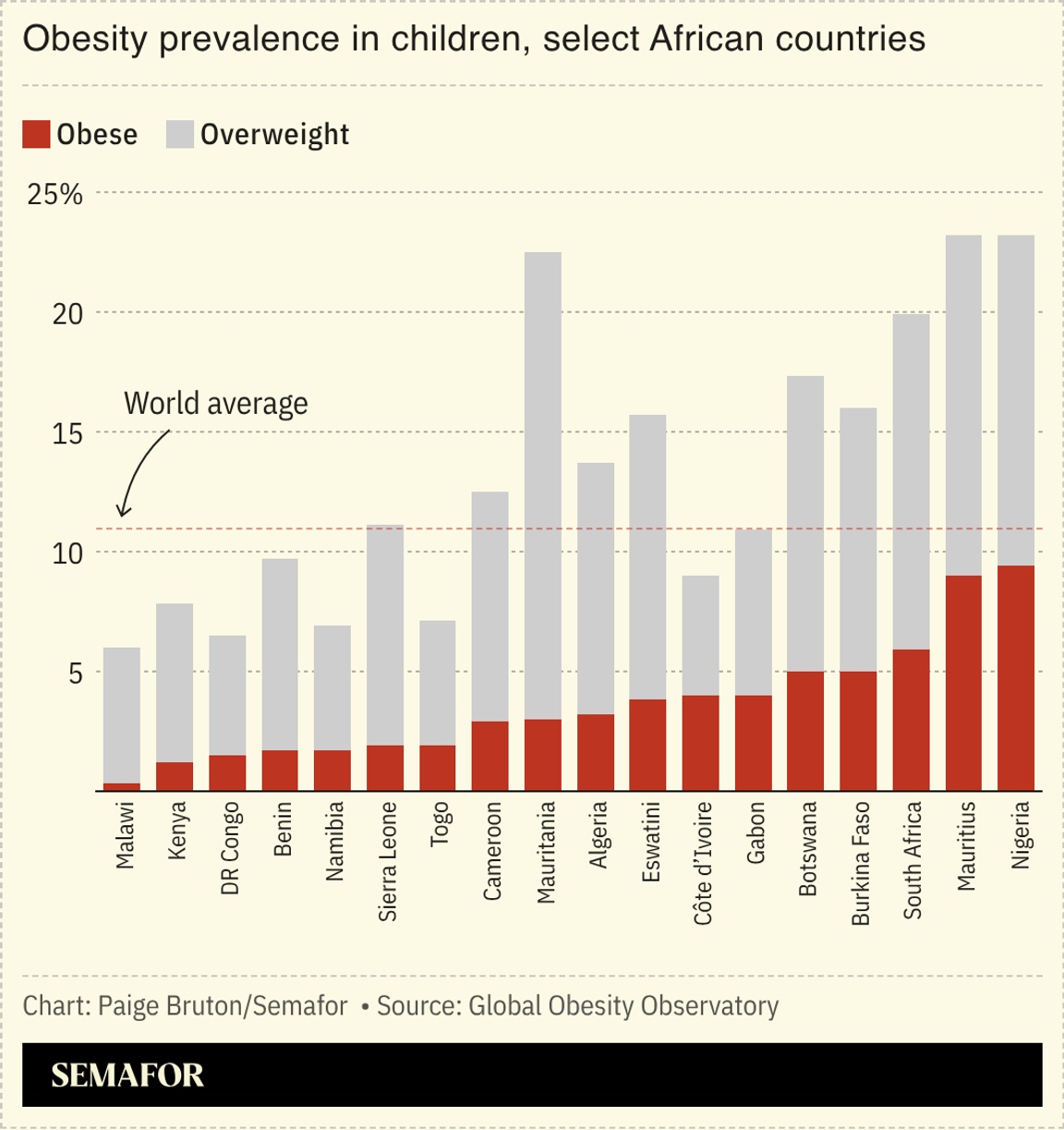 South African drugmaker Aspen Pharmacare said the rollout of its weight-loss drugs will help drive a 17% rise in earnings next year. Aspen sells Mounjaro, the weight-loss drug made by US manufacturer Eli Lilly, in South Africa. It will begin offering its own generic drug, targeting local markets as well as South America and the Middle East, according to Reuters. Demand from Africa currently accounts for only a fraction of the global weight-loss drug market that is expected to reach $100 billion by 2030, but obesity cases are rising and projected to double by 2050, causing public health concern. South Africa has become the main battleground on the continent between the leading providers of weight-loss drugs, with Eli Lilly’s Mounjaro up against Ozempic by Danish company Novo Nordisk. |
|
 - The legacy of US West Coast rapper Tupac Shakur, whose murder recently yielded a conviction 30 years after his death, lives on in an unlikely place: Cape Town, ethnographer Dariusz Dziewanski writes in The Conversation. Tupac’s music gave voice to the suffering of Black communities in the US, while also acting as a symbol of power and wealth. For marginalized young people in Cape Town’s townships, the US rapper’s legacy gives a “shared symbolic language to resist oppression,” Dziewanski writes.
- The intellectual frameworks that inspired Boko Haram, the jihadist group based in northeastern Nigeria, originated in earlier Egyptian texts, writes Aliyu Dahiru for HumAngle. One extremist text includes Sayyid Qutb’s Milestones, which was written from an Egyptian prison cell in 1966 shortly before the author’s execution, contributed to the conceptual language that jihadist ideologues later brought to Nigeria. Another was a 2005 letter from Ayman al-Zawahiri, Osama bin Laden’s then-deputy, which became one of the group’s most important internal documents, Dahiru writes.
- US-based non-profit GiveDirectly, which provides aid through direct cash transfers to families, claimed it donated to 4,600 people ahead of flooding in the farming district of Ibaji, Nigeria. The group said the AI-powered aid programme doubled farmers’ incomes, lowered food insecurity by 90%, and left 93% feeling more prepared for future floods. However, an investigation by Damilola Ayeni for The New Humanitarian revealed that some would-be aid recipients were mistakenly excluded as they couldn’t keep their phones charged to receive verification calls.
- African scholars and values must be included in the future of AI to avoid the continent missing out on its benefits, University of Zimbabwe professor Fainos Mangena argues in Aeon magazine. Large language models are
|
|
|


