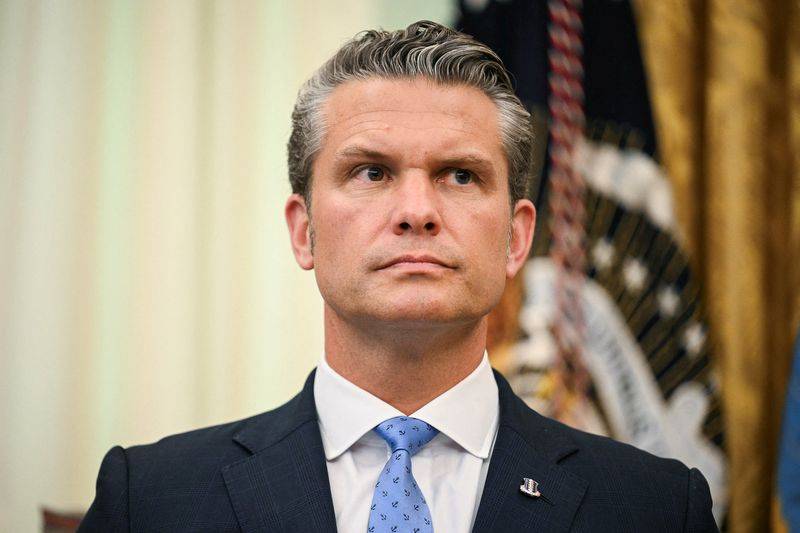
The Pentagon is in chaos, but the secretary of defense might just think he’s the heir apparent.
SEP 03, 2026
It was a few hours after midnight on election night, and Fox News host Pete Hegseth was wearing a MAGA hat, leaping with joy and high-fiving colleagues at a bar in Tennessee.
Hegseth was on the clock. Fox had dispatched the cohost of Fox & Friends Weekend to Kid Rock’s “Big Ass Honky Tonk & Rock n’ Roll Steak House” in Nashville, where the MAGA rapper was holding a 2024 presidential election night party. Hegseth was hosting Fox’s digital coverage, drink in hand.
“Trump elected president!” Hegseth cheered in a video posted to Instagram that showed him and his Fox colleagues celebrating the results.
Hegseth had reason to celebrate. His unequivocal support for Trump from his lowly perch on Fox had earned him the ear of the president throughout his first term in office. Now, with Trump set to return to the White House, that fealty would soon earn him a nomination to serve in one of the most powerful positions in the US government: secretary of defense.
Nearly two years later, Hegseth’s tenure at the top of the Pentagon has been marred by scandal. Signalgate, wherein Hegseth shared highly sensitive attack plans in a group chat that inadvertently included the editor in chief of The Atlantic, feels quaint in light of what’s happened since. He has overseen the disastrous military operation in Iran, which opened with the bombing of an elementary school that killed more than 150 children and is now mired in a costly stalemate. Through firings and forced exits, he has presided over the gutting of Pentagon leadership; most recently there was the resignation of Army secretary Dan Driscoll, who reportedly warned Trump on his way out the door that the chaotic management of the department risked calamity. Hegseth is the least popular wartime secretary of defense in history, holding a 23% approval rating in a recent poll.
Hegseth does not appear chastened by this reality. A Trump administration source tells Vanity Fair there are active discussions among his close advisers about a run for president in 2028. Last month, he joined a House Republican running for reelection at a campaign event in Iowa, a classic stop for presidential aspirants. NBC News reported soon after that Hegseth “has floated a White House run with close friends and associates.” Pentagon spokesman Sean Parnell told NBC in a statement that Hegseth “is not running for president,” and Hegseth himself said in a post on X that the story was “100% false.”
The prospect was met with contempt when I put it to a former Trump official who worked alongside Hegseth. “He has spent his entire tenure on self-promotion and culture-war theatrics,” the official said, requesting anonymity to speak candidly. “The damage he has inflicted on our military will take years to repair, and the sooner he goes, the better it will be for the country and for President Trump’s legacy.”
“Secretary Hegseth has been a transformative leader for the Department of War and, at President Trump’s direction, has ushered in a new era of Peace Through Strength,” Parnell said in a statement. “The entire department is unified behind the secretary’s vision and will continue working to put our warfighters and America first.”
To understand how Hegseth has operated at the Pentagon, it’s worth tracing back to the start of his public career. When he began appearing on Fox News in 2014, he was a fairly typical conservative, a protege of Bill Kristol and an acolyte of The Weekly Standard. During the 2016 campaign he was a voluble critic of the reality-TV host seeking the nation’s highest office, declaring him wholly unqualified for the job of commander in chief and utterly incoherent in his views of the world.
Eventually, Hegseth was hired as a cohost at Fox & Friends Weekend, a morning show he worked at for nearly a decade—much of which, sources at the network tell Vanity Fair, was spent auditioning for a job in his White House. By then, Hegseth had restyled himself from neoconservative activist to full-blown MAGA warrior. And by virtue of his zealous patriotism and unflinching support for Trump, he was soon able to wield mighty influence over the president’s foreign policy and military decision-making.
The subject on which Hegseth wielded the most sway was in advocating for US troops accused of war crimes. Starting in 2018, Hegseth began defending troops accused of shocking misconduct, and not just the ambiguous cases. Hegseth championed soldiers, like Eddie Gallagher, who stood accused of committing such egregious acts that they were turned in by their own platoonmates. Gallagher is a particularly shocking case: The former Navy SEAL was accused of a series of atrocities, including executing a handcuffed teenager with a knife in Iraq and shooting children with a sniper rifle.
Hegseth relentlessly lobbied for Gallagher and others both on and off the air. He appealed for Trump to intervene in their cases, which would be a highly unusual move for a president. Trump, who watched Fox & Friends Weekend regularly, once tweeted out a promotion of an interview Hegseth had with Gallagher that had yet to air: “Have no fear, all will end well for everyone!” Ultimately, in four different cases, including Gallagher’s, Trump intervened and overruled the Pentagon. He credited Hegseth for his efforts on social media.
What’s so striking about Hegseth’s pivot on war crimes is he was once a fierce advocate for accountability. In 2009, he argued that by defying these laws, “you’re hurting yourself a lot more than you are helping yourself. Even if you’ve killed five bad guys, if you’ve killed two innocents, you’ve set yourself back more than you’ve moved forward.”
During his first term, Hegseth urged Trump to aggressively bomb Iran, targeting its infrastructure, nuclear facilities, and even cultural sites. That kind of militaristic approach to foreign policy runs counter to the common perception of Trump as an “anti-war” president, but it was always more in line with reality. Four times as many American soldiers died in combat during Trump’s first term as during Biden’s. It should not have come as a surprise that one of Hegseth’s first acts in the job was to rename his agency “The Department of War.” If you watch one of his speeches and take a shot every time Pete Hegseth says “lethality” or “kinetic” or “warfighter,” you’ll be as sober as Pete Hegseth in his prime.
Having the ear of the president during Trump’s first term did not endear Hegseth to executives at Fox News, who bristled at his defiant flouting of news network guardrails, but it did put him in the running for head of Veterans Affairs. According to The Washington Post, he was passed up for the job because he was deemed “too inexperienced to run the government’s second-largest bureaucracy.”
Now, Hegseth runs the Pentagon, and in the job he’s pursued policies that echo his crusade against accountability for war crimes on Fox News. Last year, he ignored protests from senior military leadership and gutted the program charged with protecting civilians during US military operations, according to a new report from ProPublica. In the months after, American bombs killed hundreds of civilians in Africa and the Middle East, including the strike on the elementary school in Iran.
Hegseth has imported his view that the military should be able to operate with impunity. Trump initially blamed Iran for the elementary school massacre, but according to reporting from The New York Times, a preliminary investigation by the military found the United States was responsible for the bombing. More than six months later, the Pentagon has refused to release the results of its investigation, and Trump continues to deny responsibility. When reached for comment, a defense official said, “There are no updates to the investigation at this time”—the same answer I’ve been getting since April.
“There are terrorist groups that do not respect the law,” says Senator Jack Reed, a Democrat and the ranking member on the Armed Services Committee. “But we have tried throughout our history to be different, to in fact insist on very high standards. And this fetish of lethality [that Hegseth] has is not a good military strategy. We’ve seen that in the Gulf. We’ve dropped so many bombs to kill so many people that now we’re short on munitions, critical munitions, and we’re nowhere close to a solution to the problem.”
The resignation of Driscoll, the secretary of the Army, raised new questions about Hegseth’s leadership at the Pentagon. The exodus, says Reed, is “unprecedented.” Senator Thom Tillis, a Republican, called on Trump to fire Hegseth in a statement on Wednesday. “I have never witnessed more inept management of the brave men and women who serve our country,” he wrote. “He is intimidated by competence and retreats to ginning up culture wars instead of soberly attending to the vital work of our national defense and the health and well-being of our fighting force.”
Reed agrees: “He should depart as soon as possible and put the Department of Defense in the hands of someone with better judgment, more experience, and one who’s not going to politicize the department.”
Can Hegseth mount a bid for the presidency with this track record? It wouldn’t be the first time a deeply unpopular political figure made it all the way. When Trump left office in 2021, his public approval was at its lowest and the fresh horror of January 6 led many to believe his political career was finished. Still, for Hegseth to make the climb would be astonishing in light of how the war is going.
“It’s never going to happen,” one Republican operative close to Trump tells me. “The race is JD’s to lose.”