| | ‘Everybody and their brother is a digital infra and power lawyer now.’͏ ͏ ͏ ͏ ͏ ͏ |
| |  | Energy |  |
| |
|
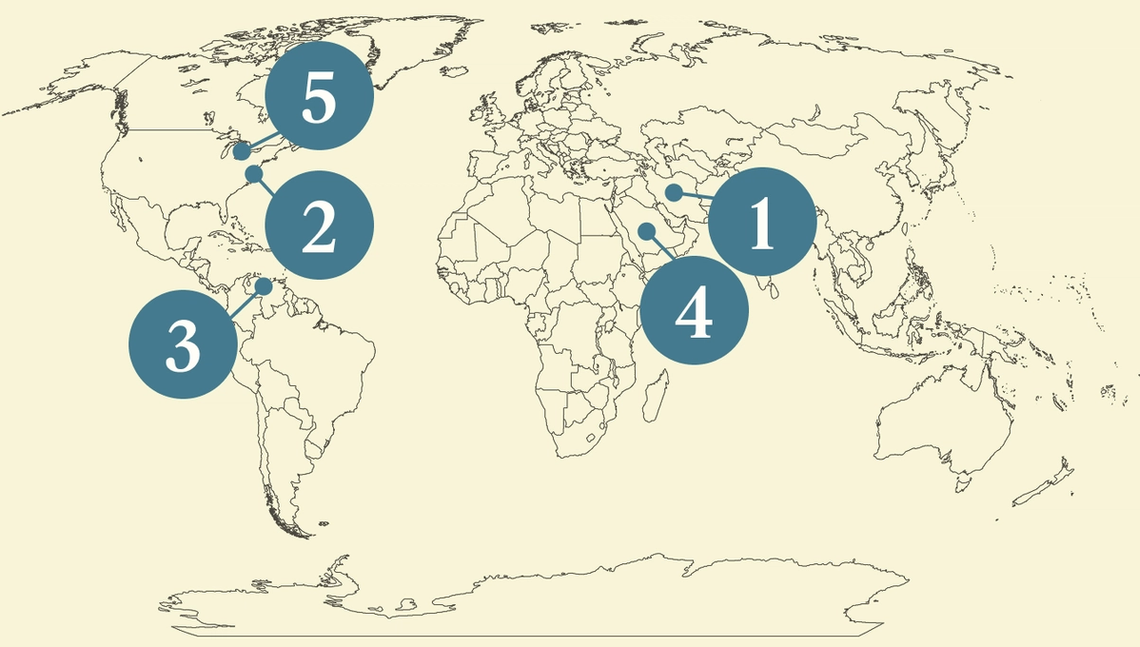 - Murky passage
- Lawyers mine data
- Oil deal scrutiny mounts
- OPEC’s internal threat
- Ford’s sales target
 Ukraine’s grid confronts jet-powered drones, and global energy companies confront AI-powered cyber attacks. |
|
 The United Nations Environment Programme issued a stark assessment Wednesday of the trajectory of global temperatures. The target cap adopted by the 2015 Paris Agreement — 1.5 degrees Celsius above pre-industrial levels — is guaranteed to be overshot, the report says. To completely avert disastrous conditions for human lives and livelihoods is no longer possible. Our best shot is to brace for a much hotter world, and then try hard to cool things off. And for that, the report concludes, “rapid upscaling of CDR is critical.” UN agencies and international scientific panels have endorsed carbon dioxide removal (that is, withdrawing CO2 from the air rather than preventing its release) before, but rarely framed it as such a foundational need. The field ranges from the ultra-low-tech — i.e., plant more trees — to all manner of cutting-edge carbon-sucking contraptions. Today about 2.2 billion metric tons of CO2 are withdrawn annually through these methods. Fixing the climate will require that figure to rise as much as ten-fold by 2100, the UN report finds. The report is clear that replacing fossil fuels in the energy system is still essential; every ton not emitted now is one less that has to be drawn out later. But renewable energy, while we could certainly always use more of it, is basically doing fine. Global investment has tipped down from a 2024 peak, but not plunged. Costs continue to fall rapidly. AI, EVs, and air conditioners are driving an historic surge in power demand where every electron is welcome. Even in the US, with vanishing tax credits and a hostile government, I rarely hear any serious investors describe clean energy (except offshore wind, for now) as uneconomic. CDR is a different story. The trouble is, it requires huge amounts of land, time, and/or cash. “Even if global fossil CO₂ emissions reached zero and deforestation were halted entirely, it would take about 100 years of sustained afforestation and forest management activities at the current scale to reduce global temperature by 0.1°C,” the UN report concludes. The sum of global governments’ CDR-related reforestation pledges amounts to two-thirds of the world’s arable land, which would make CDR an even bigger threat to food security than climate change. Most tech-based methods remain inaccessibly expensive, according to Oxford researchers. And unlike renewables, which are valuable for many more reasons than being CO2-free, CDR is mostly economically useless without government policies to incentivize it. And those clearly aren’t happening at scale: There’s a gap of up to $1.6 trillion in annual investment from 2030 to 2050 between what’s in the expected CDR pipeline and what’s needed, according to McKinsey. CDR isn’t readily recast as an “energy security” issue, which makes it hard for most global politicians to grapple with these days. But if the UN report is right, we’re rapidly approaching a world in which ignoring CDR will be far more costly than finding new ways to do it better. |
|
Lawyers mine data for gold |
| |  | Tim McDonnell |
| |
 Kevin Wurm/Reuters Kevin Wurm/ReutersThe rush by AI hyperscalers and their Wall Street backers to build billions of dollars’ worth of data centers and associated energy projects has set off fierce competition for talent among major law firms. A few years ago, electricity-related dealmaking was a backwater at many Wall Street firms, often immersed in staid regulation and involving relatively small deals. That has completely changed, attorneys at several big firms told Semafor. Faced with a deluge of deals for the construction, powering, and operation of AI data centers, most have set up dedicated digital infrastructure desks — drawing in lawyers specializing in energy, real estate, insurance, finance, and other fields — which have quickly become among the busiest and most lucrative in the office. “Personally, I’ve done $110 billion worth of deals in the last 12 months,” said Melissa Kalka, a partner on the digital infrastructure team at Kirkland & Ellis, which now counts more than 100 people. “This is the most dynamic industry in the economy right now.” |
|
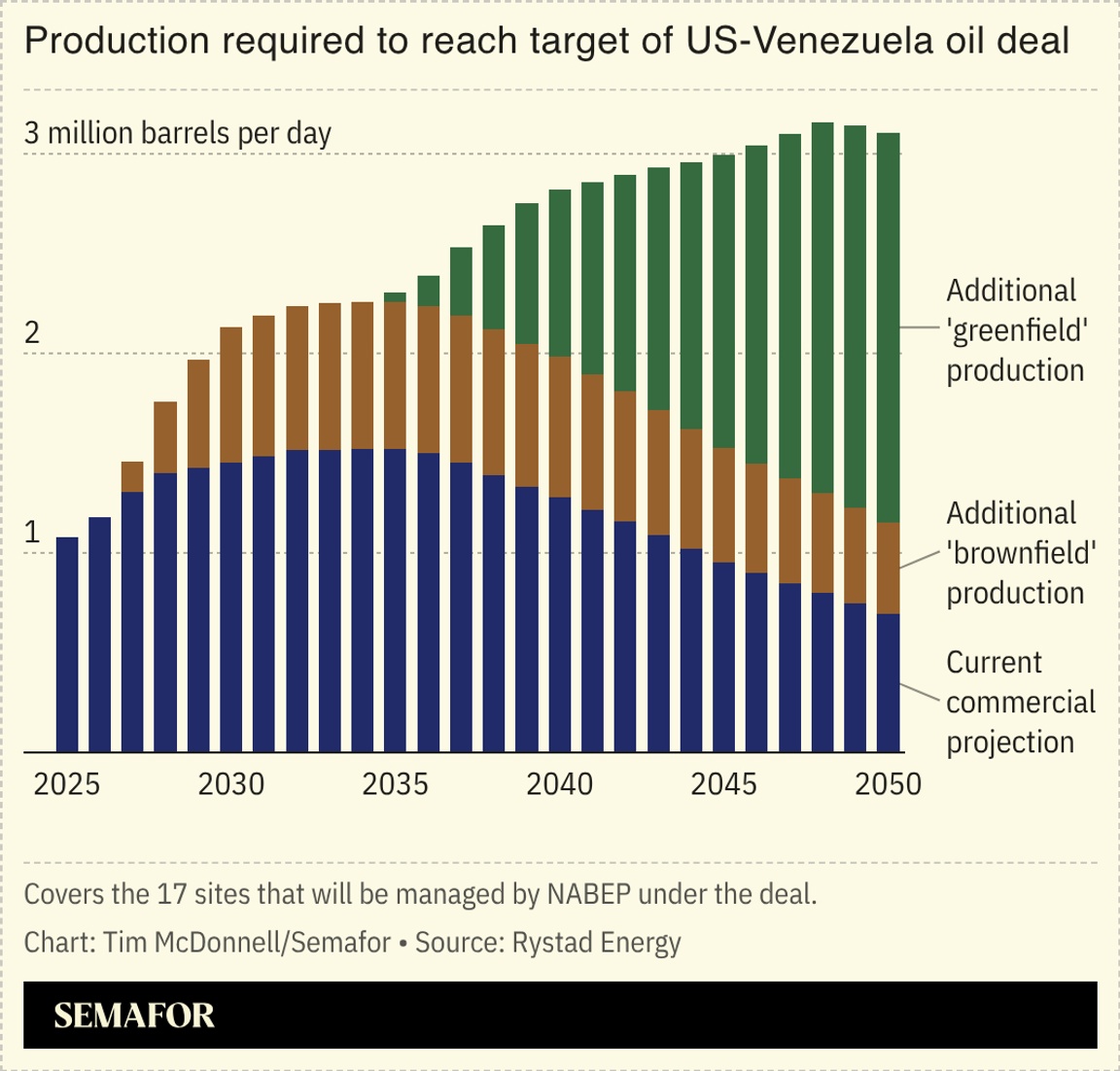 The obscure Pentagon office that is set to take an equity stake in Venezuela’s oil industry was originally established to make loans to firms developing critical technologies, Semafor reported. Congress had already conveyed to the Pentagon’s Office of Strategic Capital that it lacked the authority to take equity stakes in firms by declining to pass legislative proposals to grant it this permission. The news comes amid mounting skepticism to the deal from Congressional Democrats and from all sides of the Venezuelan political spectrum. Some Western energy companies haven’t been deterred from new investments: Days after Washington and Caracas announced the deal, Chevron, Eni, and GE Vernova committed to expanding projects in Venezuela. Chevron, the only American company to never exit the country, said it planned $7 billion of investments in the next five years. But as US officials demur about a timeline for elections there, the Pentagon deal is “the wrong way to revive Venezuela’s economy,” The Financial Times editorial board argued. |
|
| |  | Wael Mahdi |
| |
 Maxim Shemetov/Reuters Maxim Shemetov/ReutersSaudi Arabia’s deepest crude discount since the pandemic points to deeper divisions within the world’s most important oil group, and potentially to Riyadh’s mounting anxiety about losing market share. Saudi Aramco has priced its flagship Arab Light crude for Asian buyers at its widest discount since June 2020: $2 a barrel below the Oman/Dubai benchmark for September. The cut comes as the UAE exits OPEC, Iraq seeks more capacity, Venezuela tilts toward Washington, and the Strait of Hormuz remains impaired. It is a strange price signal from a market still living with reduced flows through Hormuz six months into the Iran war. Discounts usually suggest too much oil chasing too few buyers, not a supply corridor operating far below normal levels. Aramco’s move does not prove that Saudi Arabia has begun a new market-share war. But it does suggest Riyadh is unwilling to surrender Asian customers while the immediate disruption at Hormuz obscures a looser underlying supply outlook. The next price list, expected around OPEC+’s Sept. 6 meeting on next month’s output, will test that interpretation. If Aramco trims its discount, traders may conclude September was a one-month accommodation for disrupted shipping and weak demand. If it extends or deepens the discounts, the message will be clearer: Saudi Arabia is prepared to defend market share in Asia even as OPEC+ tries to maintain a common supply policy. |
|
 Ford is coming for Tesla’s EV sales record in the US. The automaker has a goal to sell 100,000 of its new $30,000 electric truck, the Fathom, in its first year of sales next year, the Wall Street Journal reported. That’s a figure that no US automaker apart from Tesla has so far achieved for a single model. And it’s a test of whether CEO Jim Farley’s strategy to stem massive losses from Ford’s EV division by focusing aggressively on cost-cutting will pay off. |
|
 Commodity Context is a data-centric and visualization-forward oil market research service led by widely cited analyst Rory Johnston. Readers can expect a mix of real-time event analysis, data reviews, and deeper thematic research, as well as the Oil Context Weekly wrap-up every Friday. Subscribe for free or go deeper with paid here. |
|
 New EnergyFossil FuelsFinance |
|
|


