| | In today’s edition: New estimates for the Gulf’s rising defense bill, Chinese tech firms show up in ͏ ͏ ͏ ͏ ͏ ͏ |
| |  Abu Dhabi Abu Dhabi | Damascus | Riyadh |
 | Gulf |  |
| |
|
 - Bombs and bonds
- Billions on defense
- Gulf cash in ‘New Damascus’
- Chinese firms LEAP
- Postcard from Jebel Ali
 Gulf supercars rack up London parking fines. |
|
Gulf bolsters finances as war escalates |
 US Central Command via Reuters US Central Command via ReutersIran attacked US military bases in Bahrain, Iraq, and Jordan in retaliation for overnight US strikes on Iran. Oil jumped by more than 5% to $95 a barrel. Two Filipino sailors aboard a Saudi-owned vessel were killed in an attack on the ship in the Strait of Hormuz. Meanwhile, new reports compounded fears that the conflict is fast metastasizing beyond the Middle East: A Financial Times investigation revealed that Russia has been secretly helping Tehran develop supersonic cruise missiles. Against this backdrop, Gulf governments are shoring up their finances. Saudi Arabia raised $3.25 billion in an international sukuk (Shariah-compliant bond) that attracted $16.5 billion in orders, and Kuwait authorized borrowing from its $1 trillion-plus sovereign wealth fund — a pool it hasn’t tapped since Iraq’s 1990 invasion. |
|
The Gulf’s $2.1 trillion budget |
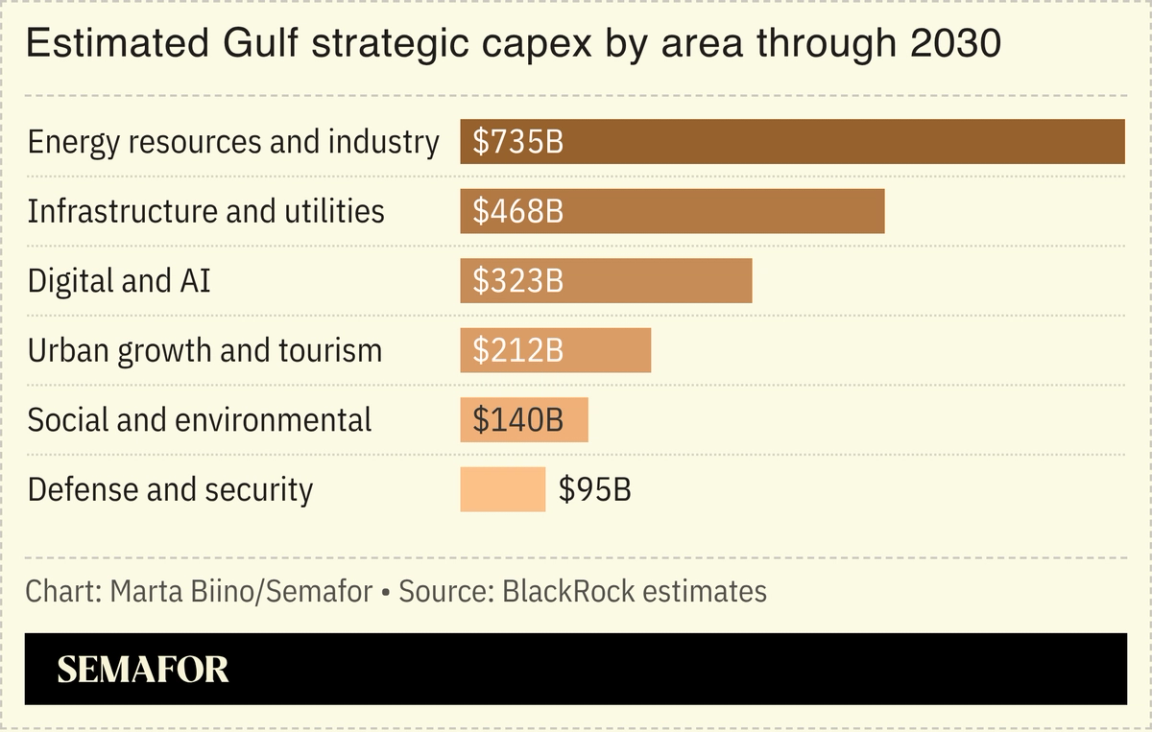 Gulf states will spend roughly $95 billion on defense, aerospace, and security infrastructure through 2030, according to a new report from BlackRock Investment Institute. That number sits inside a $2.1 trillion capital expenditure map over the next four years, alongside ports, grids, and data centers. BlackRock’s methodology says the estimates cover private and state-owned enterprise capital, not government budgets. So this is not the procurement line defense analysts track: It is factories, facilities, and sustainment, the kind of military-industrial activity Saudi Arabia’s SAMI and the UAE’s EDGE Group were built to localize. Much of that larger $2.1 trillion number predates the US-Iran conflict. What has changed is the sequencing and priority: BlackRock groups $660 billion under “strategic redundancy” — export routes, ports, and power and water projects — and describes it as the segment most affected by the war. |
|
Arada’s $7 billion Syria bet |
 Courtesy of Arada Courtesy of AradaSharjah-based developer Arada — backed by royals from Saudi Arabia and the UAE — partnered with Syria’s recently formed (and opaque) sovereign wealth fund to develop a $7 billion new district in Damascus. The deal is the latest example of Gulf capital being funneled into Syria’s reconstruction, aligned with a broader US effort to keep the country out of Iran’s orbit. It also marks a return, of sorts, for one of the region’s top investors: Arada’s co-founder Khaled bin Alwaleed Al Saud is the son of billionaire Prince Alwaleed bin Talal, who owned the Four Seasons hotel in Damascus before selling it to a frontman for Syria’s deposed president in 2018. For UAE property developers, which were facing a slowing home market even before the Iran war, Syria also represents an international growth opportunity. Dubai real estate mogul Mohamed Alabbar announced in July plans to develop housing and tourism infrastructure in Syria worth at least $20 billion, including homes, resorts, and schools in Damascus and the coastal city of Latakia. |
|
Chinese tech makes Riyadh moves |
 Hamad I Mohammed/Reuters Hamad I Mohammed/ReutersThe LEAP technology conference running in Riyadh this week has seen Chinese firms planting deeper roots in the kingdom, spanning AI infrastructure and manufacturing. ByteDance’s enterprise cloud arm, BytePlus, is partnering with Saudi telecom operator Mobily to build its first physical cloud infrastructure in the Middle East, in Riyadh. China’s Tencent Cloud secured a Saudi operating license to serve clients in government and finance, EnterpriseAM reported, a move that will build on $150 million the tech giant has invested so far in the kingdom. And hardware maker Lenovo is on track to begin mass production of a laptop (unveiled at LEAP) in Riyadh by the end of the year. The deals may perk up ears in Washington: The Trump administration has dangled advanced chips to the Gulf, in part on terms aimed at keeping Chinese tech firms out. Still, American Big Tech is circling. Elon Musk’s xAI announced at LEAP it plans to build its first data center outside the US in Saudi Arabia. — Kelsey Warner |
|
Gulf’s biggest port waits out war |
 Manal Albarakati/Semafor Manal Albarakati/SemaforJebel Ali is among the world’s largest container ports. Driving through the port and free zone last week, I saw a single crane in operation. Containers are stranded in nearly every yard, most tenants are locked up, and berths that normally handle more than 80 scheduled services a week sit under raised cranes. A jarring scene for those used to the symphony of ships, trucks, and people moving stuff. The Strait of Hormuz has been effectively closed to container shipping since Feb. 28. The port, which moved 15.5 million containers in 2024, handled 374,000 in the second quarter, down 90% year-on-year. DP World still spends about $100 million a month — its prewar operating cost — so it can restore full capacity within 48 hours once traffic resumes, an official told Semafor. The port and free zone generate about a third of Dubai’s GDP; overland cargo from the east coast costs four to five times more than Hormuz, the official said. — Manal Albarakati |
|
 As AI and emerging technologies reshape the global economy, 3 billion people remain offline, disconnected from the digital opportunities transforming our world. On Tuesday, September 22 in New York City, The Next 3 Billion will bring together leaders including David Miliband, President and CEO of International Rescue Committee; Dr. Jean Kaseya, Director-General of Africa CDC; Jumoke Oduwole, Minister of Industry, Trade and Investment of Nigeria; Josh Parker, Head of Sustainability of Nvidia; Kara Hurst, Chief Sustainability Officer of Amazon, and more to explore how AI, energy, and global development can expand access, unlock opportunity, and drive inclusive growth across the world’s fastest-growing regions. Sept. 22 | New York City | Delegate Application |
|
 Aviation- Middle East airlines carried 1.7% more cargo in July. While international passenger traffic was still 9.5% below a year earlier, it was an improvement compared to June, when there was a 14% decline. Cargo lanes to Europe and Asia shrank for a fifth straight month. — Arab News
Energy- Abu Dhabi’s state-owned energy company ADNOC has reportedly restored its 922,000-barrel-a-day Ruwais refinery to full capacity after an Iranian strike in March. Fuel exports have recovered to about 70% of prewar levels, when the company shipped around 600,000 barrels a day of diesel, jet fuel, naphtha, and other products. — Bloomberg
- A unit of Abu Dhabi investment firm 2PointZero is acquiring a majority stake in African independent power producer Azura. The deal gives subsidiary ePointZero entry into some of the continent’s largest markets for electricity at a time of rapidly growing demand. — The National
Fast Food- American-Mexican fast food has the Gulf’s heart, and Taco Bell wants back in: The chain is returning to the UAE after leaving in 2012, with Americana Restaurants relaunching it in Dubai ahead of a wider Gulf rollout. Chipotle’s Riyadh debut last week drew a crowd and a three-hour line.
|
|
 A car parked in Covent Garden, London. Luke MacGregor/Reuters. A car parked in Covent Garden, London. Luke MacGregor/Reuters.In New York, cars with UN plates have become notorious for racking up parking fines with impunity. In London, wealthy Gulf visitors and their supercars have developed a similar reputation. Ferraris, Lamborghinis, and McLarens with Gulf plates clog the streets around Harrods each summer, sometimes parked illegally while their owners shop, The Wall Street Journal reports. While a $200 parking ticket may seem stiff to most, it’s a rounding error for those spending more than $30,000 to fly their vehicles thousands of miles to London for the summer. Drivers from one of the smallest Gulf countries are the biggest offenders: Vehicles with Qatari plates received 2,570 tickets in Westminster last year, more than those from any other foreign country, according to the Journal. |
|
|


