| | In this edition, John Ternus’ challenge will be facing Apple’s AI era, and Wall Street’s man in unif͏ ͏ ͏ ͏ ͏ ͏ |
| |  | Business |  |
| |
|
 - Apple’s AI era
- PE’s Pentagon pal leaves
- Saudi IPOs yanked
- Leon’s version
- ‘Strategic yogurt’ redux
|
|
 Hi, and welcome back. A lot happened while Rohan and I were on vacation, but the one thing still on my mind — freshly cleansed by Hudson Valley air — is Kevin Warsh’s speech in Jackson Hole. The Fed chair argued the central bank should say less about what it’s thinking and where it’s heading, embracing the “constructive ambiguity” that Alan Greenspan trafficked in. (That’s Law 17, for fans of Robert Greene’s classic blueprint for wielding power: Cultivate an air of unpredictability.) Warsh wants investors to “play the ball, not the referee” — to spend more time reading the economy and less time gaming out the Fed’s next move. The problem, Goldman’s chief economist noted, is that players who have only ever watched the ref don’t suddenly become great at the game. They just watch the ref worse and we get more volatility in the market. Public companies ran this experiment before. A study of 96 firms that dropped earnings guidance between 2000 and 2006 found they suffered short-term stock hits but no real damage. A later study of 180 companies that suspended guidance when the pandemic hit in 2020 similarly found no lasting punishment. Investors either filled in the silence by giving more weight to analyst calls and alternative data sources, or simply grew comfortable with it. Warsh is betting on a bit of both for the Fed. Meanwhile US bond yields are rising as investors interpreted Warsh’s speech — “You can call it a trail map ... just don’t call it forward guidance,” he said, a bit futilely — as hawkish. Companies that stopped issuing forecasts during the pandemic and never restarted weren’t a random sample. They were bad forecasters that constantly missed their own numbers, and Covid gave them an excuse to stop. The Fed has been a bad forecaster for a while. Warsh is probably right that the “dot plot,” which tracks where Fed officials expect rates to go, is more trouble than it’s worth. It’s stopped anchoring expectations and become something to be wrong about, repeatedly. The harder question is timing. Abandoning guidance in the middle of a crisis gets a pass that abandoning it on a clear day might not. The Fed’s current mess — sticky inflation, an AI capex boom overheating half the economy while the other half cools, a debt load that begs for lower rates — may be enough of a storm to justify pulling signals that markets have spent two decades depending on. |
|
Ternus confronts Apple’s AI era |
 David Swanson/Reuters David Swanson/ReutersSteve Jobs and Tim Cook solved Apple’s biggest problems of their respective eras — building new products people loved and then manufacturing them at global, margin-fattening scale. John Ternus, who takes over as CEO today, will now have to confront Apple’s AI era. Among his first tasks: Defending the powerful App Store that for decades operated like a walled garden and locked users into Apple’s smartphones. Those walls are coming down, thanks to a wave of vibe coding enabled by OpenAI’s Codex and Anthropic’s Cowork. Apple can’t ban those apps or control what happens outside Apple’s ecosystem — and they’re clearly the future. Apple’s best bet now may be to turn its attention to the hardware it’s really good at building. The field is wide open for a device that can be for the AI era what the iPhone was for the mobile era. But the competition will be greater — Apple’s longtime hardware guru, Jony Ive, is now building a contender at OpenAI — and profit margins, as Cook knows better than anyone else, will likely be smaller. — Reed Albergotti |
|
Wall Street’s man in uniform departs |
 From left: Secretary of Defense Pete Hegseth, Army Secretary Daniel Driscoll, and Chairman of the Joint Chiefs of Staff Gen. Dan Caine. Kevin Lamarque/Reuters. From left: Secretary of Defense Pete Hegseth, Army Secretary Daniel Driscoll, and Chairman of the Joint Chiefs of Staff Gen. Dan Caine. Kevin Lamarque/Reuters.Private equity is losing a friend in the Pentagon. Army Secretary Dan Driscoll, who had been one of the biggest proponents of bringing private capital into America’s military machine, resigned Monday after months of clashing with Defense Secretary Pete Hegseth, Semafor’s Shelby Talcott and Morgan Chalfant report. Driscoll courted private-equity and credit deals to revamp procurement, structure deals, and build data centers on military lands like the one Carlyle is currently negotiating in Texas. The Pentagon has been hiring investment bankers from the private-equity world to its Office of Strategic Capital, dangling the chance to work on $200 billion worth of deals, Semafor previously reported. Silicon Valley remains well enough plugged in through tech-friendly officials like Emil Michael and the influence of tech firms like Palantir and Anduril, but Driscoll’s departure leaves Wall Street financiers down a uniformed cheerleader. Stephen Feinberg, the billionaire Cerberus cofounder serving as deputy defense secretary, remains and has been seen as favoring private equity over its smaller, more experimental cousins in venture. |
|
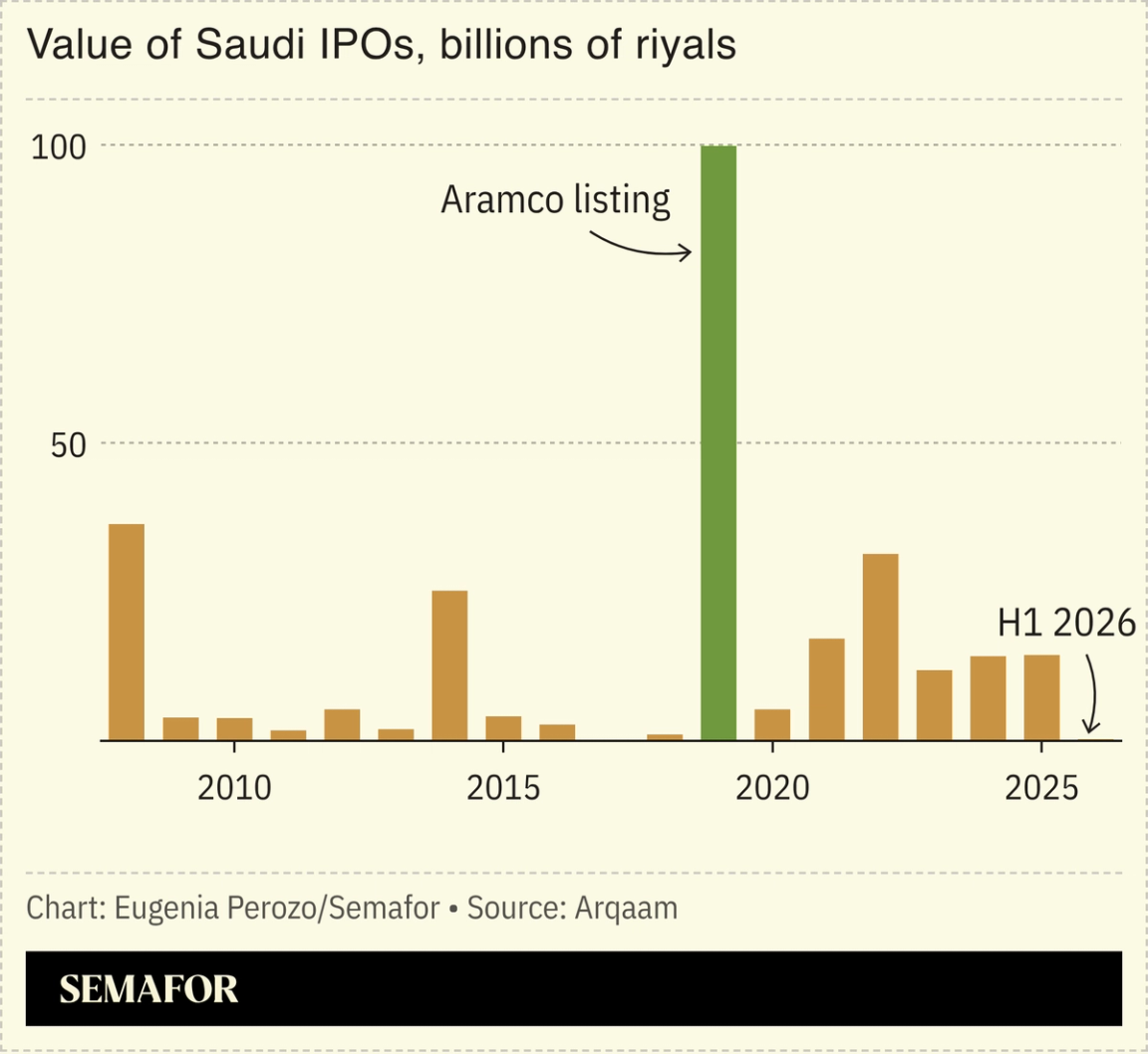 Three Saudi companies shelved plans to go public over the next month as the Iran war hangs over the region’s economy, Semafor’s Matthew Martin scoops. The decision by bottled drinks company Berain Water, lubricants and automobile servicing business Petrolube, and Facilities Management Company to postpone their IPOs suggests investors remain wary of putting new money into Saudi’s stock exchange. It’s a blow to the kingdom’s sovereign wealth fund, PIF, which had planned to take as many as eight portfolio companies public this year, including Travis Kalanick’s CloudKitchens, in a bid to raise cash. Saudi’s markets regulator has been investigating the poor performance of recent listings, including the advice given by investment banks, as it tries to revive the IPO market, Matthew previously reported. |
|
New Black book picks fight with NYT |
 Kylie Cooper/File Photo/Reuters Kylie Cooper/File Photo/ReutersBill Cohan’s new Money to Burn: The Unvarnished Truth About Leon Black, Apollo, and the Rise of a New Wall Street is aimed, in part, at rebutting The New York Times’ coverage of Black and his ties to Jeffrey Epstein, which hastened the financier’s exit from Apollo, Cohan told Semafor’s Ben Smith. The Times, he said, is on a “Leon jihad.” He added: “I just listened and heard him tell his story — and believe me, I would have loved to be the one to refute what he said, but I haven’t been able to.” In his view, Times journalists at work on a book on Epstein and Wall Street are “frustrated Leon won’t talk to them — but they haven’t been very nice to him, so I don’t know why he would.” Times journalists, in turn, are incredulous that Cohan’s book leaves out Epstein’s role, which they reported this March, in helping Black pay out part of $20 million “to a dozen women, at least some of whom he’d had sexual relationships with.” The Times “covered Leon Black fairly and accurately, and the reporting has stood up through all the Epstein revelations that followed,” Times spokesman Charlie Stadtlander said. |
|
Elliott takes on the French |
 Sarah Meyssonnier/Reuters Sarah Meyssonnier/ReutersElliott Management has a big stake in French gas giant Air Liquide, Semafor’s Rohan Goswami reported Monday. The activist investor met with the industrials giant last week and is pushing Air Liquide to boost its margins, which lag its chief competitor, and consider buying back stock, according to people familiar with the matter. The question now is what Paris will do. France fiercely protects its national icons, and its companies have wider latitude than American firms to fend off meddlesome outsiders. Look to 2005, when the government intervened to protect Danone from a takeover by Pepsi, an episode that made “strategic yogurt” a shorthand for French protectionism. |
|
 Hedge funds just posted their worst month against the S&P 500 in two decades, and JPMorgan is cutting jobs at its fastest pace since 2015. Short Squeez covers what is happening on Wall Street and why, every morning, for 250,000 bankers, investors, and private equity professionals. Subscribe today. |
|
➚ BUY: Coupons. A global selloff pushed sovereign bond yields to their highest level since 2008, raising borrowing costs for cash-strapped governments around the world. ➘ SELL: Savings. One of those governments, the European Commission, has a plan to put the bloc’s €10 trillion in household savings “at the service of its companies.” Redirecting “lazy” cash through regulatory changes and tax incentives could unlock needed investment and close Europe’s capital-markets gap with the US. |
|
 Companies & Deals- Bank of Jensen: Nvidia’s efforts to get junk-rated or unrated companies access to its chips continue, this time with a $35 billion cloud deal with Anthropic.
- Don’t call it a comeback: Adam Neumann is back where it all started. Neumann — whose first big venture, WeWork, was heavily backed by Gulf sovereign money — is opening a Dubai office for his new real estate venture, Flow.
Watchdogs- Kitchen cabinet: Trump’s inner circle is shrinking, Semafor’s Shelby Talcott writes. The turnover carries higher stakes for the president, whose presidency has been defined by a smaller circle of advisers who have direct, frequent access to him.
|
|
|


