| | Concentrating control of Venezuela’s oil industry with the US government could ultimately backfire. ͏ ͏ ͏ ͏ ͏ ͏ |
| |  Washington, DC Washington, DC | Bogotá |  Beijing Beijing |
 | Energy |  |
| |
|
 - Refiners face Trump
- Solar beats coal
- Oil drilling pivot
- Disaster for insurers
 Xi visits Cairo to talk renewables, and BYD notches a profit jump. |
|
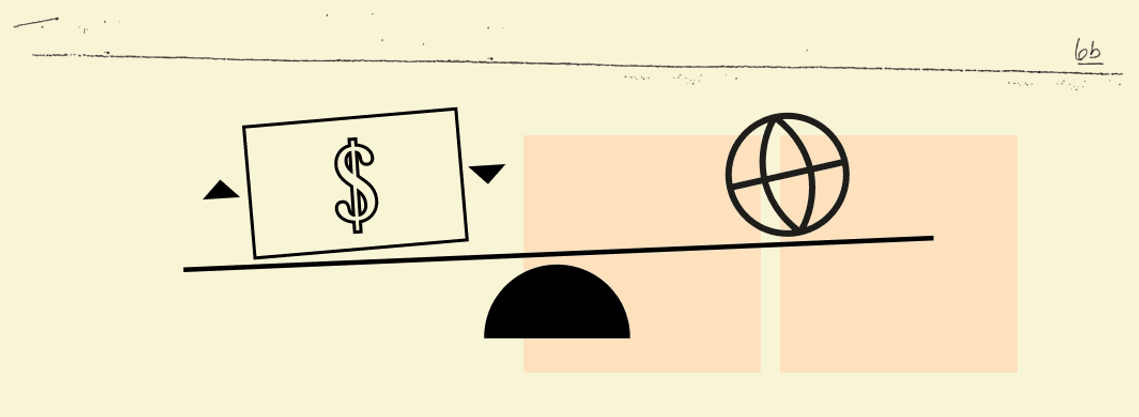
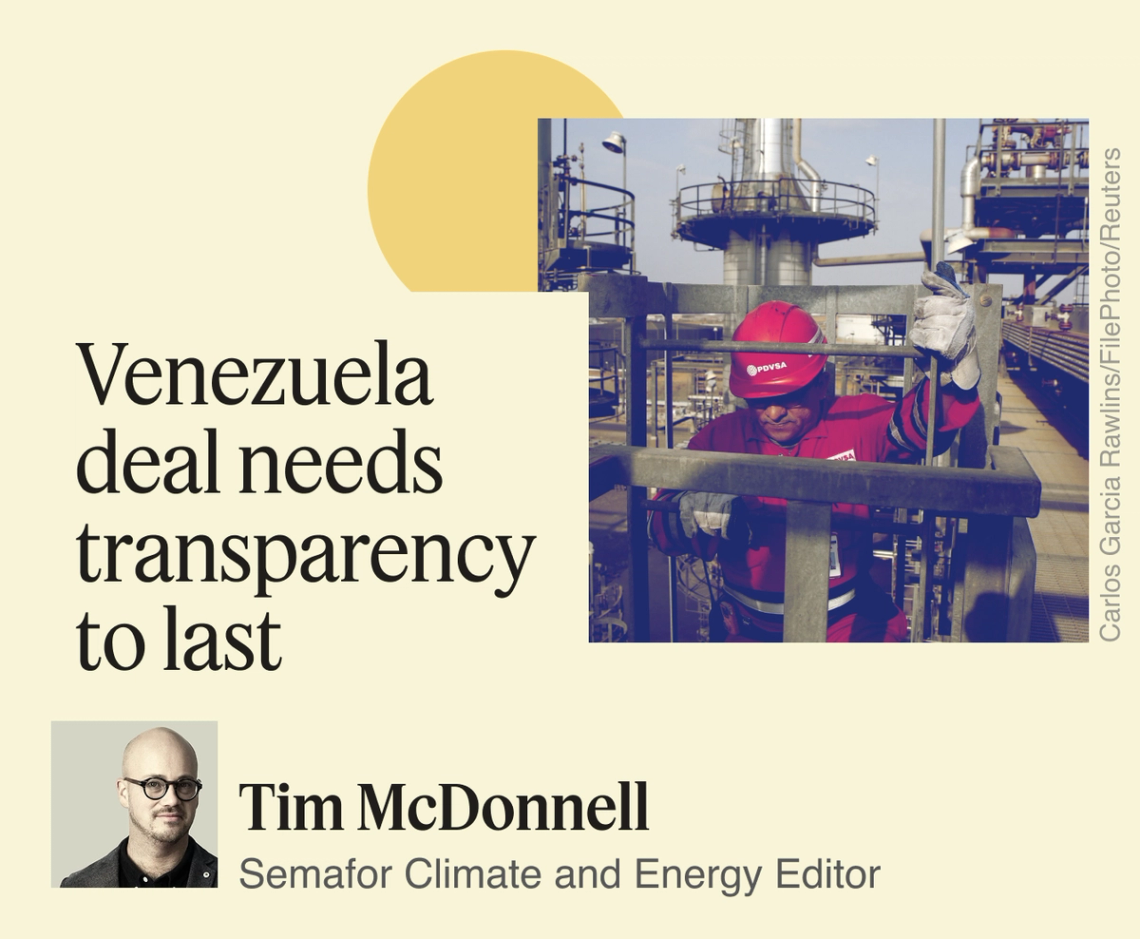 US President Donald Trump hasn’t won the energy war in Venezuela yet. The White House this week released the first details of the deal Trump announced Friday between Washington and Caracas: The Pentagon will take an equity stake in the Venezuelan oil producer NABEP, which will then assume responsibility for what the administration said will be the world’s second-largest privately held oil reserve. In theory, the deal manifests Trump’s long-stated aim in Venezuela: For the US to take significant control over the country’s oil, and use it to feed US refineries and undermine Middle East competitors. But the deal carries the seeds of its own undoing. “In order to unlock the level of investment that Venezuela needs, there has to be an improvement in the rule of law, so that you can have guarantees that are not provided by a foreign government,” Luisa Palacios, the former chairwoman of Citgo, the refiner that was majority-owned by Venezuela and is undergoing a court-order sale to US investors, told me. “I’m not sure how this deal moves forward any of the conditions relevant to mobilize resources.” There’s little doubt that a renewed wave of oil is coming from Venezuela. Exports jumped 30% in August from the previous month. And the flow from the 17 fields assigned to NABEP could double by 2030 just from boosting production at existing sites, according to Rystad. Meanwhile, more investment is incoming for the rest of Venezuela’s oil patch: Energy Secretary Chris Wright is in Caracas today to oversee new investment agreements involving Chevron, GE Vernova, and others. Still, NABEP’s preferential access to capital and permitting authority could essentially pit future Western investors against the US government, a potential deterrent (not to mention the strange fact that the US government is now, to a degree, betting against US-based drillers). And some oil executives, energy lawyers, and members of the Venezuelan public are raising alarms about the deal’s legality and the involvement of Alejandro Betancourt López, a longtime player in Venezuela’s energy sector who was under investigation by Swiss authorities for possible financial crimes, but whom Secretary of State Marco Rubio helped return home to lead the country’s new oil regime. Reaching the tens of millions of barrels and hundreds of millions of dollars promised by the NABEP agreement will require a multi-decade operation, and partnerships with US and European energy companies. But if it looks corrupt — something that Congressional Democrats have promised to investigate if returned to the majority — it won’t survive that long. The history of oil overflows with examples of imperialistic overreach being confronted, eventually, by populist backlash, leftist governments, and asset seizures. ExxonMobil and ConocoPhillips have been after the billions they lost to that process in Venezuela for 20 years. There’s a window now to bring Venezuela’s oil fields back to their former glory, even as global oil demand moves inexorably toward decline — The Wall Street Journal reported that NABEP has plans to set up more than 50 new drilling rigs in the next few years. But translating that into a durable benefit for the Venezuelan and American people will require a commitment to democracy, not just cash. |
|
 Majid Asgaripour/WANA/Reuters Majid Asgaripour/WANA/ReutersOil prices jumped after two oil tankers passing through the Strait of Hormuz were struck on Monday. US President Donald Trump said he didn’t expect any military response against Iran to amount to more than a “slap.” Although uncertainty remains about the state of mines in the strait, Goldman Sachs reported that total exports of crude and refined products are back to two-thirds of pre-war levels, and that Hormuz crossings are likely close to what US officials have described. But the US Navy’s deep involvement, and record-breaking fees for tankers, confirm those barrels are coming at a much higher cost. With US gasoline still above $4 per gallon and midterm elections due in two months, Trump will host today a group of oil refinery executives at the White House. Though a browbeating is likely, US refineries are already running full-steam and the government has already pulled its main levers for controlling prices. |
|
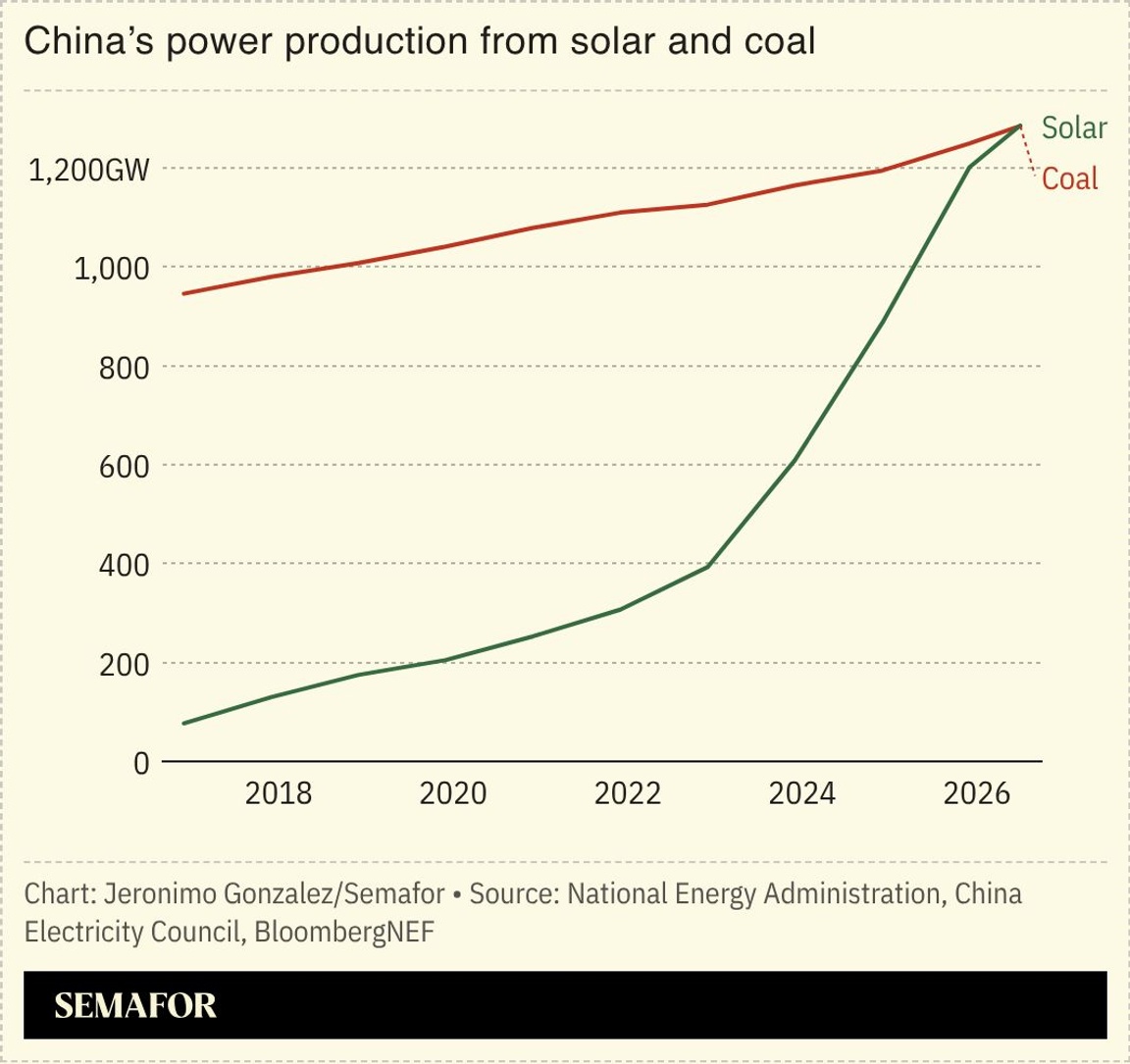 Solar surpassed coal as China’s top source of power for the first time ever, underscoring the country’s remarkable rollout of green energy as it looks to contain the impact of the Iran war. Solar accounted for almost a third of total installed capacity at the end of July, up from virtually nothing just a decade ago. The world’s largest oil importer has plowed into renewables at an unprecedented scale, expanding overall power generation and boosting energy-intensive industries like AI. The Iran war has proved that Beijing’s long-term energy strategy was prescient, an expert argued: “China’s dependence on imported oil remains substantial, but the geopolitics of energy are shifting,” a researcher at the Oxford Institute for Energy Studies wrote. |
|
Colombia’s oil drilling pivot |
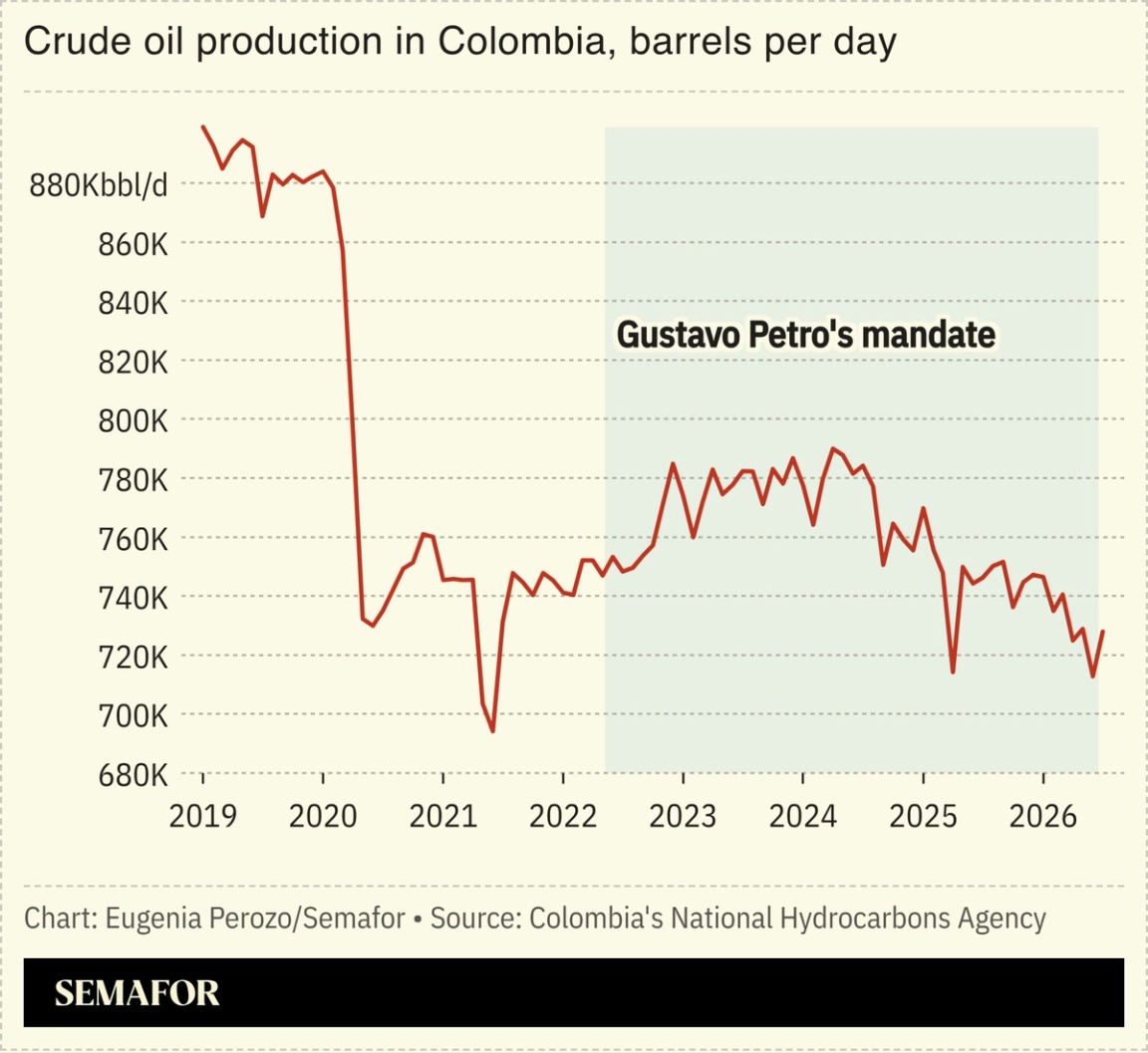 The gates to Colombia’s fossil fuel industry may be reopening, but security and fiscal issues remain. President Abelardo de la Espriella pledged to revoke a ban on new exploration licenses for oil and gas projects implemented under his predecessor Gustavo Petro, who had sought to make Colombia a positive model for the green energy transition. The reality of the country’s energy mix and the economic importance of fossil fuels made these ambitions difficult to realize, however: In 2024, over 75% of Colombia’s energy demand was met by fossil fuels. Will lifting the ban attract oil and gas majors back to Colombia? “It’s not an on and off button,” political risk analyst Sergio Guzmán told Semafor. As De la Espriella rolls out reforms, investors will want to see “long-term fiscal certainty.” “Security is a huge concern,” Guzmán says. Petro’s administration had negotiated an armistice with many armed groups, reducing levels of conflict. The new president has vowed a crackdown, which Guzmán warns could lead to retaliations that target critical infrastructure. — Eugenia Perozo |
|
Disasters drive insurance losses |
 Natural disasters have cost insurers nearly $200 billion so far this year, $19 billion more than in the same period last year, according to risk modeling firm Verisk. The number is rising rapidly, despite a relatively mild hurricane season in the US, as wildfires, drought, and other impacts of climate change strike at many economies. The true scale of damage is likely far higher, Verisk said, since only about one-third of losses are covered by insurance. |
|
 New EnergyFossil Fuels- US employment in oil and gas production has fallen by 13,000 jobs since Trump was inaugurated last year, despite promises of an industry revival.
- European oil majors are increasingly forging joint ventures, dubbed ‘smashcos’, as the industry seeks flexibility and growth opportunities.
Politics & Policy- German energy firm RWE is set to use $900 million of a $1.2 billion US federal government payout — given on the condition the company gives up a set of US offshore wind licenses — to buy a stake in a major LNG project in Louisiana owned by Australian billionaire and Trump donor Michael Dorrell.
- Russia is preparing a major set of attacks on Ukrainian energy infrastructure, the military said in a Telegram post.
Minerals & MiningEVs |
|
|


