
|
 |



What to expect from the Supreme Court:
The Court could issue a decision in the White House ballroom case any time now, after Chief Justice Roberts issued an administrative stay last Friday that let Trump keep working. This is one of those confusing situations where the plaintiffs obtained an injunction that prevented further construction of the ballroom (but not of the bunker), and what the administration asked the Supreme Court to do was enter an injunction against the district court’s injunction so they could go back to work. The case is National Park Service v. National Trust for Historic Preservation, and we discussed the district court’s order in It’s Our House, back at the end of March when it issued.
Also, we can expect to see the Court issue what’s known as a “summer order list” on Friday. Even though the Court is out of session, the Justices are still at work, and the order list makes some of their decision-making public, including decisions to add cases to its docket, as well as decisions it has issued, including those off of the shadow docket. You can click the links here to see the oral argument schedule for the new term of Court, which starts on Monday, October 5.
What to expect in the lower courts:
Donald Trump is trying to erase his pal Steve Bannon’s criminal conviction. This is just another verse in the same song: Use the Justice Department to reward your friends and punish your enemies. It’s sickening to watch, as Attorney General Todd Blanche swears to uphold the rule of law while serving Trump instead of the oath he took.
The federal judiciary continues to push back where it can. In July of 2022, Bannon was convicted of two misdemeanor counts of contempt of Congress for defying a House subcommittee subpoena to testify about January 6. After losing on appeal, he served four months in prison. Then Donald Trump returned to the White House and DOJ asked the Supreme Court to toss the conviction, which they did. But that wasn’t enough. Trump’s Justice Department also asked the trial judge, Carl Nichols, to dismiss Bannon’s conviction and indictment “in the interests of justice.” They wanted to make it as though the indictment had never happened.
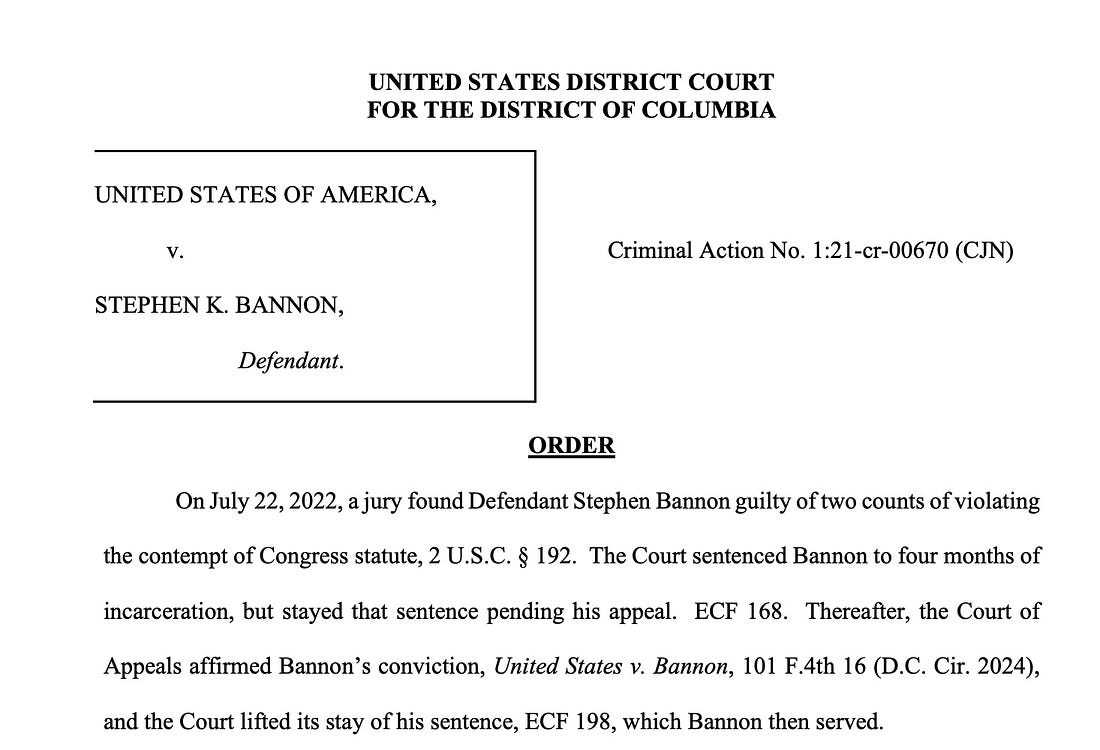 |
Last Wednesday, the Judge told DOJ no, at least for now. In his order, he explained the technical legal issue:
“Rule 48(a) provides that the ‘government may, with leave of court, dismiss an indictment, information, or complaint.’ … The Supreme Court long ago stated that this ‘leave of court’ requirement ‘obviously vest[s] some discretion in the court.’ … As the Court of Appeals has put it, the ‘requirement of judicial leave … gives the court a role in dismissals following indictment.’ … The ‘primary concern’ is ‘protecting a defendant from harassment, through a prosecutor’s charging, dismissing without having placed a defendant in jeopardy, and commencing another prosecution at a different time or place deemed more favorable to the prosecution.’ … Where, as here, the defendant consents to the dismissal, that concern is obviously alleviated.”
But that didn’t end the inquiry in Judge Nichols’ mind. He continued, “But even in the ‘distinctly different situation’ where a ‘defendant concurs in the dismissal,’ … the ‘leave of court’ proviso still may require ‘an independent judicial assessment of the public interest in dismissing the indictment.’” So he gave his. He pointed out that precedent requires that prosecutors do more than just make a conclusory statement that a dismissal is in the public interest, that they must provide “a statement of reasons and underlying factual basis.” Then, it’s up to the court to guard “against abuse of prosecutorial discretion.” He concedes that the court’s role at this stage is “exceedingly narrow” because prosecutors enjoy broad discretion to dismiss cases. But he is clear that the government must comply with the procedural requirement that it state its reasons for requesting the dismissal.
That makes sense. If there wasn’t some role for the court to play here, then why require prosecutors to seek leave of court at all? The rules would permit them to notice the dismissal and end the case. But the Federal Rules of Criminal Procedure vest final approval in the court; it’s not just a rubber stamp. And so, Judge Nichols will require the government to follow the rules if it wants the special benefit for Steve Bannon that it seeks. I look forward to the explanation of how erasing the indictment and conviction of a man who refused to comply with a Congressional subpoena serves the interests of justice.
Judge Nichols denied the government’s motion without prejudice, noting that “The Government is free to submit a renewed motion that complies with Rule 48(a)’s requirements.” It’s an embarrassing schooling of the government, which should not have to be told how to comply with a basic, clear rule. Were they just sloppy, or were they unable to figure out how to justify what their audience of one wants them to do here? Although Judge Nichols also directed the government to address a technical legal issue about the timing for such a request if they do file a new motion, it’s very likely that, if they comply with the rule, he will dismiss the indictment, unless the government’s statement of reason is completely outrageous—that’s a possibility we can’t dismiss until we see it, which could happen as soon as this week.
Trump’s ongoing quest to expand the scope of presidential power:
Lisa Cook, the first Black woman to become a Federal Reserve Governor, took her case to the Supreme Court last term and won. The Court held she couldn’t be fired without at least some notice and an opportunity to respond, after Trump tried to fire her based on mortgage fraud allegations that were never proven.
On August 5, Trump’s White House notified Cook that the president was “considering” whether to remove her, again. She was given 21 days to respond to the mortgage fraud allegations. So last week, her lawyer, Abbe Lowell, responded forcefully in a letter to the White House counsel. He wrote that the mortgage fraud claim relied “on untried and unproven allegations of criminal wrongdoing set forth in a referral to the Department of Justice … submitted by William J. Pulte, Director of the Federal Housing Finance Agency, on August 15, 2025. Governor Cook has never committed mortgage fraud or any intentional wrongdoing, and there is no legally cognizable cause for removing her from the Federal Reserve Board.”
In essence, Lowell’s argument is that even if everything the administration has alleged about Cook is true, it doesn’t amount to a federal crime: “Attempting to terminate Governor Cook on the basis of Director Pulte’s Referral would ignore the facts and the law. The Letter describes acts by Governor Cook that, ‘taken together,’ supposedly constitute grounds for her removal. But neither of those acts shows intentional wrongdoing or amounts to a crime, and neither constitutes ‘cause’ under the Federal Reserve Act.” Cook had a residence in Michigan, and then asked the same lender to help with a loan for a vacation property. They provided her with a form, which she signed, for a primary residence. At worst, it’s “an inadvertent oversight,” and that conduct “is not fraudulent or criminal.” The bank knew it was a second home, and no one was defrauded. No prosecutor would ever indict this case, quite simply, because there’s no crime.
Nor does this render Cook unfit to serve. Lowell explains, and this is the best part of his letter, that:
“The President should know firsthand that listing two properties as a ‘primary’ residence does not show intentional wrongdoing or demonstrate ‘unfit[ness] for office.’ In 1993, President Trump reportedly acquired ‘primary’ residence mortgages for two different Florida homes just seven weeks apart. For each home, President Trump apparently signed a form attesting that he would occupy the property as his principal residence within 60 days and live there for at least a year. In reality, however, neither property was President Trump’s primary residence. He lived in New York and reportedly listed both Florida properties for rent. Surely the President does not believe himself ‘unfit for office’ because he signed these contradictory ‘primary’ mortgage documents.
But there’s more. Both Treasury Secretary Scott Bessent and Attorney General Todd Blanche have entered into “primary” mortgages for multiple homes and “at least three other current and former members of the President’s cabinet—Sean Duffy, Lee Zeldin, and Lori Chavez-DeRemer—have similarly held two primary mortgages at the same time,” according to Pro Publica, Lowell writes.
This might be referred to as a checkmate.
Lowell concludes that “In evaluating each of these cases, the details of which have been public for nearly a year, the President has not fired any of these officials nor asked them to resign. He seemingly understands that signing two ‘primary’ mortgage forms does not constitute an intentional act of wrongdoing or ‘call[] into question [one’s] competence and trustworthiness.’”
The ball is in the White House’s court. We’ll see if they try to bluster through. Given the Supreme Court’s willingness to use pretzel logic to protect the independence of the Fed, as opposed to other agencies where they’ve let Trump fire at will, the White House counsel may not be eager to fire Cook and end up back in front of them.
A wild card of a civil case:
In something of a Hail Mary of a case brought by more than 30 Epstein survivors against the FBI for failing to investigate, Magistrate Judge Ryon M. McCabe declined to dismiss without at least some discovery. It’s a Hail Mary only because the law, the Federal Tort Claims Act (FTCA), is so protective of the Bureau’s investigative discretion, not because the FBI handled the case properly.
A decision like this by a magistrate judge is reviewable by a district judge, which will happen here before any discovery takes place. The plaintiffs, who have repeatedly amended their complaint as new information comes to light, allege that the FBI’s handling of their reports was negligent as early as 1996, and that they could have prevented additional girls and women from falling victim to Epstein’s ring had they taken adequate steps. One of the strongest allegations involves Maria Farmer, who reported Epstein t