| | In this edition: Zambia opposition leader detained, Johannesburg’s collapsing finances, and the rooi͏ ͏ ͏ ͏ ͏ ͏ |
| |  | Africa |  |
| |
|
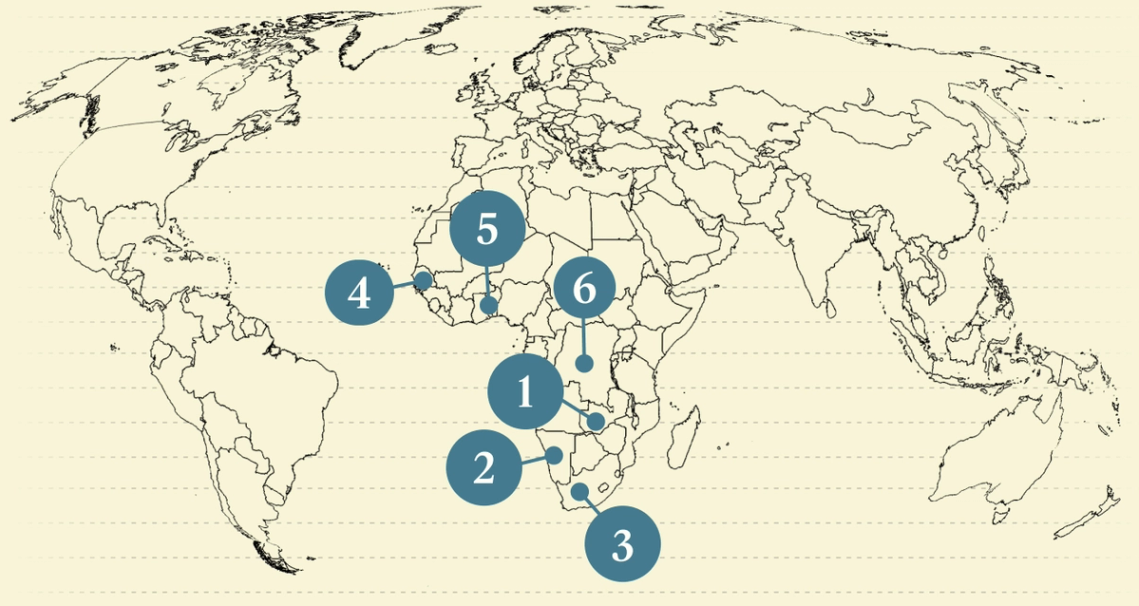 - Zambia’s Mundubile detained
- New DRC-Angola deal
- Johannesburg finance shortfall
- Fuel price disarray
- Solar record nears
- Press freedom risks
 Weekend Reads, and how South Africa’s rooibos went global. |
|
Zambia detains opposition leader |
 Zambian opposition leader Brian Mundubile votes in the most recent elections. Moses Mwape/Reuters. Zambian opposition leader Brian Mundubile votes in the most recent elections. Moses Mwape/Reuters.Zambia’s main opposition leader and his running mate were held in connection with alleged treason offences, two weeks after a disputed election that saw President Hakainde Hichilema secure a second term. The detention of Brian Mundubile and Makebi Zulu on Thursday risks clouding Lusaka’s credentials as a relatively stable southern African democracy and denting investor confidence in Africa’s second-largest copper producer. Police said they recorded “warn and caution” statements from both men — a step before formal charges are filed — but gave no details of the alleged offence. Mundubile, who rejected the election result as neither free nor fair, had been in hiding since security forces raided his Lusaka home during the election period. Hichilema’s confirmed second term was met with relief by financial markets and prompted Citigroup to advise clients to pile on Zambia’s bonds as the president pledged to triple annual copper output in five years to 3 million tons and secure fresh IMF backing. But UN rights chief Volker Türk has urged Zambian authorities to “stop arresting people arbitrarily” while the EU Electoral Observation Mission has noted a “constrained democratic space.” — Tiisetso Motsoeneng |
|
DRC and Angola sign new deal |
 Angolan President João Lourenço and Congolese President Félix Tshisekedi. @Presidence_RDC/X. Angolan President João Lourenço and Congolese President Félix Tshisekedi. @Presidence_RDC/X.DR Congo and Angola signed a US-backed railway agreement aimed at improving the transport of minerals to the Atlantic coast, as global superpowers vie for control of Africa’s key resources. Experts believe that once the Lobito Corridor linking mineral-rich DR Congo and Zambia to Angola’s Atlantic ports is fully operational, journey times that currently stretch to 30 days could be cut to a week or less. The Trump administration has proposed investing up to $1 billion in the infrastructure project, among others, as it looks to challenge China’s hold on DR Congo’s mining industry: A recent report from the US National Geospatial-Intelligence Agency showed Chinese companies control 72% of the copper and cobalt mines in the African country. This item first appeared in Semafor’s twice-daily Flagship briefing. Subscribe here. → |
|
|
‘Doom loop’ threatens Johannesburg |
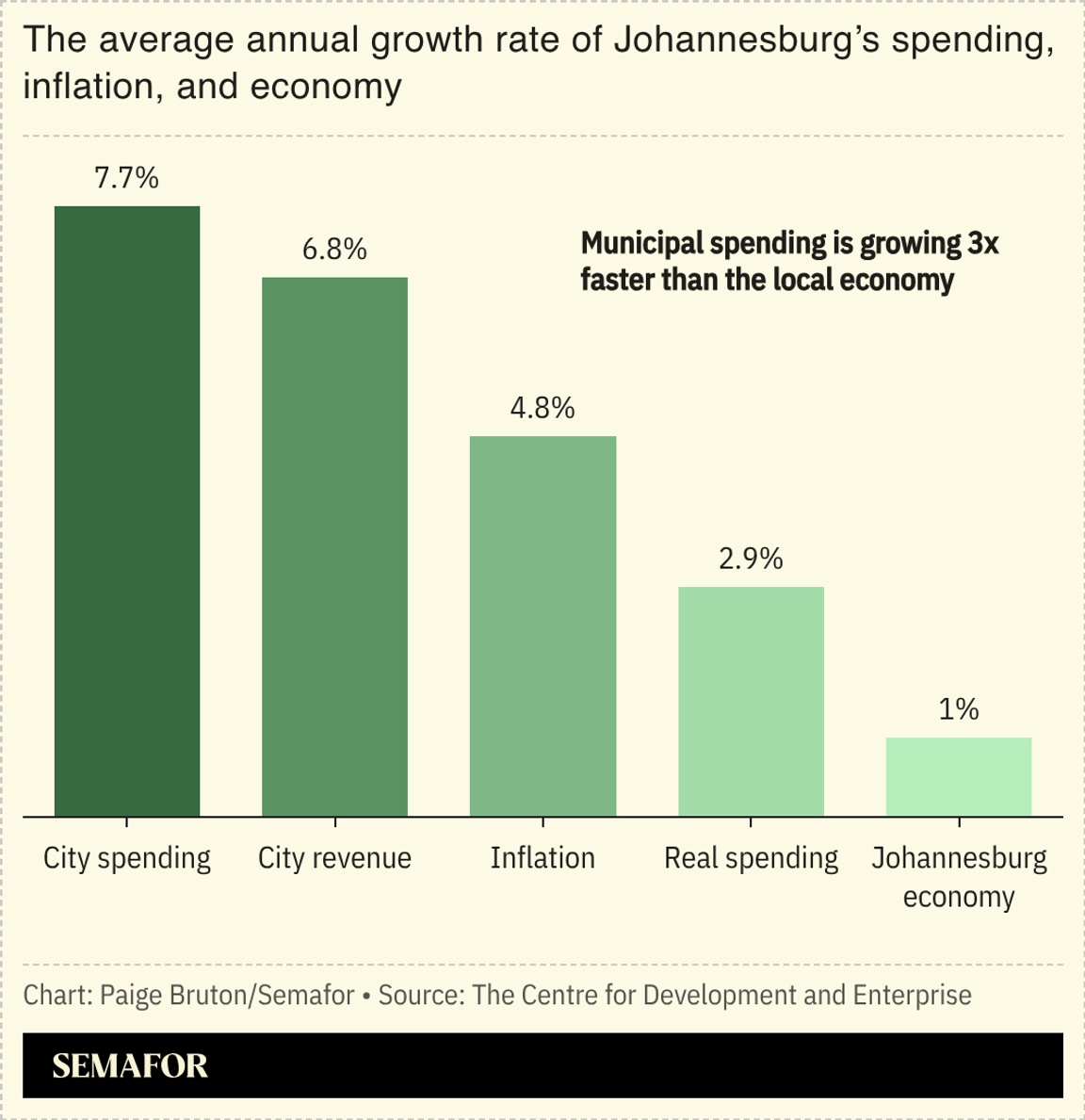 Johannesburg’s finances are collapsing under the weight of unpaid bills, leaving South Africa’s economic hub cash-starved and politically rudderless, according to a new report. The city is “living off a fiscal fiction,” said the Centre for Development and Enterprise think tank, booking revenues as if invoices had been paid, when collections lag far behind. Unpaid bills have surged, the report said, trapping the city in a financial “doom loop”: As defaults rise, the city hikes rates on paying customers, who in turn stop paying. Meanwhile, wage increases have seen employment costs grow by more than 9% per year over the past decade. Infrastructure spending has also halved in real terms, leading to widespread water leaks and potholed roads. The report comes ahead of South Africa’s local government elections in November. The vote in Johannesburg, a city that generates 16% of South Africa’s $400 billion-plus GDP and is home to Africa’s highest concentration of corporate headquarters, is the central battleground of the nationwide polls. — Tiisetso Motsoeneng |
|
Uneven fuel fallout in W. Africa |
 Stringer/Reuters Stringer/ReutersThe sharp rise in global oil prices sparked by the Iran war has had an uneven impact in Francophone West Africa, with some countries’ fuel prices double the level of their neighbors. Senegal, the second-largest economy in the West African Economic and Monetary Union, hiked its prices this month, reaching $1.70 per liter of fuel. In Niger, fuel prices largely remain at $0.89. The IMF had warned of “uneven exposure” across the bloc, whose eight members share a common currency and some economic policy. Senegal, which faces tight budgetary constraints due to ballooning debt, has spent nearly all of its full-year allocation for fuel subsidies already. Meanwhile, Côte d’Ivoire, which makes up more than a third of the group’s economic heft, has seen two price jumps over the last three months to $1.61. Togo has also held the line like Niger. Niamey has been cushioned by its small domestic refining capacity, while Lomé was one of the first African nations to buy refined fuel from Nigeria’s Dangote refinery in March. — Paige Bruton |
|
 AFSIC returns to London on October 13-14, bringing investors and business leaders together to explore opportunities across Africa’s fintech, infrastructure, healthcare, and other key sectors. This year’s program is the conference’s most comprehensive yet, with a wide range of industry discussions and a high-caliber investor audience. Register here. |
|
Africa set for solar installations record |
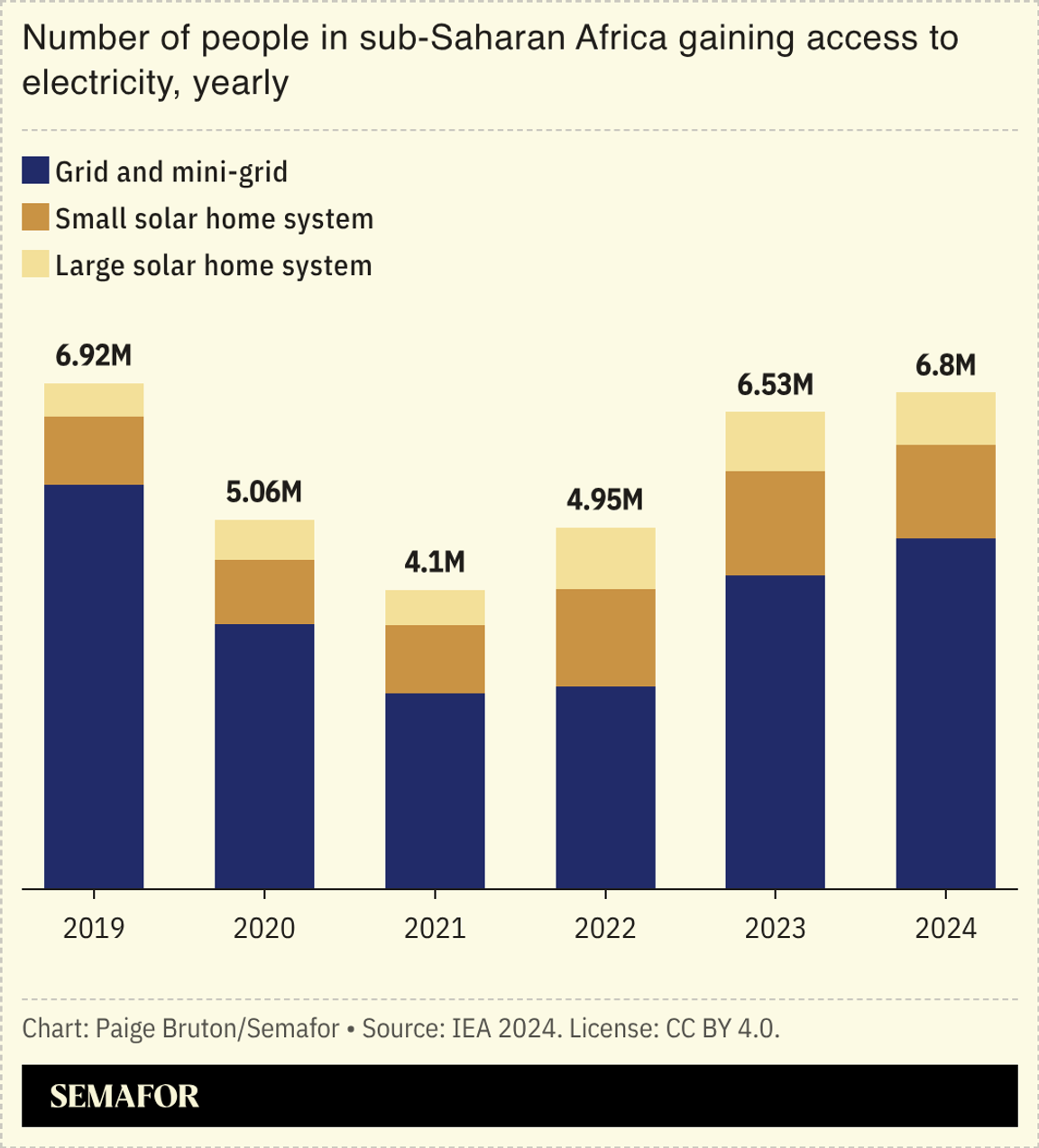 Africa is set for a record year of solar installations, according to new analysis. The continent is on track to install 17 gigawatts of solar in 2026, up 45% year-on-year, according to the global energy think tank Ember and the African Tech Futures Lab. If fulfilled, it would mark the third consecutive record year for African solar installations. In a separate study, the International Renewable Energy Agency said off-grid renewable energy has the potential to play “a more central role” in climate adaptation across Francophone West Africa, while also plugging critical infrastructure gaps. IRENA said solutions such as solar mini-grids were “crucial for expanding access to dispersed and underserved populations” in Benin, Burkina Faso, Côte d’Ivoire, Guinea, Mali, Niger, and Senegal, where rural electrification rates can range from 2% to 10% in certain areas. Inadequate energy and infrastructure investment has meant nearly 600 million people in Africa still lack access to electricity. Many countries are turning to the potential of solar power: Last year Nigeria struck a $200 million deal with a renewable energy company to connect rural areas with solar mini-grids. — Preeti Jha |
|
 Stringer/Reuters Stringer/ReutersJournalists working on environmental topics in sub-Saharan Africa are coming under attack, a new report found. The International Press Institute, a nonprofit that aims to protect media freedom, recorded 26 incidents of attacks and threats in the five months to March. Those reporting critically on natural resource exploitation — especially illegal mining, deforestation, and oil management — were at particular risk, it said. Journalists in DR Congo, Ghana, and Mozambique faced assault, abuse, and threats while reporting on illegal mining and logging operations, while in Chad and Namibia, reporters faced arrest and intimidation after scrutinizing the management of national oil resources. Two journalists arrested during this period remain in detention: One was arrested in Zimbabwe in February on “cyberbullying” charges after his outlet reported on suspected corruption in a multimillion-dollar waste-to-energy deal. — Preeti Jha |
|
 - Russia has planted ghost reporters and fake experts in African media outlets to promote its interests on the continent since at least 2021, new research suggests. The analysis by Graphika, a US firm that maps online networks, builds on earlier news reporting identifying websites with ghost reporters, where bylines are not linked to a genuine journalist. The ghostwriting operations primarily spread content around terrorism and security in Africa, including information critical of Ukraine and the US, or stories praising Russian paramilitary groups active in Africa.
- A Kenyan goat herder’s discovery of a $200 gold nugget sparked a major gold rush, the BBC reported: Around 10,000 people arrived in the small village of Cheporor in western Kenya at its height, with exaggerated rumours about the number and size of discoveries drawing even larger crowds. More than 200 businesses also sprang up around the dig sites, selling water and food. However, the rush belies a harsh reality: Several gold hunters told the BBC that they hope a discovery will help cover basic necessities, like their children’s schooling.
- The rollout of Turkish AI-powered drones across conflicts in Africa has killed hundreds of civilians due to operational errors, according to a HumAngle investigation. Western sanctions on Turkish weapons have driven a rise in sales to the Sahel region, Ethiopia’s Amhara, and northern Nigeria. However, few of the military recipients are receiving the same training that is being rolled out for Ukrainian buyers, the outlet finds. The result is that civilians have been misidentified as military targets, and in one instance an allied militia group was wrongly targeted in Ethiopia.
- Africa’s push to retain more value from its critical mineral exports is making headway but still faces hurdles, Le Monde writes. Refining materials often requires building electricity infrastructure, roads, and other transport links, in addition to building the core facility. Zimbabwe has successfully used export restrictions to leverage China to build local lithium refining plants. But foreign development models on the continent still prioritize constructing major export corridors such as the Lobito railway, which seek to export materials as quickly as possible, the outlet argues.
|
|
|