| | In today’s edition: Qatar’s prime minister lands in Tehran, LEAP returns to a changed Gulf, and LIV ͏ ͏ ͏ ͏ ͏ ͏ |
| |  | Gulf |  |
| |
|
 - Qatari PM visits Tehran
- Riyadh’s tech LEAP
- Gulf media really is a thing
- LIV Golf’s mass layoff
- Back-to-school tests airlines
 Week Ahead: LEAP opens in Riyadh, and OPEC+ makes its first output call since unwinding the cuts. |
|
There will be no briefing on Friday, Aug. 28. |
|
Mediators line up in Tehran |
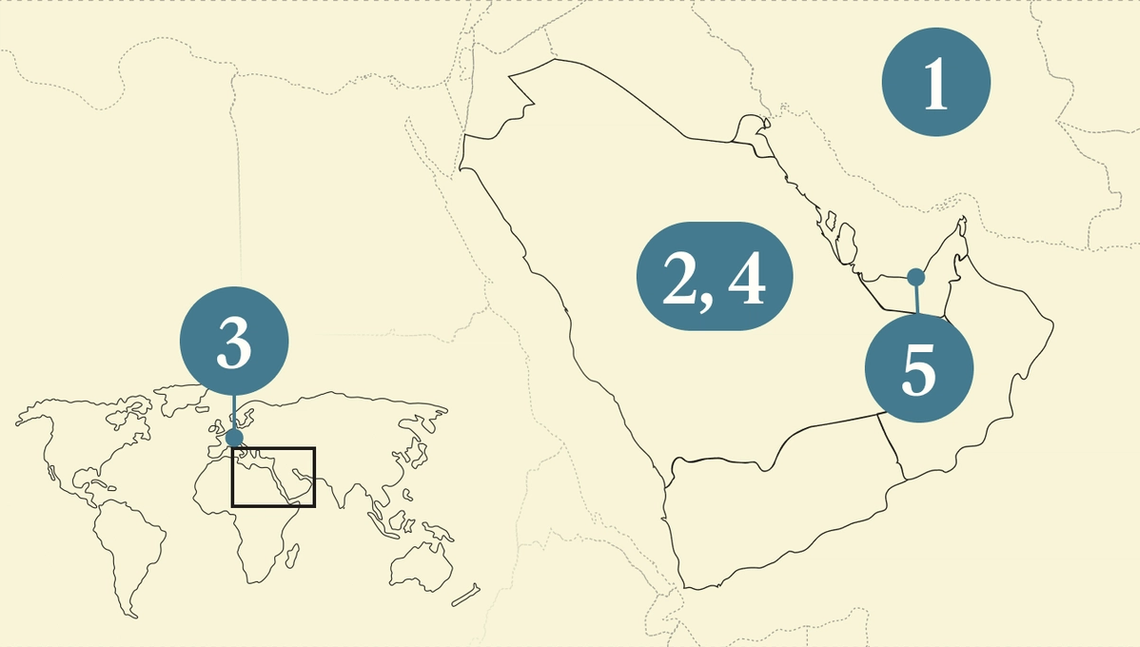
 Iran’s Parliament Speaker Mohammad Bagher Ghalibaf during a meeting with the chief of Pakistan’s Defence Forces. Iranian Parliament Speaker Office/WANA via Reuters. Iran’s Parliament Speaker Mohammad Bagher Ghalibaf during a meeting with the chief of Pakistan’s Defence Forces. Iranian Parliament Speaker Office/WANA via Reuters.The runway at Imam Khomeini International Airport in Tehran is bustling with diplomacy: Qatar’s prime minister is in town today trying to restart talks between the US and Iran, following visits from Pakistan’s army chief and Oman’s foreign minister. Doha helped secure a June ceasefire that unraveled in July; US Central Command has not reported a strike on Iran in nearly a month, but no talks are scheduled. Iran and Oman are meanwhile edging toward a temporary shipping corridor through the Strait of Hormuz. Iran’s military-run Defa Press said a route through Iranian territorial waters had been agreed, conditional on Washington lifting its naval blockade. A senior Iranian source told Reuters no agreement had been finalized, but Oman’s foreign minister said he was hopeful a corridor would be announced “soon.” Gulf governments fear a long stalemate that leaves Iran able to disrupt the waterway more than another round of fighting, according to Reuters. |
|
LEAP returns to a changed Gulf |
 Riyadh’s LEAP conference in 2023. Ahmed Yosri/Reuters. Riyadh’s LEAP conference in 2023. Ahmed Yosri/Reuters.Saudi Arabia’s biggest tech conference returns to Riyadh on Monday, five months after it was originally scheduled to take place. LEAP bills itself as the world’s most attended technology event — it drew more than 200,000 visitors last year, and its first four editions saw more than $42 billion in announced investments. Chief executives including HUMAIN’s Tareq Amin, Cisco’s Chuck Robbins, and AMD’s Lisa Su are expected to speak. The focus this year centers on Amin’s company, the Public Investment Fund’s AI champion, which entered the hardware game last September with a Qualcomm-powered prototype. A more market-ready successor is expected to launch at LEAP. The conference is also notable for being the largest Gulf event delayed by the war to try again. Other events have defied expectations: Semafor reported in June that Abu Dhabi’s flagship startup gathering drew a crowd organizers feared wouldn’t come. |
|
 Axel Springer’s CEO Mathias Döpfner. IMAGO/Hartenfelser via Reuters. Axel Springer’s CEO Mathias Döpfner. IMAGO/Hartenfelser via Reuters.Axel Springer is the latest media company to plant a flag in the Gulf, with a new entity headquartered in Abu Dhabi that is on the hunt for “opportunities.” The move comes shortly after the publisher of Politico and Business Insider completed a deal to acquire The Telegraph newspaper from Abu Dhabi-backed RedBird IMI; an investment in The Circuit, a regional digital publication, is also part of the expansion. It’s hard not to notice the media scene is starting to feel a little crowded around these parts, from the launch of Fortune’s Gulf-focused newsletter to Middle East Currents, the relatively recent newsletter from Reuters. Still, it’s a tough business, sometimes in this region especially — Semafor has covered misadventures at the Dubai media startup Moniify and more recently government pressure on newswire photojournalists during the Iran war. But a conviction we share is that the Gulf’s rise this century is among the most vital and compelling geoeconomic stories of our time (you appear to agree: Gulf has been Semafor’s fastest-growing briefing since Jan. 2025). More scrutiny, more rigor, and a dose of competition are healthy. A crowded media party is rarely a bad thing… right? — Kelsey Warner |
|
PIF pulls the plug on LIV Golf |
 US President Donald Trump and Yasir Al-Rumayyan during a LIV Golf event. Dennis Schneidler-Imagn Images. US President Donald Trump and Yasir Al-Rumayyan during a LIV Golf event. Dennis Schneidler-Imagn Images.LIV Golf is laying off the majority of its workforce while it tries to secure funding to keep the breakaway competition alive, after Saudi Arabia’s Public Investment Fund said it wouldn’t provide any more cash. Affected employees will leave in the first week of September as work continues to raise funds to relaunch “LIV 2.0.” LIV has said it’s confident about getting new backers to replace PIF, which has poured $5 billion into the league. The circuit was something of a passion project for PIF Governor Yasir Al-Rumayyan, an avid golfer. But the league had been unable to attract enough advertising or sponsorship revenue to offset the huge signing bonuses paid to bring in some of the sport’s biggest names. Elsewhere, PIF has been cutting spending and scaling back the ambitions of many of its plans. |
|
The Gulf’s uneven rebound |
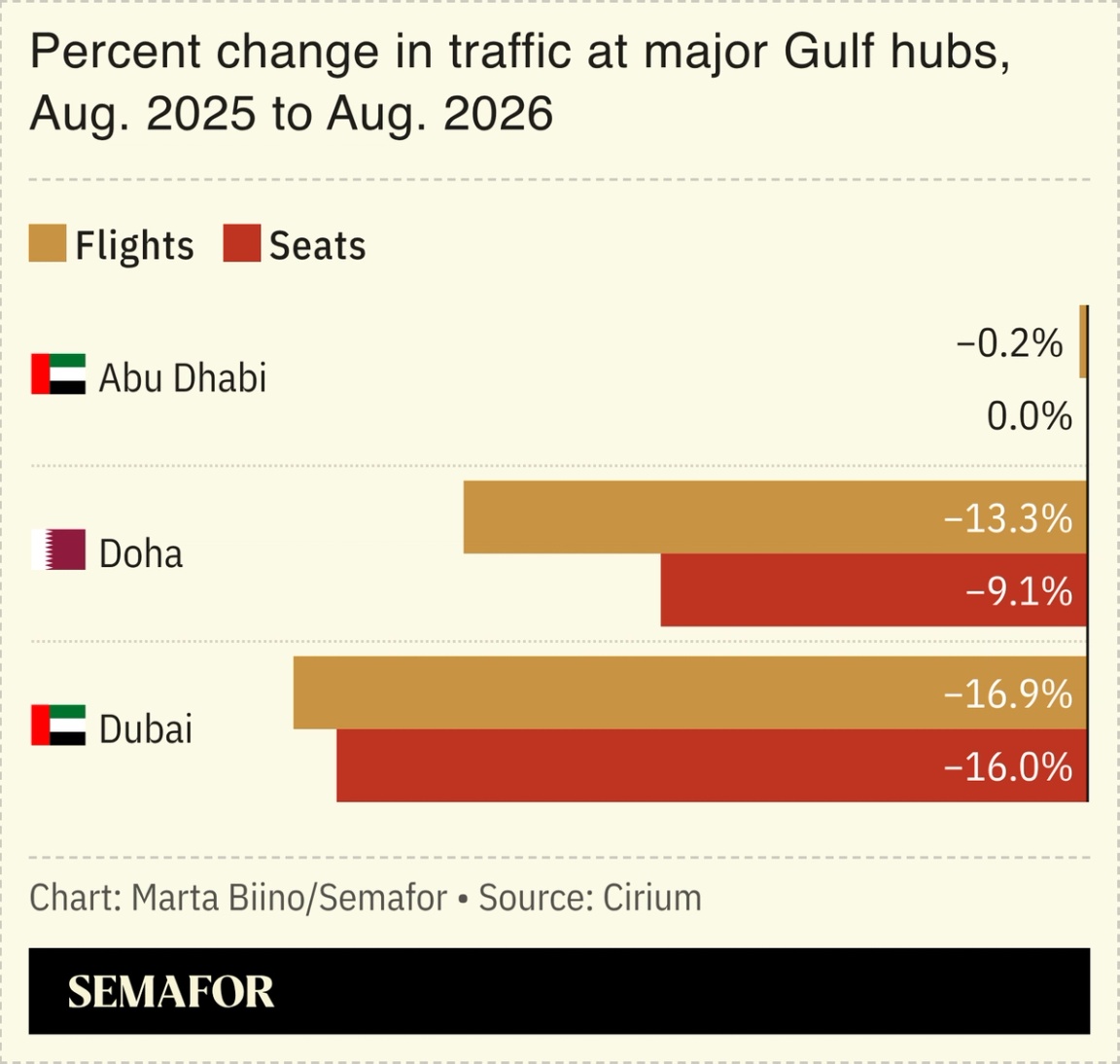 As diplomats, schoolchildren, and business executives trickle back into the region, inbound flight data for August paints a picture of uneven recovery. Abu Dhabi is whole again: Arrivals into Zayed International were within 18 flights of last August, according to data provided to Semafor by Cirium. Dubai, which relies much more on tourism, is not: Inbound flights to DXB were down 17% and seats down 16% year-on-year, while Doha’s flights fell 13%. Dubai alone accounts for more than three-quarters of the region’s lost seats. Dubai Airports put numbers to the damage this week, reporting that DXB handled 31.5 million passengers in the first half, down 31.3% compared to 2025. The airport had forecast close to 100 million passengers for 2026 before the US-Iran war began. Emirates President Tim Clark said last month the airline was flying at 90% of capacity, but Lufthansa, British Airways, and Singapore Airlines have all extended route suspensions in the region. |
|
 Even as the AI economy is booming, Blackstone is investing “through the lens that this may change,” says Jon Gray, chief operating officer of the $1.3 trillion asset manager. On this week’s episode of The CEO Signal, presented by PwC, Gray tells Penny Pritzker and Andrew Edgecliffe-Johnson that he is constantly checking to ensure Blackstone has not blindly “fallen in love” with an idea. Gray also says fears of private credit triggering the next financial collapse are “not very logical” and explains why recent shocks can strengthen the system. Plus, he shares how he and CEO Steve Schwarzman run Blackstone, along with the business case behind his “dorky Dad” running videos. |
|
 Aug. 30: Public schools reopen in Qatar for the 2026-27 academic year. Aug. 31: UAE public schools and some private schools reopen for 2026-27. Aug. 31-Sept. 3: LEAP technology conference takes place in Riyadh. Sept. 1-3: Middle East Energy at the Dubai World Trade Centre. Sept. 3: August PMI readings for Saudi Arabia, the UAE, and Qatar. Sept. 6: The seven OPEC+ countries’ monthly meeting. First output decision since the group finished unwinding output reductions. |
|
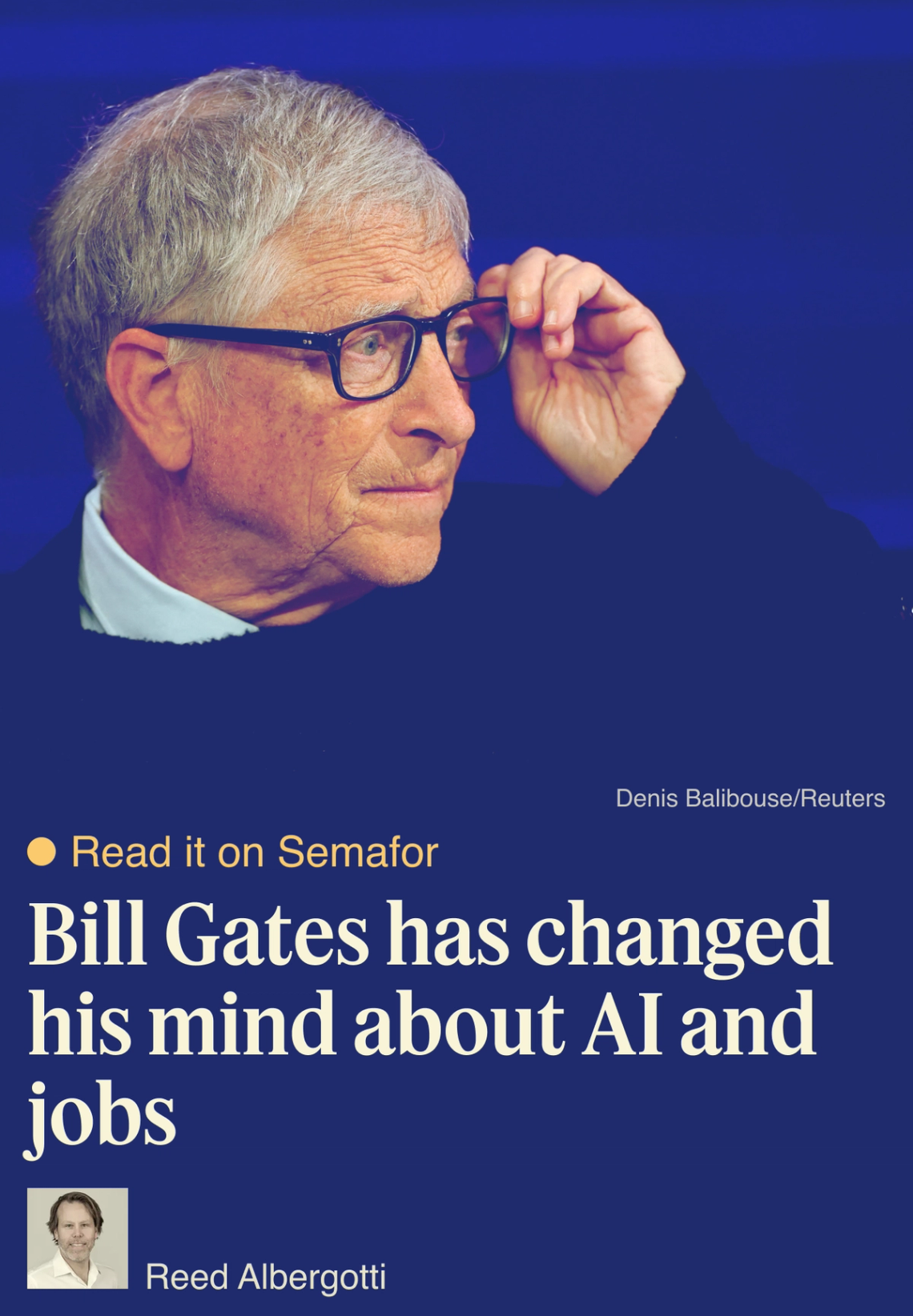 The News: The technology has crossed dangerous thresholds in biology, cybersecurity, white-collar work, and human relationships, the billionaire businessman said in an interview with Semafor. → |
|
|
|


