| | In today’s edition, Trump’s transport plans, renewables investment, and electric grid strain. ͏ ͏ ͏ ͏ ͏ ͏ |
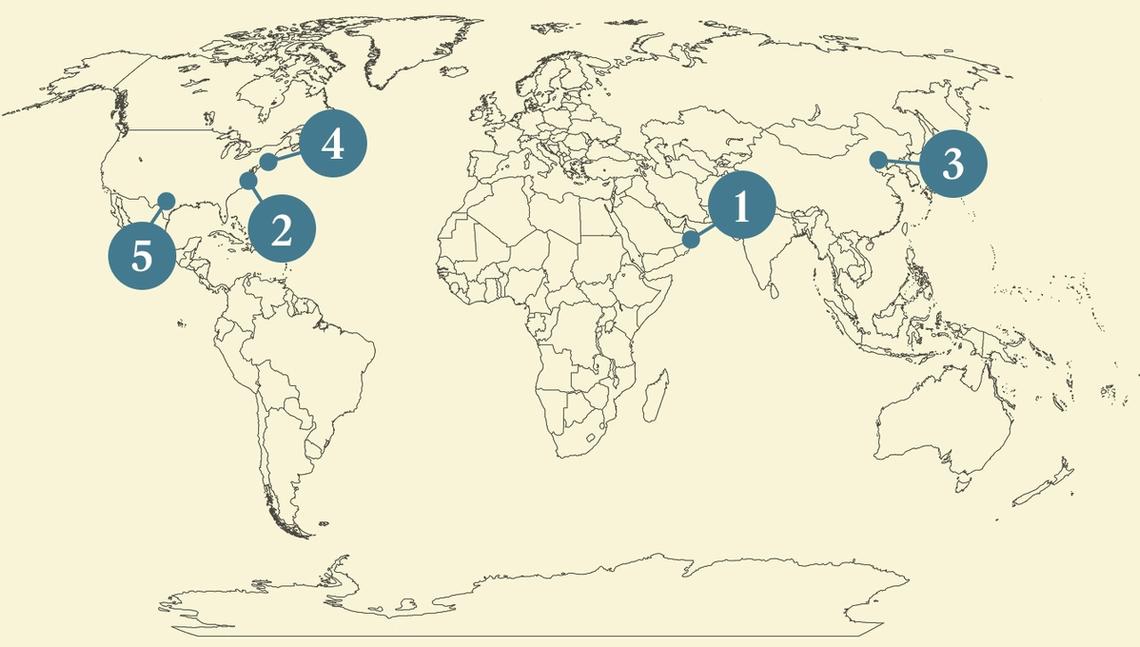
| |  Muscat Muscat |  Washington Washington | Beijing |
 | Energy |  |
| |
|
 - Refiners v. farmers
- ‘Right of way’ grids
- Renewables stagnate
- Flipping the script
- Data center capex
 Trump moves to block foreign hardware from the US grid, and power trading surges in China. |
|
 Europe is facing a test of how much it has learned from half a decade of successive energy shocks — and US gas exporters should pay attention. Natural gas prices in Europe hit their highest point in three years this week. While the volume of crude oil escaping the Persian Gulf has moderately ticked up recently, liquefied natural gas exports from Qatar — which, prior to the war, accounted for one-fifth of global supply — remain near rock bottom. That’s triggered the recurrence of a familiar pattern: Global gas undersupplied, US LNG rushing in to fill the gap, and Europe and Asia forced to bid against each other for a limited number of cargoes. Until recently, Asia had been winning, with LNG deliveries there commanding a significant premium over those to Europe. As a result, Europe’s gas storage facilities are at their lowest point for this time of year since 2011. Over the past two weeks, European prices have caught up enough to flip the script and send more US LNG tankers there than to Asia. But the competition is just getting started: To maintain its purchasing edge this winter, EU gas prices will likely need to be 40% higher than current levels — and more than double the prewar forecast — Goldman Sachs analysts wrote this week. That sounds scary for European households and factories. But in general, the European economy has learned its lesson after the gas crisis triggered by Russia’s 2022 invasion of Ukraine: Renewables adoption and energy efficiency gains have allowed the EU economy to use significantly less gas per unit of GDP than just a few years ago. Warm weather brought on by this year’s strong El Niño should also help. And while the LNG price boost is a short-term win for US exporters, it points to a deeper warning. Emerging economies watching Europe’s experience are “losing trust” in LNG as a reliable energy source, TotalEnergies CEO Patrick Pouyanné cautioned this week, flagging a major concern for his shareholders whose company is the top US exporter. LNG market turmoil is also bad for the climate: While Europe jumps ahead to renewables, for many Asian countries the most likely alternative will be to fall back on coal. On a happier note, I’ll be back in the Big Apple next month for New York Climate Week. Drop me a line if you’d like to link up, and join us for our now-traditional Thursday night happy hour. |
|
 Stringer/Reuters Stringer/ReutersShipping traffic through the Strait of Hormuz increased slightly after Oman and Iran said they made progress on new rules for passing tankers. Oil prices fell for the third day in a row after US President Donald Trump wrote on social media that the strait had been cleared of mines — an assertion some analysts greeted with skepticism — and Muscat and Tehran said they were working toward a new system where inbound ships would stay near the Iranian coast and outbound ships would use a middle lane. But an agreement between the countries doesn’t necessarily mean the US blockade will be lifted; as a result, “we don’t expect the framework to structurally increase Arab Gulf exports via Hormuz,” Rapidan Energy Group analysts wrote. In the meantime, the White House is pushing regulators to allow US refineries to cut the volume of biofuels mixed into the country’s gasoline and diesel supplies, which would likely lower pump prices but set up a clash with Republican-led farming states. |
|
| | Shelby Talcott and Tim McDonnell |
| |
 Eduardo Munoz/Reuters Eduardo Munoz/ReutersThe Trump administration is unveiling a new proposal aimed at turning the nation’s highway and rail lines into “multi-use” utility corridors that could hold critical infrastructure like transmission wires, fiber optic lines, and water pipelines. The initiative, according to details shared first with Semafor, will allow state-level transportation agencies and railroads to lease out land alongside roads and tracks to private-sector companies to develop new infrastructure. The plan — which mirrors proposals that Biden administration officials, environmental groups, and congressional Democrats have advocated for years — comes as the administration scrambles for ways to drive down energy costs, but follows the cancellation of a number of major transmission initiatives. The Energy Department ended a $4.9 billion conditional loan commitment last year for a transmission project and scrapped three other transmission corridor proposals this month. Alan Mitchell, a senior manager for US federal policy at the Clean Air Task Force, a climate nonprofit, commended the Trump administration’s plan as a “step in the right direction” and a “serious, practical use of existing authority.” But Mitchell argued that the administration’s other actions could undercut it. “The administration needs to act consistently to get our country the transmission it needs where it needs it,” he told Semafor. |
|
Renewables investment stagnates |
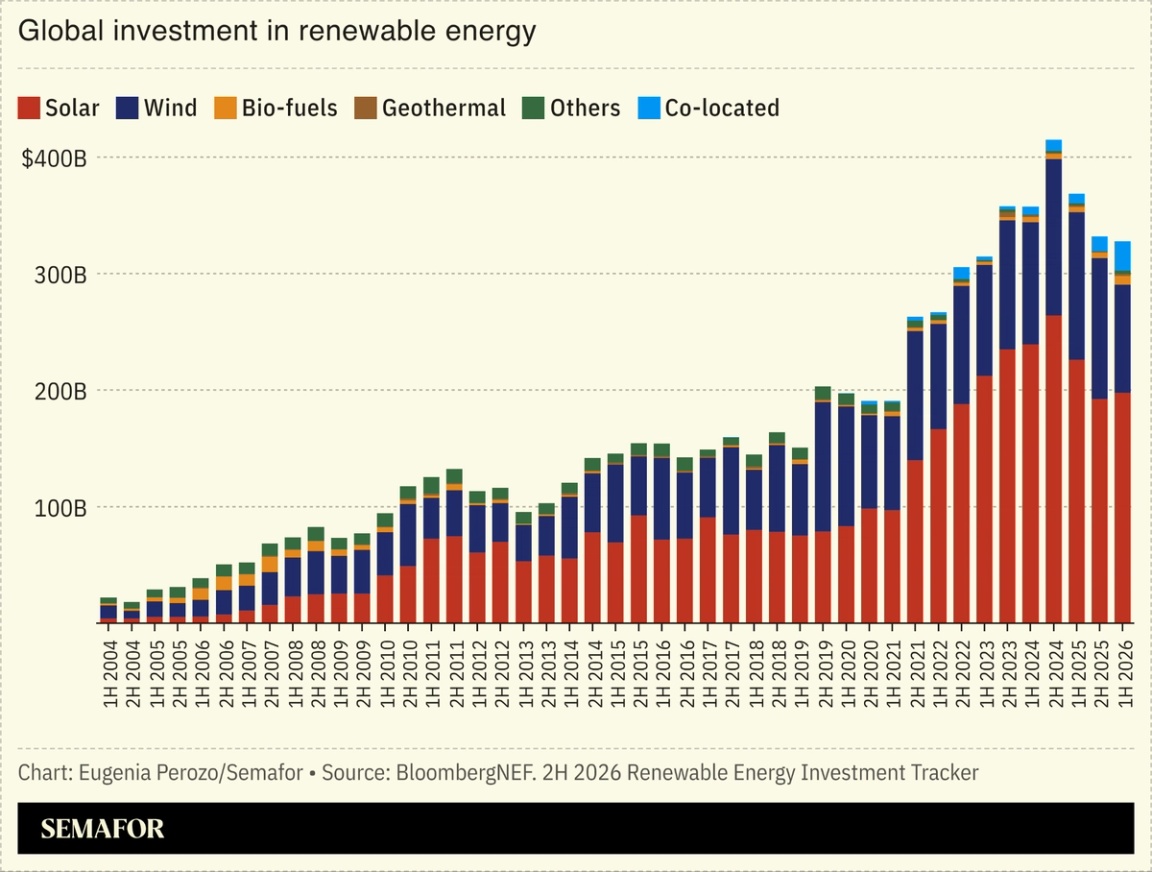 Global renewable energy investment fell to $327.5 billion in the first half of 2026, down 21% from a 2024 peak — but solar continues to grow at breakneck speed. Investment in the first half of 2026 was roughly flat from the prior six months, according to a new report from BloombergNEF. The dip over the past few years was driven primarily by a major contraction of the offshore wind industry. Solar attracted the most investment among renewable energy subsectors during the first six months of the year as countries rush to build capacity as worries grow that global wars will continue squeezing energy supplies. Africa is set for a record year of solar installations, according to a new report from energy-focused think tank Ember. China remains the biggest global market for renewables. However, its market share has shrunk: It now accounts for a quarter, while in 2022 it attracted over half of all global renewable energy investment. — Eugenia Perozo |
|
 Emerald AI, a startup that builds software allowing data centers to reduce their strain on the electric grid, closed a $150 million funding round that pushed its valuation above $1 billion. The company, whose technology allows data centers to tone down their power consumption at moments of peak demand, expects to have commercial contracts agreed with more than 100 megawatts worth of global data centers by the end of this year, CEO Varun Sivaram, a former Biden administration climate official, told Semafor. Eventually the company plans to go public, he said. In the meantime, its goal is to make data centers an asset for reducing local power costs, not driving them up: “There should be no better citizen to invite into your community than a data center,” he said. |
|
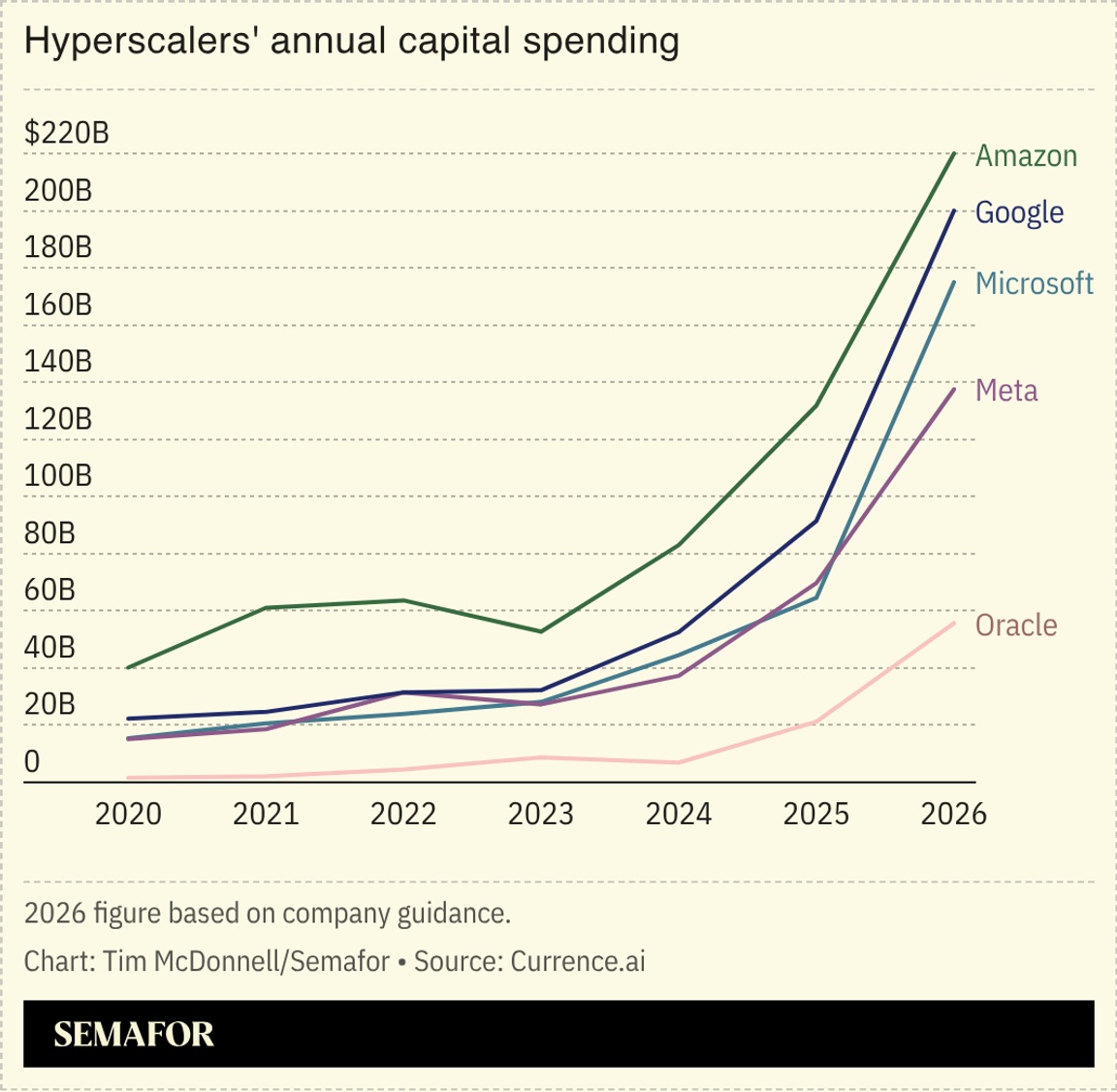 A burst of Big Tech capital spending doesn’t necessarily mean a corresponding burst of data center construction: The biggest driver of hyperscaler costs is rising prices for chips and power generation equipment, not more expansive construction plans, according to analysis by the AI and clean tech market research firm Currence.ai. In other words, it now costs much more to reach the same level of computing power — and that means companies will be under pressure to squeeze a higher profit margin from their new facilities in order to pay back the huge volume of debt required to build them. In the meantime, opposition from communities and lawmakers has driven a surge in project cancellations, the analysis concluded, up 66% in the second quarter of this year compared to the first. |
|
 New Energy- China’s renewable energy policy overhaul, which has undercut profits, has led companies to pursue alternative opportunities such as power trading.
- The US Army announced plans for nuclear reactors at five of its bases, selecting five energy companies that will receive awards of up to a combined $2.2 billion from the Department of Defense.
- Thailand doubled its renewable energy goals, as it shifts away from LNG following disruptions from the Iran war. More than half of the country’s electricity production currently comes from imported natural gas.
Fossil Fuels- TotalEnergies said it is looking to secure a $1.3 billion reimbursement for loans as it completes its exit from the Arctic LNG 2 project in Russia, which was sanctioned by the US in 2023 as part of efforts to curb Russian exports.
Finance- Insurers’ profits could take a hit from Europe’s extreme summer heatwave, which raised claims due to heat-related deaths and worsening health.
TechPolitics & Policy- Some foreign equipment is now banned from being used in the US energy grid, after President Donald Trump signed an executive order claiming these posed an “unusual and extraordinary threat.”
Food & Agriculture- A Champagne harvest weeks ahead of schedule rattled French growers, who say they hope wine grapes will adapt to changing weather conditions as climate change intensifies.
Personnel |
|
|


