| | In today’s edition: The Gulf’s balancing act between Washington and Beijing, MBS leaves Paris with a͏ ͏ ͏ ͏ ͏ ͏ |
| |  Abu Dhabi Abu Dhabi |  Paris Paris | Kuwait City |
 | Gulf |  |
| |
|
 - China, Gulf in focus…
- …as a China showdown looms
- MBS’ French connection
- UAE, Russia enter trade pact
- Kuwaiti crackdown cont’s
 A Saudi copycat of a viral London bakery. |
|
Beijing’s Middle East week |
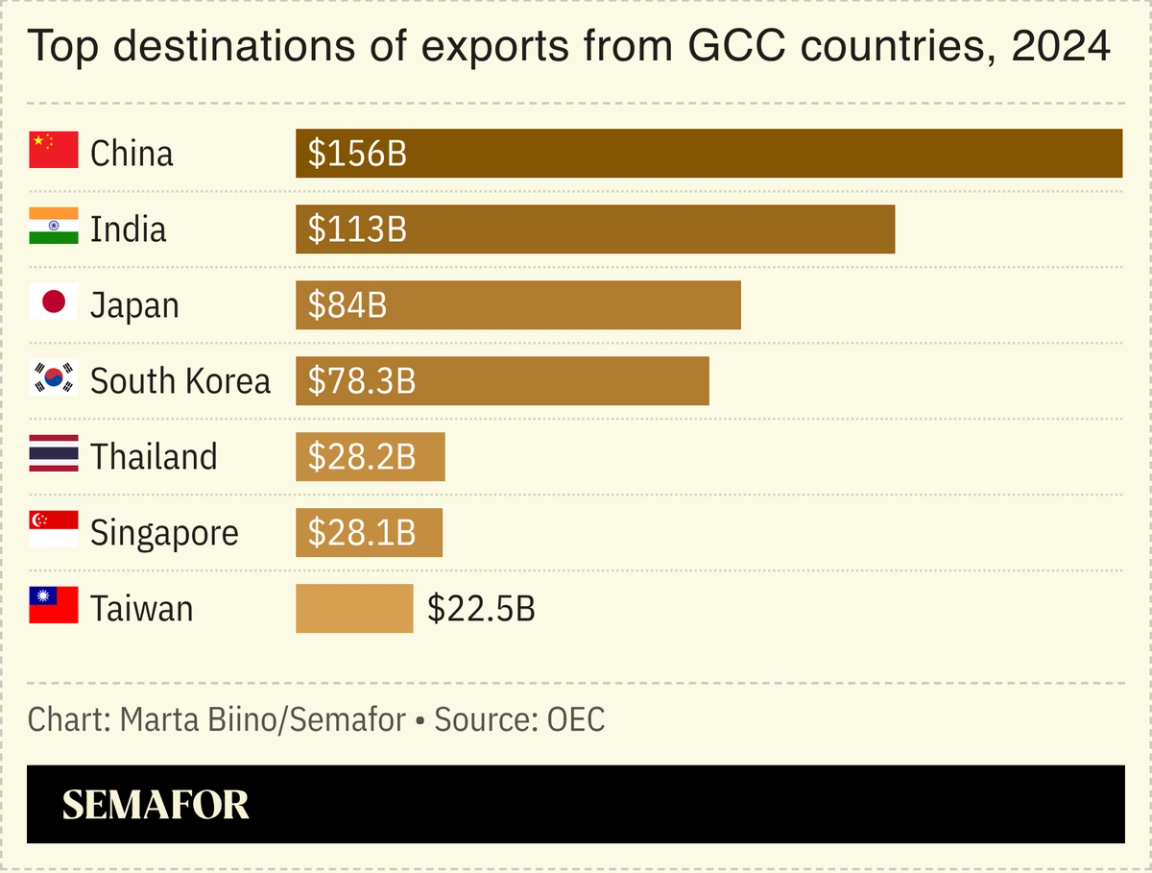 China’s foreign minister warned that the Middle East and Gulf had again reached a critical juncture, urging a return to dialogue and negotiations, during a week of Chinese engagement across the Arab world. Wang Yi’s talks with his Kuwaiti counterpart came after senior officials from the six GCC foreign ministries met a Chinese delegation in Riyadh on Aug. 20 to discuss Iranian attacks on member states, and maritime and energy security. At the same time, Jordan’s king is in Beijing for talks with China’s leader, while Egyptian and Chinese air forces this weekend launched joint exercises. Beijing, the largest buyer of both Iranian and Gulf crude, has influence in the region. That made it even more conspicuous when the US Treasury secretary on Monday threatened secondary sanctions against Iran’s trading partners, but named no Chinese banks. Still, the region’s governments have tempered their expectations about forming a security partnership with China, which is reportedly providing Iran with satellite imagery and shoulder-launched missile systems. — Ed Clowes |
|
 Evelyn Hockstein/Reuters Evelyn Hockstein/ReutersThere’s a China-sized hole in the Trump administration’s plan to wage an “economic D-Day” against Iran. China is Iran’s most important economic lifeline, and prior to the war, the two countries had a mutually beneficial oil arrangement: China bought nearly all the crude Iran managed to export, at a significant discount, in exchange for ignoring Western sanctions. All told, Iranian oil provided about 12% of China’s imports. This year the US did step up sanctions on one of China’s biggest refineries over its purchases of Iranian crude, and the American naval blockade in the Strait of Hormuz has for now effectively halted most Iranian crude exports. But with Chinese leader Xi Jinping due to meet Trump in Washington next month, the administration is clearly aiming to avoid a full-on economic war with Beijing. — Tim McDonnell |
|
MBS’ France visit covers favorites |
 Bandar Algaloud/Courtesy of Saudi Royal Court/Handout via Reuters Bandar Algaloud/Courtesy of Saudi Royal Court/Handout via ReutersSaudi Crown Prince Mohammed bin Salman concluded a visit to France with a raft of agreements covering many of his top priorities including AI, geopolitics, and even his favorite pastime: video games. France has become the fourth-largest investor in Saudi Arabia, and MBS is returning the favor: A €6 billion theme park was among a series of agreements totaling more than $10 billion inked in Paris. France’s CMA CGM will, meanwhile, develop a new Red Sea port terminal in Jeddah, as the kingdom looks to lessen its reliance on the Strait of Hormuz. Saudi AI champion HUMAIN also agreed to cooperate with France’s Mistral on localizing AI models, betting that the demand for sovereign AI will accelerate. But the real highlight for the Crown Prince would likely have been the Esports World Cup. Moved from Riyadh to Paris due to the Iran war, MBS has attended the event every year since he launched it in 2024. — Matthew Martin |
|
Russia, UAE latest trade pact in spree |
 Maxim Shipenkov/Pool via Reuters Maxim Shipenkov/Pool via ReutersA trade pact signed last year between Russia and the UAE comes into effect this week as the Gulf country looks to strengthen bilateral relations and boost non-oil trade. While short of a full free trade agreement, the pact — signed a year ago during a visit by UAE President Mohamed bin Zayed to Moscow — will simplify two-way investment between the countries. A separate free trade deal covering goods, struck between the UAE and the Russia-led Eurasian Economic Union, takes effect on Oct. 6, The National reported. Non-oil trade between the two countries hit $20.4 billion last year, nearly double the 2022 level. Russia’s economy is facing a widening deficit and lower energy revenues under heavy international sanctions. The UAE has stayed neutral during Russia’s war in Ukraine, playing a diplomatic role and becoming a haven for Russian and Ukrainian expats alike in the process. |
|
Kuwait amends citizenship rules |
 Stephanie McGehee/Reuters Stephanie McGehee/ReutersKuwait is advancing its citizenship crackdown under new rules introduced Sunday that bar naturalized citizens from voting and replace paper nationality certificates with electronic ones. Naturalized citizens could previously vote once they had held citizenship for 30 years, though they could not run for office or be appointed to parliament. For now, that last policy isn’t so relevant: Kuwait’s emir dissolved the legislature — once viewed as one of the most powerful elected bodies in the Gulf — in May 2024 before embarking on a regulatory overhaul that has stripped at least 50,000 people of citizenship. Authorities say some of them held dual nationality, which is illegal for Kuwaitis, while others had obtained citizenship through fraud; rights groups say the government’s political opponents have also been targeted. |
|
 Economy- Qatar has repatriated $13 billion to boost foreign currency deposits in local banks and shore up liquidity as non-resident deposits dropped due to the Iran war. — AGBI
Energy- French energy major TotalEnergies will invest in expanding Abu Dhabi’s Fujairah oil export pipeline, its CEO said. The Habshan-Fujairah pipeline has been crucial to circumventing the Strait of Hormuz and bringing exports from the Gulf of Oman coast during the Iran war; the UAE aims to double its capacity by next year. — Reuters
Finance- UBS is offering Middle East clients leveraged deposits to take advantage of higher regional savings rates, part of the Swiss bank’s focus on the Gulf despite the Iran war. — Bloomberg
Sovereign Wealth- LIV Golf is scrambling for cash as the upstart league faces questions about its future after the Public Investment Fund, its main backer, pulled new funding. — WSJ
|
|
 The Arome Bakery in Khobar. @aziz.picks/TikTok. The Arome Bakery in Khobar. @aziz.picks/TikTok.A viral bakery in London has fired a warning shot at an alleged copycat in Khobar, whose owners had built an almost like-for-like replica in the Saudi port city. “It has recently come to our attention that a bakery is operating using our brand name and logo in Saudi Arabia,” Arôme wrote on Instagram. “This bakery is not affiliated with us in any way.” You’d never guess that looking at videos online of the one in Khobar. The squiggly logo is identical to its London counterpart save for the circumflex, which appears to have been lost in translation. The imitation Arome clearly did a stellar job knocking off the OG: Social media users in Saudi Arabia celebrated the arrival of the vaunted London shop, known for blending Asian flavors with French patisserie techniques. But the celebrations didn’t last long. Arome Khobar’s Instagram account has been deleted, and its developer Roaya did not respond to a request for comment. — Ed Clowes |
|
|


