|
Contact: Jan Suszkiw, arspress@usda.gov
NovoFlyTM Screwworm Strain Readied for Active Duty
American scientific ingenuity in the form of sterile fly releases helped eliminate New World screwworm from the country in the 1960s. Now, ARS researchers are combining that ingenuity with next-generation tools to counter new resurgences of the pest threatening livestock and wildlife in New Mexico and Texas.
“Releasing sterile screwworm flies is a proven, decades-old approach to eliminating populations of this pest and preventing the harm it inflicts—physically to livestock animals and wildlife and financially to the producers who raise livestock for our milk, meat, hide and other products,” said Kim Lohmeyer, Director of ARS’s Knipling-Bushland U.S. Livestock Insects Research Laboratory in Kerrville, TX. “Advances in genetics have now given us better tools to understand the screwworm’s population dynamics and leverage that knowledge for improved control methods, including sterile fly releases.”
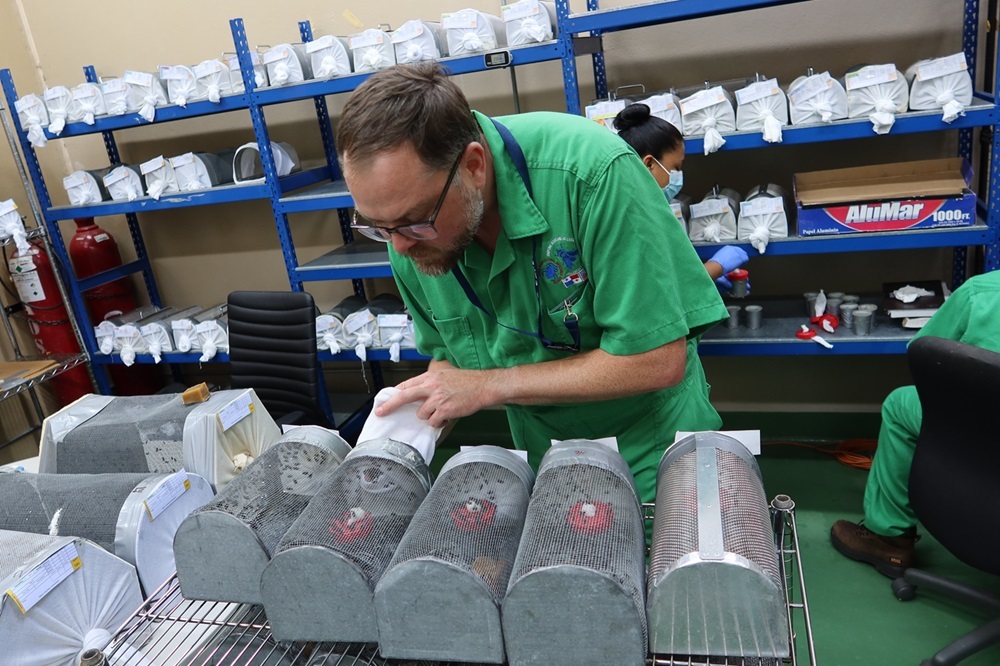 Alex Arp, a Research Geneticist with ARS Knipling-Bushland US Livestock Insects Research Laboratory in Kerrville, Texas shown in a screwworm lab with staff members at a COPEG (Panama–United States Commission for the Eradication and Prevention of Screwworm Infestation in Livestock) screwworm facility in Panama. (USDA-ARS Photo)
The latest example is NovoFly™, an all-male strain of screwworm developed by Lohmeyer’s team and university collaborators. With full regulatory approval of NovoFly™, critical resources can be redirected towards producing only males, essentially doubling the number available for SIT releases to eradicate established populations of the pest or isolate outbreaks of it.
Central to screwworm eradication is the Sterile Insect Technique (SIT). SIT is a biologically based approach to pest control that originated with the pioneering studies of ARS entomologists Edward B. Knipling and Raymond C. Bushland. That research began in the mid-1930s and continues today at the Kerrville lab, which was posthumously named after these two entomologists.
In January 2026, USDA Secretary Brooke Rollins and Deputy Secretary Stephen Vaden highlighted SIT as part of a New World Screwworm Grand Challenge to counter recent U.S. incursions of the pest up through Central America.
The SIT calls for releasing sterilized male flies near infestation areas where they can mate with wild female flies. The resulting eggs fail to hatch into flesh-eating larvae, which typically burrow into wounds or mucus-lined openings of livestock animals such as cattle—but also wildlife and, less often, pets and people. Without larval offspring, the screwworm population eventually collapses, sparing animals further harm and reducing producers’ costs for insecticides, veterinary services, and medications.
Despite SIT’s success in eradicating America’s indigenous screwworm population by 1966 (and eliminating subsequent resurgences of it), researchers saw room for improvement. “A sterile male can prevent a lot of wild females from reproducing, but a sterile female fly that mates only once doesn’t help with SIT,” explained Alex Arp, an ARS Research Geneticist who co-developed the all-male NovoFly™ strain. While only sterile males are desirable, until now there has been no good way to separate them from females prior to SIT release, he added.
Producing only male flies would increase production efficiency by doubling the number of male larvae that can be reared and male pupae that can be sterilized without major changes to production facilities. Without sterile females being released, sterile males have increased opportunities to mate with wild females, resulting in a more effective, efficient SIT program.
Toward that goal, Arp and collaborators engineered Novofly™ with a genetic “switch” that kills female larvae during early rearing stages but doesn’t function in males. This allows for a doubling in the number of males that can be brought to maturity for release using the same amount of artificial diet and equipment.
NovoFly™ is currently undergoing regulatory approval before the Environmental Protection Agency. Once approved, NovoFly™ will be mobilized for “active duty” at designated screwworm rearing facilities. USDA’s Animal and Plant Health Inspection Service coordinates SIT efforts in the U.S, Mexico, and Central America.
“The research that went into creating NovoFly™ will provide the basis for the Grand Challenge project led by Max Scott of North Carolina State University together with Arp and many other collaborators,” Lohmeyer added—an effort that will set the stage for the next generation of this screwworm strain.
To learn more about USDA’s whole-of-government approach to combatting NWS, visit “Stop Screwworm: Unified Government Response to Protect the United States”
The Agricultural Research Service is the U.S. Department of Agriculture's chief scientific in-house research agency. Daily, ARS focuses on solutions to agricultural problems affecting America. Each dollar invested in agricultural research results in $20 of economic impact.
|