| | In today’s edition: The New York Times’ AI experiments, a Chinese YouTube rival, and more turnover a͏ ͏ ͏ ͏ ͏ ͏ |
| |  New York New York |  Nashville Nashville | Shanghai |
 | Media |  |
| |
|
 - NYT’s AI
- Daily Wire departure
- Mixed Signals
- YouTube’s new competitor
- Blockbuster summer
|
|
 Warner Music CEO Robert Kyncl recently remarked to me and Semafor business editor Liz Hoffman that most executives operate with 90% of what they need to know about any given subject. “What it takes is extra-curious people who seek the remaining 10,” he said. “And when you do that, suddenly the path of what you should try to do emerges.” Kyncl has applied this insight to AI in the music business. But after our interview, I called Semafor’s editor-in-chief, Ben Smith, to ask: What areas in the news business have coalesced around conventional wisdom, and is it possible the truth is more complicated? Here’s two news truisms: Individuals, not institutions, have the trust of increasingly siloed audiences. And platforms can’t be relied upon to build a sustainable business, so it’s important to control your own distribution and own your following. Both true. And yet: As the personality-driven news media landscape matures, it’s getting crowded. Everyone is in the personality-driven news media business, leaving a wide open lane for anyone who can figure out how to bundle personalities together into a singular offering. And despite the deep Facebook-era scars, there are some spaces where on-platform business is growing, and — dare we say — friendly to some news publishers. As we noted in 2024, YouTube has become an important part of the business for podcast companies, particularly if the site continues to improve tools allowing publishers to increase their own advertising monetization. And some publishers are seeing growth in short-form video business, too: Recent Mixed Signals guest Rachel Karten pointed out that InStyle Magazine has successfully created a show for TikTok and Instagram Reels that is integrating widely viewed partnerships (in other words, people are watching videos made by publishers with marketing inside of them). Mike Rothman, the Daily Mail’s new US general manager, told Semafor last week he expects the Mail’s social video revenue to grow to more than a third of total direct advertising revenue in the next year or two. None of these data points disprove the conventional wisdom. But don’t be surprised if a few smart media operators follow Kyncl’s advice and seek the opportunities in the overlooked 10%. Also today: The New York Times’ AI experiments, a Chinese YouTube rival, and more turnover at the Daily Wire. |
|
 Kylie Cooper/Reuters Kylie Cooper/ReutersThe New York Times has begun testing its first generative AI tool for readers, hoping to improve its troubled search feature but alarming some of the paper’s journalists.
Non-news parts of the company like Wirecutter have been experimenting with AI for months. But in recent weeks, the paper has quietly rolled out a new search page for a small subset of visitors that responds to queries with excerpts, relevant links to Times stories, and AI-generated summaries of Times reporting. It’s the news arm’s first test of AI-generated text unmediated by a Times journalist or editor.
“We are always testing new ways for our users to discover and engage with Times journalism,” Times spokesperson Graham James said. “This experimental feature is an example of how we are using the latest technology to create a better search experience.” |
|
Daily Wire turnover continues |
 Cheney Orr/Reuters Cheney Orr/ReutersOne of the biggest players in conservative media is losing its chief financial officer at an unusual moment. Two people familiar with the move told Semafor that Matthew Mabry, the Daily Wire’s CFO, is leaving the company. His departure comes as the Daily Wire seeks to reposition its business and take on new investors. The company has been looking to raise as much as $100 million in investment at a $750 million valuation, Semafor reported in June. Financial documents indicated the company had been in talks with Highmount Capital about leading a large investment round with an eye toward potentially going public in the coming years. The company has shifted its priorities, scaling back its expensive scripted streaming business. And in July, the company sold Jeremy’s Razors, one of its lucrative consumer product lines, to now-former co-CEO Jeremy Boreing, for whom the brand is named. The company has also been churning through executive-level roles in recent months. In addition to Boreing’s departure last year and Mabry’s departure in recent days, the company’s former chief operating officer, Chris Williams, left in May. A spokesperson for the Daily Wire declined to comment. |
|
Rachel Karten on ‘Mixed Signals’ |
 Are we seeing the death of the social media follower? Rachel Karten thinks so. On this week’s episode of Mixed Signals, the social media consultant and Link in Bio newsletter author joins Max and Ben to talk about how the shift from follower-based to algorithm-driven distribution broke the contract between platforms and creators, why brands are quietly building their own shows without telling anyone they’re behind them, and what the regulatory gap around paid content is actually doing to the feed. |
|
YouTube’s Chinese rival enters Anglosphere |
 Go Nakamura/Reuters Go Nakamura/ReutersChina’s YouTube equivalent, Bilibili, is making a play for the rest of the world and courting non-Chinese creators to boost its appeal, Semafor’s J.D. Capelouto reported last week. The company relaunched its previously discontinued international app and disclosed plans to roll out an English-language website and staff up in key markets around the world, including in Los Angeles, London, São Paulo, and Tokyo, according to new job listings and marketing materials distributed to creators. Bilibili has already been pushing prominent Western creators (read: MrBeast) to post videos on its main Chinese-language site, which boasts 376 million monthly active users. Bilibili’s entrance into the US market could challenge YouTube’s dominance, but also open up thorny questions about censorship, moderation, and data security for the company — the kind of fights that plagued TikTok in the US for years. Bilibili could particularly make inroads with gaming and anime content, which is especially popular on its main Chinese site, but its embrace of AI-generated video could turn off some American users. |
|
Let’s all go to the movies |
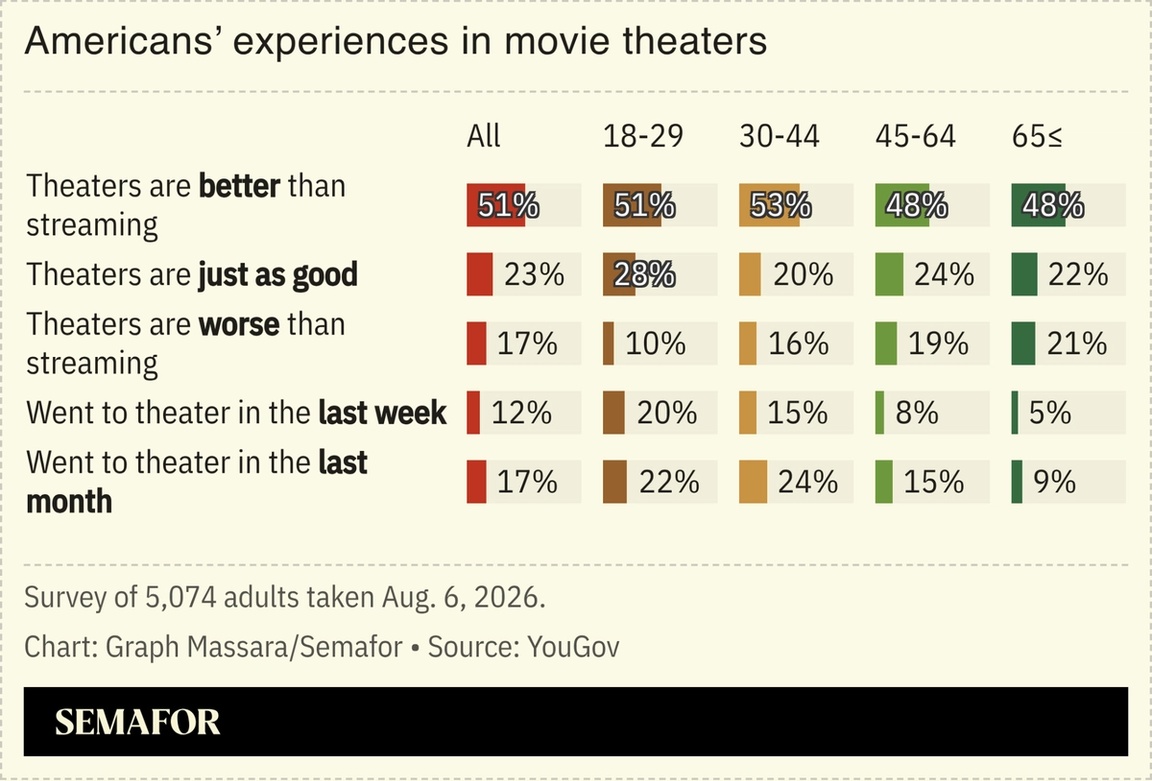 This summer’s box office boom is real — and poised to persist long into the cooler months, if last week’s website-crashing rush for Dune 3 tickets is any indication. Driving the trend, according to a mounting body of demographic surveys and ticket sales data, has been moviegoers under 30, in line with Gens Z and Alpha’s fixation on IRL experiences. One in five Gen Z adults said they’d seen a movie in theaters in the last week, a YouGov survey this month found, easily outpacing older generations; about one in four Gen Z and millennial adults said they’d gone in the last month. And for all the perennial handwringing about whether the youth are ruining theater etiquette, 51% of Gen Z and 53% of millennials said seeing a movie on the big screen was a superior experience to just streaming at home, while less than half of adults over 45 said the same. — Graph Massara |
|
Trapital: Dan Runcie takes seriously Kyncl’s suggestion on Mixed Signals that Netflix start streaming music. The Ankler: A secret group of top filmmakers and Silicon Valley types have been meeting to hammer out a framework for AI use in Hollywood, Richard Rushfield writes. New York Times: Paramount and California officials will meet tomorrow to discuss a potential settlement to the blue-state antitrust suit currently blocking the studio’s merger with Warner Bros. Discovery, Lauren Hirsch, Benjamin Mullin, and Laurel Rosenhall write. The Intercept: Matt Sledge reports on a potential industry front group that’s been sending out texts urging Californians to lobby state Attorney General Rob Bonta to back the Paramount-Warner Bros. merger. Status: Longtime 60 Minutes correspondent Bill Whitaker recently gave a toast at a private meeting in which he told colleagues he occasionally feels like a “traitor” for staying at the show, and described the current state of affairs as a “seesaw,” Oliver Darcy writes. CBS News: The Pentagon moved to fire the publisher and the editor-in-chief of Stars and Stripes, as well as a reporter covering the Middle East, over interviews they gave to CBS News, Jennifer Jacobs and Kathryn Watson report. |
|
 - MeidasTouch announced last week that it is partnering with radio giant Audacy on ad sales and distribution. The two companies share a key investor, Soros Fund Management. Co-founder Ben Meiselas told me later that the company wants to build out its radio operation, and it has its eyes on other distribution methods, including a FAST channel and maybe even traditional linear television.
- The New York Times continues to experiment with its podcast marketing strategy. The company has been running dynamically inserted podcast ads on Spotify that appear during ad breaks on other podcasts. And in a little-noticed moment on The Joe Rogan Experience earlier this year, Rogan and comedian Theo Von revealed that the Times approached them separately about advertising on their shows (they both said they declined).
- MS NOW launched its membership program last week, as Semafor first reported.
- Patreon overhauled its tools for creators.
- Transportation Secretary Sean Duffy’s YouTube reality show is averaging around 6,000 views per episode.
|
|
|


