| | The US and Canada careen toward a trade war, Beijing positions itself for ‘Economic D-Day,’ and a Ch͏ ͏ ͏ ͏ ͏ ͏ |
| |  | Flagship |  |
| |
|
The World Today | 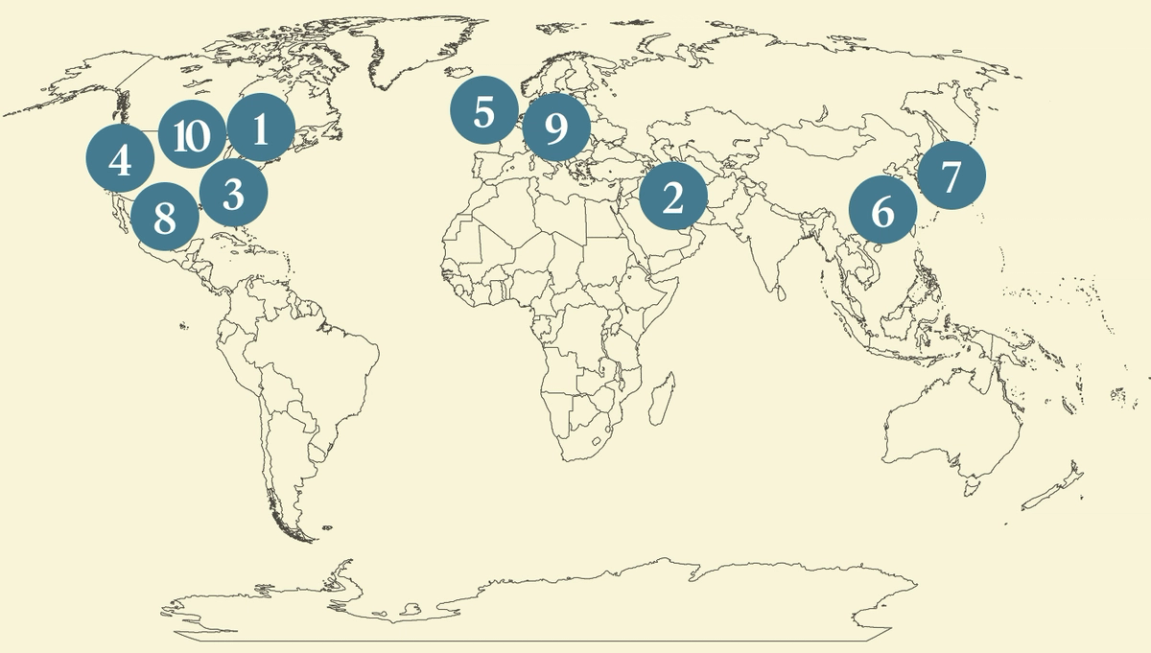 - US-Canada talks collapse
- China hosts Iranian minister
- Investors scorn bond move
- Nvidia hikes memory prices
- AI’s impact on economy, jobs
- Robot faster than Usain Bolt
- Japan to choose 2nd capital
- Billionaire’s homeless policy
- How AI affects learning
- Universities’ enrollment cliff
 A book examines how our lives are dictated by data, plus a look at the week ahead. |
|
US-Canada rift deepens over tariffs |
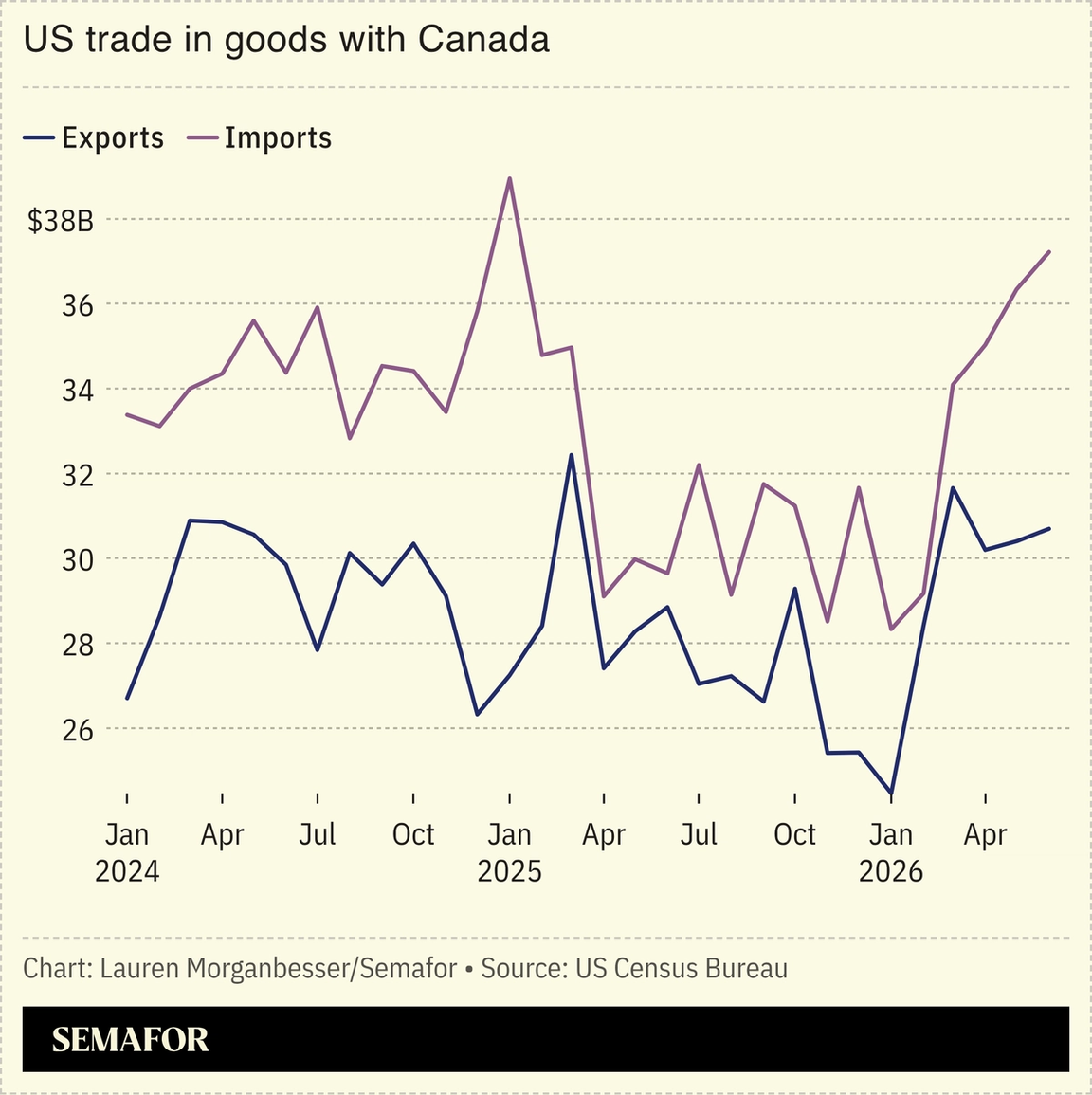 US and Canadian officials traded blame after the two sides failed to reach a trade deal Friday, teeing up a damaging trade war that could threaten broad swaths of both economies. The US’ 50% tariffs on roughly $20 billion of Canadian goods took effect Saturday, with Canadian Prime Minister Mark Carney vowing to match “Washington’s new tariffs dollar-for-dollar,” adding that Canada was “at war.” Relations between the allies have deteriorated under US President Donald Trump’s second administration, with Trump calling for Canada to become a US state and Canadian provinces boycotting US booze. Polls show most Canadians oppose concessions, hardening Carney’s stance. The breakdown signals “the old Canada-US relationship is over,” a Canadian political science professor told The Associated Press. |
|
China prepares for ‘Economic D-Day’ |
 Joyce Zhou/Reuters Joyce Zhou/ReutersChina hosted Iran’s deputy foreign minister for talks last week related to the US-Iran war, Beijing announced Sunday, disclosing the previously unreported meeting one day before Washington is expected to unveil “the toughest sanctions in history” against Tehran. The Trump administration has warned of an “Economic D-Day” for Iran and its trading partners, including China, a major importer of Iranian oil. Beijing has moved to insulate itself economically, slashing crude imports nearly 50% since the war started, according to The Wall Street Journal, and bolstering domestic energy. Experts warn that Beijing’s resilience could complicate Washington’s strategy. China, writes Shanghai Institutes for International Studies’ Zhao Long, is adept at “containing spillover, reducing risks, diversifying dependencies, [and] avoiding strategic entanglement.” |
|
Bessent’s bond market move draws fire |
 Kevin Lamarque/Reuters Kevin Lamarque/ReutersInvestors and analysts poured scorn on US Treasury Secretary Scott Bessent’s doubling of long-term bond purchases last week, which provided temporary relief but faces structural economic headwinds that are driving yields higher. The buybacks are a “band-aid on a bullet hole,” a Nomura strategist told the Financial Times, while ING analysts likened it to “rearranging deckchairs on the Titanic.” Jefferies’ chief US economist said the abrupt nature of Bessent’s move damaged the Treasury’s credibility, increasing investor skepticism. It would take a smaller US budget deficit, a stock market contraction, or decline in AI investment to depress longer-term yields, Satori Insights’ founder told Bloomberg: “Every route to lasting relief for the long end runs through something the administration doesn’t want.” |
|
Nvidia says it’s raising some prices 15% |
 Nathan Howard/Reuters Nathan Howard/ReutersNvidia warned of higher prices for servers containing its AI chips as soaring memory costs strain the AI buildout. Nvidia told some of its biggest customers to expect price hikes of more than 15%, Bloomberg reported, highlighting memory chip companies’ leverage over the AI industry. Nvidia is also pushing into AI, contributing to the squeeze: It will spend $6 billion to license technology from startup Poolside to build an open-weight model, competing with Chinese leaders DeepSeek and Moonshot and US companies OpenAI and Anthropic. That comes as frontier AI companies face pressure from open models. Anthropic’s US customers are increasingly using cheaper alternatives to its strongest models, raising questions about its high spending on advanced AI ahead of a potential record-breaking IPO. |
|
AI’s impact on jobs numbers is limited |
 Brian Snyder/Reuters Brian Snyder/ReutersAI-related investments likely account for around a third of US economic growth, but the technology’s impact on employment remains limited, economists said. ING argued that by its conservative calculations, AI spending equated to around 33% of year-on-year US GDP growth, saying that more aggressive projections conflated genuine new investment with legacy spending. And despite fears of a mass, AI-driven job cull, experts argued that evidence of large-scale cuts was limited: “Global AI-related hiring headwinds still appear confined to a narrow set of industries and workers,” Goldman Sachs said in a note to clients, while experts told the Financial Times that companies were framing firings as AI-related to paint themselves as tech-forward rather than struggling. |
|
Chinese humanoid robot beats Bolt’s time |
 Florence Lo/Reuters Florence Lo/ReutersA Chinese humanoid robot ran the 100-meter dash nearly two-tenths of a second faster than world-record holder Usain Bolt at Beijing’s “Robot Olympics” on Saturday. A different class of achievement from Bolt’s, for obvious reasons, it improved upon last year’s fastest time by more than 10 seconds, highlighting China’s blistering progress in “embodied AI” as well as its remaining hurdles: The machine, which struggles to brake, crashed into a padded wall afterward. The games have added to the hype of leading humanoid maker Unitree, whose founder and CEO has suggested the industry is still a decade away from its breakthrough “ChatGPT moment.” China leads in mass-producing robots, but the US is believed to maintain an edge in the software powering their “brains.” |
|
Japan searches for a second capital city |
 Issei Kato/Reuters Issei Kato/ReutersJapan passed a law to designate one of its cities as a second capital, triggering a flurry of public relations campaigns by the 13 local governments vying for the mantle. Deemed necessary for ensuring continuity of government in the earthquake-, typhoon-, and flood-prone nation, the law dangles an opportunity for hundreds of millions of dollars in subsidies, possible tax breaks, tourism, and urban revival. Business-flush Osaka, a leading contender, has even designated a mascot for the effort, a talking cat named Fukumaru. “A ‘don’t-miss-the-Gold-Rush’ mentality has taken hold,” a Tokyo-based expert told The New York Times, but the initiative must promote growth to offset population decline in rural areas, or it “will bring 100 harms and not one good.” |
|
Billionaire reshaping US homeless policy |
 Jonathan Alcorn/Reuters Jonathan Alcorn/ReutersA Silicon Valley billionaire is at the heart of the sprawling policy effort rewriting the public approach to fighting near-record US homelessness. Founded by Palantir co-founder Joe Lonsdale, the Cicero Institute has helped pass camping bans in 15 states (11 have made it a crime to sleep outdoors) and spearheaded the shift by US President Donald Trump’s administration away from federal housing subsidies to forced treatment of substance abuse or mental disorders: “I don’t actually think you can separate [Trump’s homelessness policy] from Cicero,” a housing activist told The Washington Post, arguing that Cicero’s approach simply criminalizes homelessness. An ally of Peter Thiel and Elon Musk, Lonsdale is also influencing federal policy on housing, public safety, education, and healthcare. |
|
Assessing the impact of AI in classrooms |
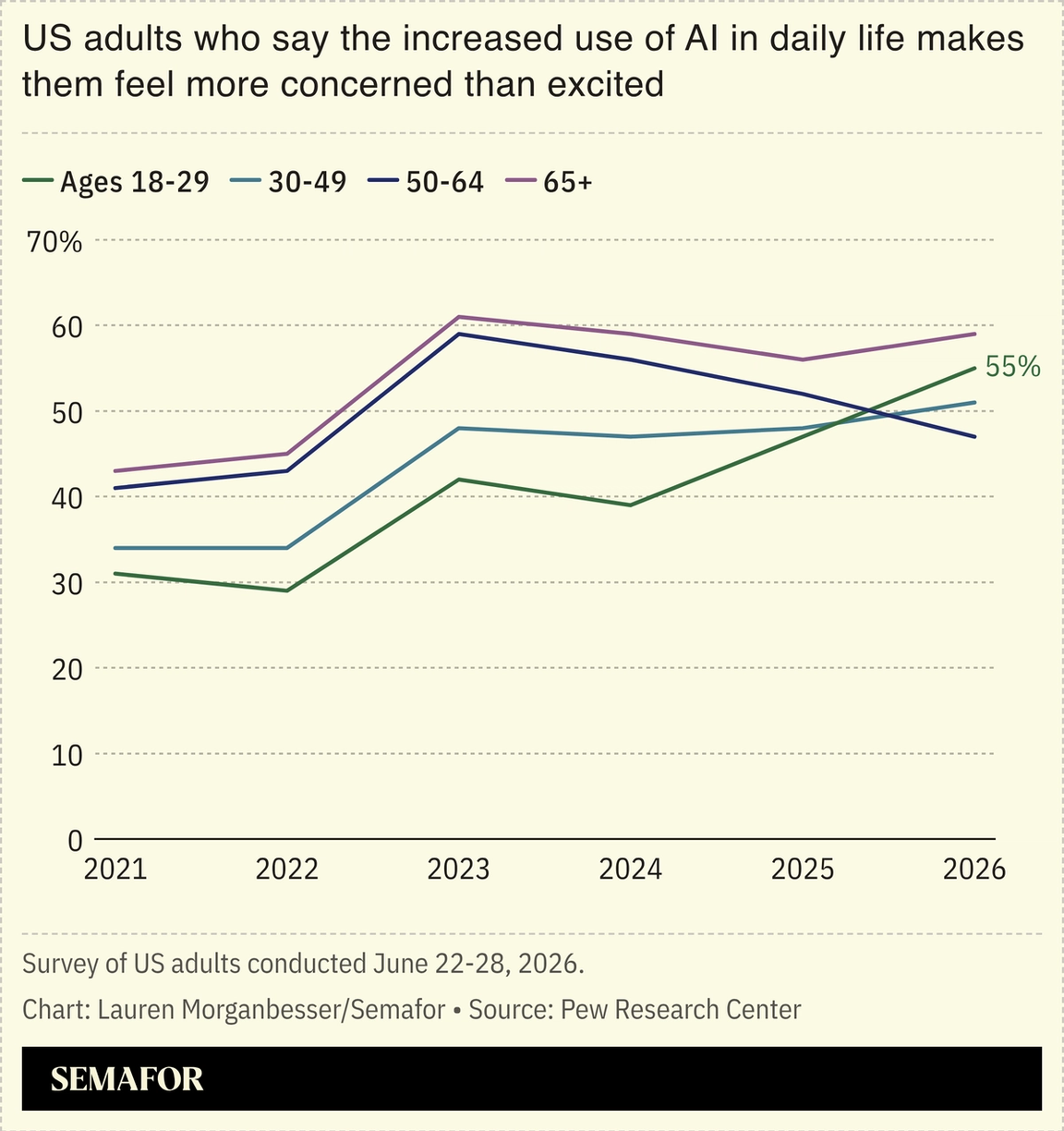 The use of AI in schools is soaring, upending education systems around the world. Recent polls show that more than 90% of students in Germany and the UK use AI, sparking concerns among experts about the technology’s impact on learning. But a new study tracking 27,000 students ages 12 to 18 in China — where adoption has been swift — paints a mixed picture: Pupils using AI saw their homework results improve by almost a fifth while the time it took them to complete that work fell by a quarter. However, on exams the students scored 20% below those who had not used AI. “AI can boost learning productivity, but only for those who use the technology intelligently,” The Economist argued. |
|
US universities face enrollment drop-off |
 Hannah Beier/Reuters Hannah Beier/ReutersUS universities are under increasing long-term financial pressure as enrollments decline, a result of falling birth |
|
|


