| | In this edition, the AI debt boom tanks bonds, and L3Harris’ CEO Chris Kubasik is ousted for impropr͏ ͏ ͏ ͏ ͏ ͏ |
| |  | Business |  |
| |
|
 - Bond blowup
- L3Harris’s cautionary tale
- Shake it off
- The US housing mess
- PIF pullback
- Monopolies for sale
|
|
 You don’t worry about bad ideas on Wall Street. Those burn themselves out quickly. You worry about good ideas because eventually someone will come along, execute them badly, and ruin the party for everyone. Few ideas on Wall Street have been better than the reinvention of insurance from stodgy backwater to dealmakers’ playground. Insurance premiums collected today and paid out years from now are an irresistible pot of money: Warren Buffett’s insurance empire brought in some $90 billion of investable money in 2025. That’s more than the total amount raised over the previous five years by all private-equity firms, excluding the two largest, KKR and Blackstone. Every big investment firm has piled into insurance, turning the risk dial up and printing money for themselves while regulators and ratings agencies looked the other way. I’ve been writing about the risks for a while. Insurers can miscalculate on underwriting and pay out more in claims than they took in. Or they can put policyholders’ money into risky things and lose it. Greg Lindberg (convicted of fraud) and 777 Partners’ Josh Wander (currently accused of fraud) weren’t systemically important enough to spoil the fun. Mark Walter may be. Walter was an early and aggressive convert to spinning policyholders’ cash into exotic investments, building a vast empire of insurers and asset managers linked through Guggenheim, where he serves as CEO. He is now selling assets quickly to unwind that dragon’s nest of interlocking loans and resolve a Justice Department investigation. He’ll probably come up with the cash. But a regulatory crackdown looks increasingly likely, either through a concerted push by states — Delaware is getting spicy in its review of another big Wall Street insurance deal — or through the federal government deciding this is a risk best not left to 50 state agencies. Finance’s hottest party may have found its pooper. Programming note: You’re in Rohan’s capable hands on Thursday, and then Semafor Business is off next week. Enjoy the dog days, beware the liquidity traps, and we’ll see you in September. |
|
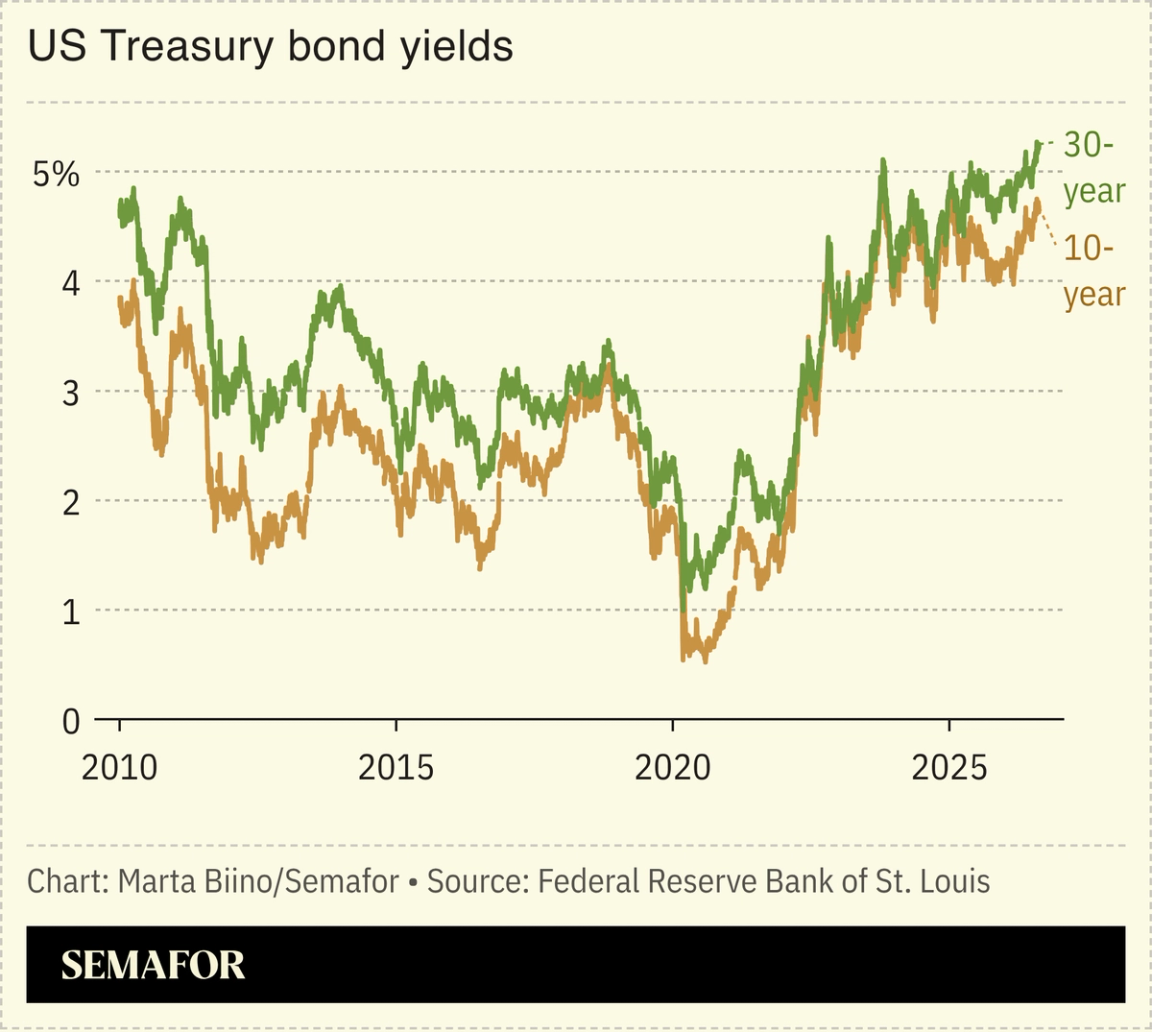 Longer-duration bonds sold off worldwide Tuesday morning, in some cases sending yields to multi-decade highs. The yield on US 30-year Treasurys hit levels not seen since 2002; Japan’s 30-year bond yields are near all-time highs. Government bonds are contending with a triple whammy: Companies spending on AI are issuing highly rated, long-term debt, providing an alternative for investors. The geopolitical landscape, both in the US and worldwide, continues to be muddy. There are mounting worries about the astronomical levels of government borrowing and the potential for benchmark interest-rate hikes. Jitters in the bond markets are spilling over into the US equities markets: The Nasdaq was down 1% by midday Tuesday, driven by slumps in chipmaking names and resurgent crude prices. |
|
L3Harris CEO ousted for impropriety |
 Brendan McDermid/Reuters Brendan McDermid/ReutersL3Harris CEO Chris Kubasik was ousted by his board after an independent probe found he engaged in an inappropriate relationship with an employee, Semafor’s Rohan Goswami scooped Monday. The probe was conducted by the $54 billion defense contractor’s outside law firm, and wrapped up in recent days, two people familiar with the matter said. Kubasik was previously in line to take over as CEO of Lockheed Martin, before he was fired in 2012 over a similar incident, which involved a “personal relationship with a subordinate employee,” Lockheed said at the time. Neither Kubasik nor L3Harris returned requests for comment. L3Harris has strong ties to the Trump administration: The Pentagon took a $1 billion stake in a spinoff of the company’s rocket business earlier this year, and L3Harris was responsible for security upgrades to Trump’s new Air Force One, gifted by Qatar. |
|
The financialization of music (Taylor’s Version) |
 Jennifer Gauthier/Reuters Jennifer Gauthier/ReutersWe are never, ever, ever, letting back catalogs get re-recorded, like ever. After Taylor Swift’s back catalog was sold out from underneath her to manager Scooter Braun (and eventually, to Shamrock Capital, the private equity firm that started out as Roy E. Disney’s family investment office), the pop star famously riposted by re-recording several of her albums to ensure royalties from her devoted fans would flow to her. That won’t happen again, says Warner Music CEO Robert Kyncl. “Taylor highlighted the need for that contractual requirement” — prohibiting artists from re-recording, now a standard in catalog deals — Kyncl told Liz and Max Tani on the latest episode of Semafor’s Mixed Signals. It wasn’t a wash for Shamrock, which ultimately sold the masters back to Swift last year at what the artist said was a “fair” and “respectful” price, Kyncl noted. “By the way, having said that, the buyers of her original catalog have gotten great return on it, even though she re-recorded because the rising tide lifted all boats,” the Warner Music chief noted. |
|
 As shifting consumer expectations, AI, generational change, and global economic uncertainty reshape the market, the world’s leading luxury brands are rethinking how they create value, preserve exclusivity, and remain culturally relevant. On Wednesday, September 2, Semafor editors will sit down with the executives, innovators, and cultural leaders shaping luxury’s next chapter, including Jenna Lyons, Executive Creative Director of FundamentalCo, and Jonny Bauer, Founder and Executive Chair of FundamentalCo. On-the-record conversations will explore the forces transforming the industry, from changing consumer behavior and emerging technologies to evolving definitions of luxury and new strategies for global growth. New York City | September 2 | Request Invite |
|
Summer’s frosty housing market |
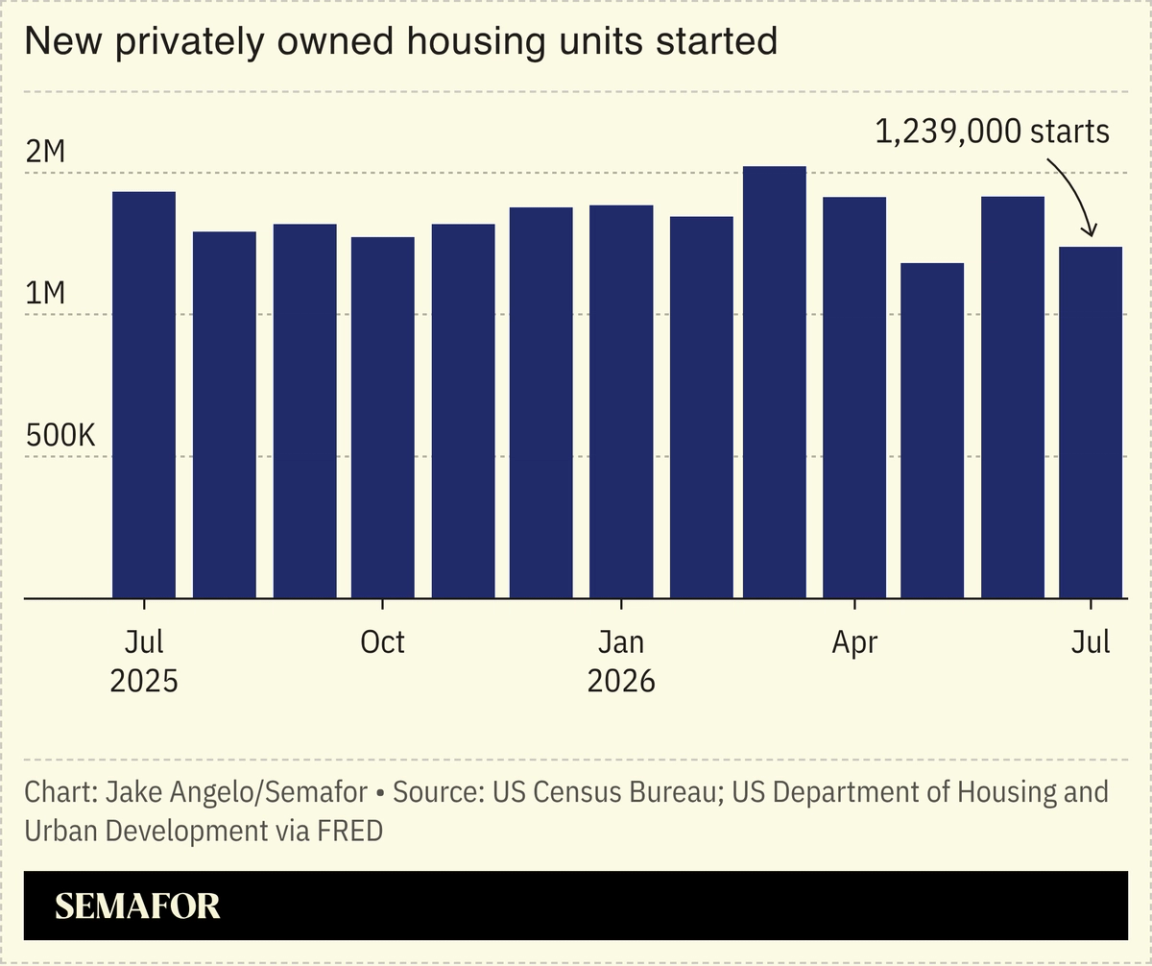 US single-family homebuilding nosedived in July, falling 16% year-over-year as higher mortgage rates kept the market frozen. High mortgage rates and a dire supply shortage have sidelined potential buyers. While those would-be buyers stay put, many are now relying on buy now, pay later services to help them stay afloat: Affirm, the pay-later app, is providing cash-strapped tenants loans to help out with rent payments. There are some signs of life in the industry. Home Depot posted a strong quarter, despite a slowdown in sales. But those numbers don’t exactly showcase consumer resilience. The earnings were buoyed by revenue from smaller projects — a paint job or a minor kitchen revamp. Customers “remain under pressure,” one Home Depot executive said Tuesday. — Jake Angelo |
|
 Hamad I Mohammed/Reuters Hamad I Mohammed/Reuters
One of Wall Street’s favorite piggy banks got a bit smaller, a reflection of both the ongoing conflict in the Middle East and a shift by the Saudi government to focus its efforts at home. The value of the Public Investment Fund’s assets under management shrank $10 billion last year to around $900 billion, according to its 2025 annual report, the first such drop this decade. They’re conserving cash, and have pulled back on big bets like the Line and LIV Golf — an unthinkable prospect just a few years ago. PIF attributed its performance to “wider market conditions,” and said it continued to make “long-term local investments to drive economic transformation.” The Saudi sovereign wealth fund hasn’t disappeared from the international stage: PIF dollars were key to closing Silver Lake’s leveraged buyout of Electronic Arts earlier this month, and are also crucial to David Ellison’s planned $110 billion takeout of Warner Bros. Discovery. |
|
A safer bet for AI-hungry investors |
 Construction site of Google’s new data center near Kronstorf, Austria. Christian Bruna/Reuters. Construction site of Google’s new data center near Kronstorf, Austria. Christian Bruna/Reuters.The unprecedented spending on the power plants behind the AI boom is causing worry in some corners of the financial markets, but it also means investors see opportunities to buy up non-AI-related assets that utilities are selling off to raise cash, Semafor’s Tim McDonnell writes. For one investor, the government-sanctioned buildout has shades of the early 2000s, when investors lost a lot of money building power plants that never found customers. But as blue-chip utilities like Duke and AEP scramble to raise billions of dollars for their AI buildouts, they are increasingly willing to cut good deals to sell off non-core chunks of their regulated businesses. That’s sparked a rush of private capital into the regulated utility business, where returns are less than jaw-dropping, but reliable. “When you can buy a regulated monopoly at a discount, you do it,” one investor told Tim. |
|
➚ BUY: Home improvement. San Francisco’s real-estate market has ballooned from post-pandemic lows on the back of the AI boom, with the median home price peaking at $1.7 million. ➘ SELL: Family matters. Jeanie Buss is attempting to block a sale of the family’s remaining stake in the Los Angeles Lakers. Infighting among the siblings has been constant since 2013: The vote to sell was reportedly initiated by Jeanie’s siblings after she attempted to dissolve the family trust before last week’s majority sale to Bob Iger and Joshua Kushner had been announced. |
|
|


