Hello,
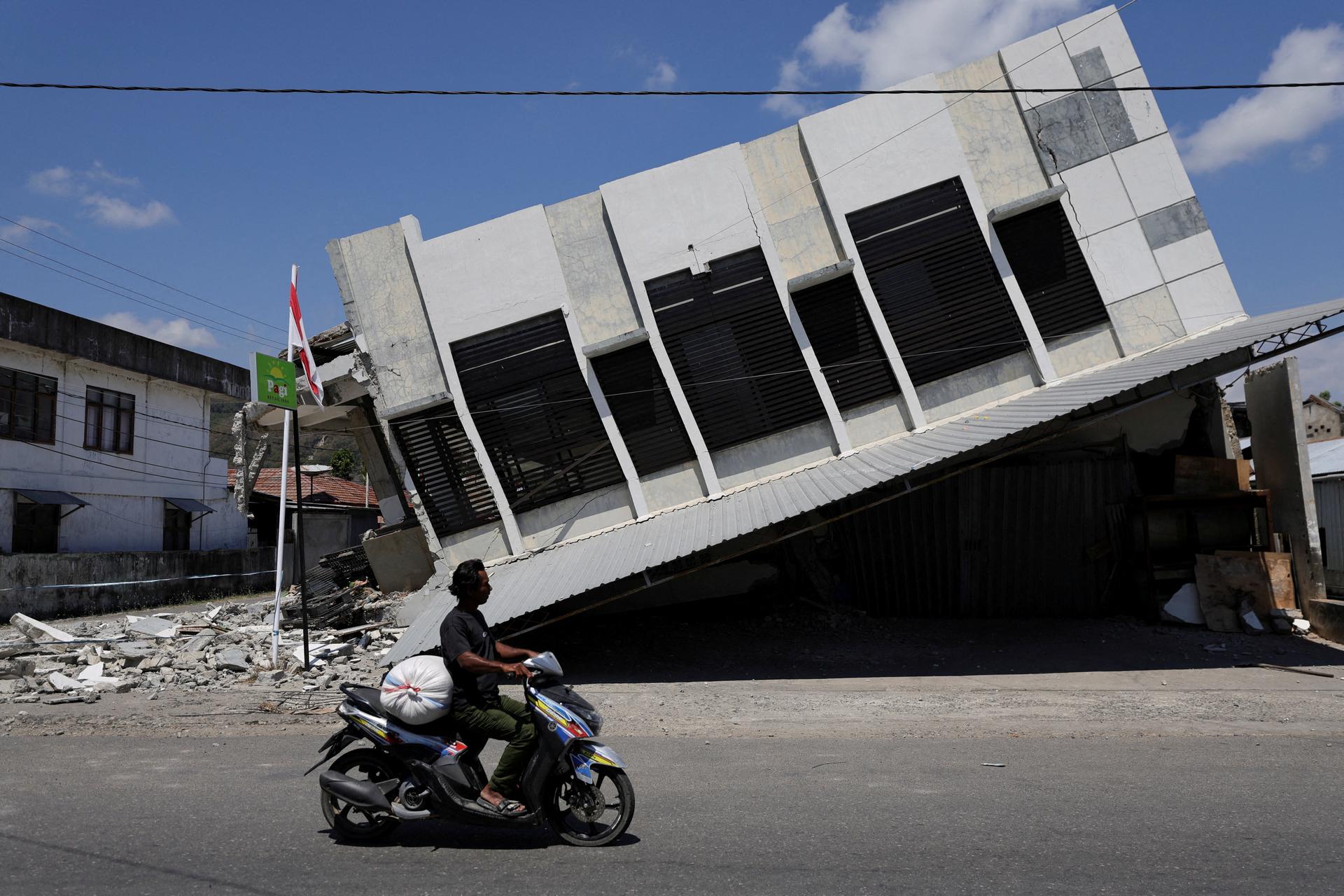
Today’s newsletter focuses on the aftermath of a powerful earthquake that killed at least 68 people in eastern Indonesia as rescuers combed through collapsed buildings in search of people trapped beneath the rubble. Late on Monday, the death toll was raised to 68 from 54 previously, said Berton SP Panjaitan, an official at Indonesia's disaster mitigation agency, adding that more than 200 people have been injured. Thousands have been evacuated following the country's deadliest disaster since a 2022 quake killed hundreds in West Java, with many sheltering in tents outdoors and afraid to return to their homes due to fears of aftershocks. Also on my radar today: |
|
|
A man rides a scooter past a supermarket that collapsed in an earthquake in Reok, East Nusa Tenggara province, Indonesia. REUTERS/Willy Kurniawan |
Casting a grim shadow over celebrations |
The tremor has cast a grim shadow over Indonesia's Independence Day celebrations and residents of East Nusa Tenggara have been jolted by nearly 1,600 aftershocks in the province as of Monday, Panjaitan said. The country's geophysics agency reported a magnitude 5.6 quake in the region on Monday morning.
In Jakarta, about 1,500 km (930 miles) west of the disaster zone, President Prabowo Subianto presided on Monday over celebrations marking Indonesia's independence from Japanese rule in 1945. Meanwhile, residents fleeing from a village in Ende in fear of tsunamis brought their clothes and mattresses to higher ground.
The quake also caused landslides and blocked roads across Indonesia's southernmost province, including the regions of Sikka and Manggarai. Fathur Rahman, chief at the rescue office in Maumere, Sikka's capital, told Reuters on Monday the search would focus on aerial monitoring for anyone missing using a helicopter and an extrication device.
Authorities readied planes to deliver aid such as food and tents, Panjaitan said. The quake damaged around 500 homes, the agency said previously. Indonesia will also build an emergency field hospital in several areas, said Benjamin Paulus Octavianus, the country's deputy health minister.
Click here for a Reuters recap on some of Indonesia’s deadliest earthquakes over the past decade. |
|
|
|
Landslides hit South Korea and China |
Over in South Korea, a landslide killed one person and injured three, media reports said on Monday, as heavy rainfall lashed the country's southern region.
The landslide struck a residential apartment building in Geoje, South Gyeongsang province, burying the first floor, the Yonhap News Agency reported. Rescue workers pulled three residents from the building, but one was later pronounced dead at a hospital, Yonhap said.
Meanwhile, a landslide hit southwestern China's Guangxi region on Monday, killing at least one person while four others remained trapped, local authorities said.
Chinese President Xi Jinping called for efforts to improve the country's ability to prevent, mitigate and respond to natural disasters, after a string of deadly floods and landslides this summer.
"As global warming continues, extreme weather events and disasters such as torrential rains, floods, typhoons, and droughts are increasing significantly, exacerbating their destructive impact," Xi said. China's strongest typhoon this year battered the capital with bouts of intense rain that flooded key roads and stranded vehicles, while lashing wide swathes of the country.
Last month, landslides triggered by flash floods in northwestern Gansu province killed 25 people, and another landslide in Chongqing in the southwest caused by a collapsed mountain left 51 dead. |
A Palestinian zookeeper interacts with a monkey during a visit to a zoo in Nuseirat, in the central Gaza Strip. REUTERS/Mahmoud Issa |
-
Animals in war: Many of the animals in the zoo near Gaza's Nuseirat refugee camp are malnourished, weakened by shortages of food, medicine and vaccines. But they are still alive, largely thanks to the efforts of zoo owner Mahmoud Gomaa. Click here to read more on how Gomaa manages to keep the animals alive while hoping to give traumatised youngsters something to enjoy after nearly three years of destruction.
-
Colombia earthquake rescue: The 7.4-magnitude quake that struck western Colombia on August 10 has left around 290 people dead, with more than 140 people still missing and 4,200 injured. In Cali, Colombia's third-largest city, emergency workers continued searching unstable piles of concrete and twisted metal over the weekend as rescue efforts increasingly gave way to the recovery of bodies.
- Hurricane Lala: Hawaii was hit with strong winds and heavy rain from Hurricane Lala over the weekend, leaving more than 40,000 utility customers without power across the state as the National Hurricane Center warned of "life-threatening" conditions.
-
Dried-up waterways: Click here for some surreal images of scorched landscapes where water once flowed, captured by our Reuters photographers, as severe droughts threaten water supplies around the world.
-
The cost of climate damage: Weather- and climate-related extremes caused economic losses of an estimated €822 billion ($953 billion) in the European Union between 1980 and 2024, according to the European Environment Agency, with a quarter of that damage inflicted in just the last four years.
|
|
|
|
Alastair Chisholm, water, policy, regulation and governance lead at British multinational professional services firm Arup, shares his thoughts on droughts in the UK: “Droughts are no longer a temporary weather event: three ‘flash’ droughts in five years show that the UK climate has changed and our approach to water must change with it.
“New reservoirs, transfers and reuse schemes are essential, but major infrastructure alone is expected to meet only around 30% to 40% of future demand. Proposed reservoirs will take years to deliver. We need to start designing for drought now.
“This means building homes that use less water; creating greener, more absorbent towns and cities; businesses making greater use of rainwater and greywater and restoring landscapes, so soils, wetlands and vegetation hold water for longer. “The Government must accelerate this shift through stronger water-efficiency standards, planning and farming policy, alongside investment in the necessary infrastructure.
“The assumption that water will always be plentiful in Britain now belongs to the past. Designing drought resilience into our homes, communities, landscapes and economy is the only plausible solution if we are to retain relative comfort levels in this new climate.” |
France's Prime Minister Sebastien Lecornu meets with officials on the outskirts of Bordeaux, south-western France following the wildfire. Christophe Archambault/Pool via REUTERS |
Today’s spotlight differs from the usual science and tech innovation or community-led initiative and focuses on a French fiscal boost to help areas affected by wildfires.
French Prime Minister Sebastien Lecornu announced tax breaks for companies affected by recent wildfires in southern France, most notably in the tourism sector, which devastated large swathes of the country. He also said the government has approved a €12 million ($13.9 million) budget to help towns having to relocate people whose homes were destroyed.
|
|
|
|
|